Home > Press > Vitamin E TPGS emulsified vinorelbine bitartrate loaded solid lipid nanoparticles (SLN): This article by Dr. Sanjay Singh et al. is published in Current Drug Delivery, Volume 15 , Issue 8 , 2018
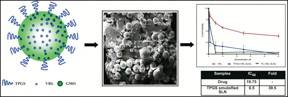 |
| Vitamin E TPGS Emulsified Vinorelbine Bitartrate Loaded Solid Lipid Nanoparticles (SLN): Formulation Development, Optimization and In vitro Characterization CREDIT Dr. Sanjay Singh, Bentham Science Publishers |
Abstract:
Vinorelbine Bitartrate (VRL), a semi-synthetic vinca alkaloid was approved by the FDA for breast cancer treatment, as it has been proven to be beneficial for first line of defense and subsequent therapies. But its hydrophilic and thermolabile structure causes hindrance to oral clinical translation. The main objective of this research is the development and optimization of a solid lipid nanoparticle (SLN) structure that can encapsulate hydrophilic and thermolabile Vinorelbine bitartrate to maximize the anticancer activity of the drug without compromising its efficacy and integrity. For this purpose, the study is mainly focused on the application of DOE, a modern statistical optimization tool for nanoparticle modification.
Vitamin E TPGS emulsified vinorelbine bitartrate loaded solid lipid nanoparticles (SLN): This article by Dr. Sanjay Singh et al. is published in Current Drug Delivery, Volume 15 , Issue 8 , 2018
Sharjah, U.A.E. | Posted on December 14th, 2018To prepare SLNs, a solvent diffusion technique was used employing Taguchi orthogonal array design with process variables and optimized formulation. Glyceryl mono-oleate (GMO) were used for its emulsifying nature and low melting point to enhance entrapment and reducing temperature associated degradation. To prevent infection, two types of surfactants, Vitamin E TPGS, and Poloxamer-188 were used to obtain TPGS-VRL-SLNs and PL-VRL-SLNs.
The results proved the method to be effective. The SLNs were produced spherical in shape with entrapment efficiency (EE) upto 58%. A biphasic release pattern was observed in in vitro release studies followed by the Korsemeyer peppas model with fickian release kinetics. MTT assay results revealed that TPGS-VRL-SLNs and PL-VRL-SLNs were 39.5 and 18.5 time more effective than VRL in its original nature. The DOE method was believed to be a successful approach for development of VRL-SLNs. Enhanced entrapment with anticancer efficacy of TPGS-VRL-SLN was the result of emulsifying nature of GMO and the cytotoxic nature of TPGS which influences VRL effects. Such properties of TPGS-VRL-SLNs may prove them to be a potentially useful carrier in cancer chemotherapeutics.
####
For more information, please click here
Contacts:
Faizan ul Haq
Copyright © Bentham Science Publishers
If you have a comment, please Contact us.Issuers of news releases, not 7th Wave, Inc. or Nanotechnology Now, are solely responsible for the accuracy of the content.
Bookmark:


| Related Links |
| Related News Press |
News and information
 Quantum computer improves AI predictions April 17th, 2026
Flexible sensor gains sensitivity under pressure April 17th, 2026
A reusable chip for particulate matter sensing April 17th, 2026
Detecting vibrational quantum beating in the predissociation dynamics of SF6 using time-resolved photoelectron spectroscopy April 17th, 2026
Cancer
New molecular technology targets tumors and simultaneously silences two ‘undruggable’ cancer genes August 8th, 2025
Ben-Gurion University of the Negev researchers several steps closer to harnessing patient's own T-cells to fight off cancer June 6th, 2025
Self-propelled protein-based nanomotors for enhanced cancer therapy by inducing ferroptosis June 6th, 2025
Possible Futures
A fundamentally new therapeutic approach to cystic fibrosis: Nanobody repairs cellular defect April 17th, 2026
UC Irvine physicists discover method to reverse ‘quantum scrambling’ : The work addresses the problem of information loss in quantum computing system April 17th, 2026
Nanomedicine
A fundamentally new therapeutic approach to cystic fibrosis: Nanobody repairs cellular defect April 17th, 2026
New molecular technology targets tumors and simultaneously silences two ‘undruggable’ cancer genes August 8th, 2025
New imaging approach transforms study of bacterial biofilms August 8th, 2025
Electrifying results shed light on graphene foam as a potential material for lab grown cartilage June 6th, 2025
Discoveries
Quantum computer improves AI predictions April 17th, 2026
Flexible sensor gains sensitivity under pressure April 17th, 2026
A reusable chip for particulate matter sensing April 17th, 2026
Detecting vibrational quantum beating in the predissociation dynamics of SF6 using time-resolved photoelectron spectroscopy April 17th, 2026
Announcements
A fundamentally new therapeutic approach to cystic fibrosis: Nanobody repairs cellular defect April 17th, 2026
UC Irvine physicists discover method to reverse ‘quantum scrambling’ : The work addresses the problem of information loss in quantum computing system April 17th, 2026
Interviews/Book Reviews/Essays/Reports/Podcasts/Journals/White papers/Posters
A fundamentally new therapeutic approach to cystic fibrosis: Nanobody repairs cellular defect April 17th, 2026
UC Irvine physicists discover method to reverse ‘quantum scrambling’ : The work addresses the problem of information loss in quantum computing system April 17th, 2026
Nanobiotechnology
A fundamentally new therapeutic approach to cystic fibrosis: Nanobody repairs cellular defect April 17th, 2026
New molecular technology targets tumors and simultaneously silences two ‘undruggable’ cancer genes August 8th, 2025
New imaging approach transforms study of bacterial biofilms August 8th, 2025
Electrifying results shed light on graphene foam as a potential material for lab grown cartilage June 6th, 2025
 |
||
 |
||
| The latest news from around the world, FREE | ||
 |
||
|
|
||
| Premium Products | ||
 |
||
|
Only the news you want to read!
Learn More |
||
 |
||
|
Full-service, expert consulting
Learn More |
||
|
|
||