Home > Press > Milestone for bERLinPro: Photocathodes with high quantum efficiency
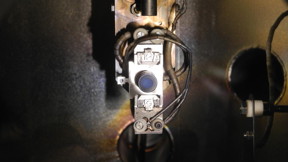 |
| Photocathode after its production in the preparatory system. CREDIT HZB |
Abstract:
Teams from the accelerator physics and the SRF groups at HZB are developing a superconducting linear accelerator featuring energy recovery (Energy Recovery Linac) as part of the bERLinPro project. It accelerates an intense electron beam that can then be used for various applications - such as generating brilliant synchrotron radiation. After use, the electron bunches are directed back to the superconducting linear accelerator, where they release almost all their remaining energy. This energy is then available for accelerating new electron bunches.
Milestone for bERLinPro: Photocathodes with high quantum efficiency
Berlin, Germany | Posted on December 8th, 2018Electron source: photocathode
A crucial component of the design is the electron source. Electrons are generated by illuminating a photocathode with a green laser beam. The quantum efficiency, as it is referred to, indicates how many electrons the photocathode material emits when illuminated at a certain laser wavelength and power. Bialkali antimonides exhibit particularly high quantum efficiency in the region of visible light. However, thin films of these materials are highly reactive and therefore very sensitive, so they only work at ultra-high vacuum.
Manufacturing process modified
A HZB team headed by Martin Schmeißer, Dr. Julius Kühn, Dr. Sonal Mistry, and Prof. Thorsten Kamps has now greatly improved the performance of the photocathode so it is ready for use with bERLinPro. They modified the manufacturing process for the photocathodes of cesium- potassium-antimonide on a molybdenum substrate. The new process delivers the desired high quantum efficiency and stability. Studies showed that the photocathodes do not degrade, even at low temperatures. This is a critical prerequisite for operation within a superconducting electron source, where the cathode must be operated at temperatures far below zero.
High quantum efficiency
The physicists were able to demonstrate this performance with detailed studies: Even after its transport via the photocathode transfer system and introduction into the photo injector of the SRF, the quantum efficiency of the photocathode was still about five times higher than necessary to achieve the maximum electron-beam current needed for bERLinPro.
Milestone for bERLinPro
"An important milestone for bERLinPro has been reached. We now have the photocathodes available to generate the first electron beam from our SRF photoinjector at bERLinPro in 2019", says Prof. Andreas Jankowiak, head of the HZB Institute for Accelerator Physics.
####
For more information, please click here
Contacts:
Antonia Roetger
Copyright © Helmholtz-Zentrum Berlin für Materialien und Energie
If you have a comment, please Contact us.Issuers of news releases, not 7th Wave, Inc. or Nanotechnology Now, are solely responsible for the accuracy of the content.
Bookmark:


| Related Links |
| Related News Press |
News and information
 Quantum computer improves AI predictions April 17th, 2026
Flexible sensor gains sensitivity under pressure April 17th, 2026
A reusable chip for particulate matter sensing April 17th, 2026
Detecting vibrational quantum beating in the predissociation dynamics of SF6 using time-resolved photoelectron spectroscopy April 17th, 2026
Quantum Physics
Detecting vibrational quantum beating in the predissociation dynamics of SF6 using time-resolved photoelectron spectroscopy April 17th, 2026
Beyond silicon: Electronics at the scale of a single molecule January 30th, 2026
Imaging
Possible Futures
A fundamentally new therapeutic approach to cystic fibrosis: Nanobody repairs cellular defect April 17th, 2026
UC Irvine physicists discover method to reverse ‘quantum scrambling’ : The work addresses the problem of information loss in quantum computing system April 17th, 2026
Discoveries
Quantum computer improves AI predictions April 17th, 2026
Flexible sensor gains sensitivity under pressure April 17th, 2026
A reusable chip for particulate matter sensing April 17th, 2026
Detecting vibrational quantum beating in the predissociation dynamics of SF6 using time-resolved photoelectron spectroscopy April 17th, 2026
Announcements
A fundamentally new therapeutic approach to cystic fibrosis: Nanobody repairs cellular defect April 17th, 2026
UC Irvine physicists discover method to reverse ‘quantum scrambling’ : The work addresses the problem of information loss in quantum computing system April 17th, 2026
Interviews/Book Reviews/Essays/Reports/Podcasts/Journals/White papers/Posters
A fundamentally new therapeutic approach to cystic fibrosis: Nanobody repairs cellular defect April 17th, 2026
UC Irvine physicists discover method to reverse ‘quantum scrambling’ : The work addresses the problem of information loss in quantum computing system April 17th, 2026
Tools
Metasurfaces smooth light to boost magnetic sensing precision January 30th, 2026
From sensors to smart systems: the rise of AI-driven photonic noses January 30th, 2026
Japan launches fully domestically produced quantum computer: Expo visitors to experience quantum computing firsthand August 8th, 2025
 |
||
 |
||
| The latest news from around the world, FREE | ||
 |
||
|
|
||
| Premium Products | ||
 |
||
|
Only the news you want to read!
Learn More |
||
 |
||
|
Full-service, expert consulting
Learn More |
||
|
|
||