Home > Press > New catalyst produces cheap hydrogen
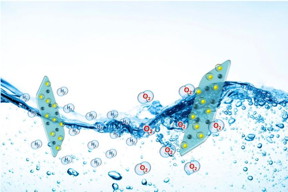 |
| A new water-splitting catalyst material produce hydrogen cheaply without fossil fuels CREDIT QUT: Ummul Sultana |
Abstract:
Professor Anthony O'Mullane said the potential for the chemical storage of renewable energy in the form of hydrogen was being investigated around the world.
New catalyst produces cheap hydrogen
Brisbane, Australia | Posted on November 30th, 2018"The Australian Government is interested in developing a hydrogen export industry to export our abundant renewable energy," said Professor O'Mullane from QUT's Science and Engineering Faculty.
"In principle, hydrogen offers a way to store clean energy at a scale that is required to make the rollout of large-scale solar and wind farms as well as the export of green energy viable.
"However, current methods that use carbon sources to produce hydrogen emit carbon dioxide, a greenhouse gas that mitigates the benefits of using renewable energy from the sun and wind.
"Electrochemical water splitting driven by electricity sourced from renewable energy technology has been identified as one of the most sustainable methods of producing high-purity hydrogen."
Professor O'Mullane said the new composite material he and PhD student Ummul Sultana had developed enabled electrochemical water splitting into hydrogen and oxygen using cheap and readily available elements as catalysts.
"Traditionally, catalysts for splitting water involve expensive precious metals such as iridium oxide, ruthenium oxide and platinum," he said.
"An additional problem has been stability, especially for the oxygen evolution part of the process.
"What we have found is that we can use two earth-abundant cheaper alternatives - cobalt and nickel oxide with only a fraction of gold nanoparticles - to create a stable bi-functional catalyst to split water and produce hydrogen without emissions.
"From an industry point of view, it makes a lot of sense to use one catalyst material instead of two different catalysts to produce hydrogen from water."
Professor O'Mullane said the stored hydrogen could then be used in fuel cells.
"Fuel cells are a mature technology, already being rolled out in many makes of vehicle. They use hydrogen and oxygen as fuels to generate electricity - essentially the opposite of water splitting.
"With a lot of cheaply 'made' hydrogen we can feed fuel cell-generated electricity back into the grid when required during peak demand or power our transportation system and the only thing emitted is water."
####
For more information, please click here
Contacts:
Niki Widdowson
61-731-382-999
Copyright © Queensland University of Technology
If you have a comment, please Contact us.Issuers of news releases, not 7th Wave, Inc. or Nanotechnology Now, are solely responsible for the accuracy of the content.
Bookmark:


| Related Links |
| Related News Press |
News and information
 Quantum computer improves AI predictions April 17th, 2026
Flexible sensor gains sensitivity under pressure April 17th, 2026
A reusable chip for particulate matter sensing April 17th, 2026
Detecting vibrational quantum beating in the predissociation dynamics of SF6 using time-resolved photoelectron spectroscopy April 17th, 2026
Chemistry
Projecting light to dispense liquids: A new route to ultra-precise microdroplets January 30th, 2026
From sensors to smart systems: the rise of AI-driven photonic noses January 30th, 2026
"Nanoreactor" cage uses visible light for catalytic and ultra-selective cross-cycloadditions October 3rd, 2025
Cambridge chemists discover simple way to build bigger molecules – one carbon at a time June 6th, 2025
Possible Futures
A fundamentally new therapeutic approach to cystic fibrosis: Nanobody repairs cellular defect April 17th, 2026
UC Irvine physicists discover method to reverse ‘quantum scrambling’ : The work addresses the problem of information loss in quantum computing system April 17th, 2026
Discoveries
Quantum computer improves AI predictions April 17th, 2026
Flexible sensor gains sensitivity under pressure April 17th, 2026
A reusable chip for particulate matter sensing April 17th, 2026
Detecting vibrational quantum beating in the predissociation dynamics of SF6 using time-resolved photoelectron spectroscopy April 17th, 2026
Announcements
A fundamentally new therapeutic approach to cystic fibrosis: Nanobody repairs cellular defect April 17th, 2026
UC Irvine physicists discover method to reverse ‘quantum scrambling’ : The work addresses the problem of information loss in quantum computing system April 17th, 2026
Interviews/Book Reviews/Essays/Reports/Podcasts/Journals/White papers/Posters
A fundamentally new therapeutic approach to cystic fibrosis: Nanobody repairs cellular defect April 17th, 2026
UC Irvine physicists discover method to reverse ‘quantum scrambling’ : The work addresses the problem of information loss in quantum computing system April 17th, 2026
Energy
Sensors innovations for smart lithium-based batteries: advancements, opportunities, and potential challenges August 8th, 2025
Simple algorithm paired with standard imaging tool could predict failure in lithium metal batteries August 8th, 2025
 |
||
 |
||
| The latest news from around the world, FREE | ||
 |
||
|
|
||
| Premium Products | ||
 |
||
|
Only the news you want to read!
Learn More |
||
 |
||
|
Full-service, expert consulting
Learn More |
||
|
|
||