Home > Press > Could a demon help to create a quantum computer? Physicists implement a version of Maxwell's famous thought experiment for reducing entropy
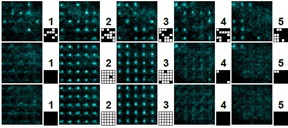 |
| Reducing entropy in a randomly half-filled 5x5x5 lattice of atoms. Each row shows a snapshot of the 5 planes in the lattice. The top row shows the initial random distribution of atoms among the 3D array of 125 possible sites. The second row show the distributions of atoms after the first sort and the third row shows the distribution after the second sort, at which point the target 5x5x2 sublattice is completely filled. This process reduces the entropy in the system by a factor of about 2.4. CREDIT Weiss Laboratory, Penn State |
Abstract:
Reduced entropy in a three-dimensional lattice of super-cooled, laser-trapped atoms could help speed progress toward creating quantum computers. A team of researchers at Penn State can rearrange a randomly distributed array of atoms into neatly organized blocks, thus performing the function of a "Maxwell's demon"--a thought experiment from the 1870s that challenged the second law of thermodynamics. The organized blocks of atoms could form the basis for a quantum computer that uses uncharged atoms to encode data and perform calculations. A paper describing the research appears September 6, 2018 in the journal Nature.
Could a demon help to create a quantum computer? Physicists implement a version of Maxwell's famous thought experiment for reducing entropy
University Park, PA | Posted on September 5th, 2018"Traditional computers use transistors to encode data as bits that can be in one of two states--zero or one," said David Weiss, professor of physics at Penn State and the leader of the research team. "We are devising quantum computers that use atoms as 'quantum bits' or 'qubits' that can encode data based on quantum mechanical phenomena that allow them to be in multiple states simultaneously. Organizing the atoms into a packed 3D grid allows us to fit a lot of atoms into a small area and makes computation easier and more efficient."
The second law of thermodynamics states that the entropy--sometimes thought of as disorder--of a system cannot decrease over time. One of the consequences of this law is that it precludes the possibility of a perpetual motion device. Around 1870, James Clerk Maxwell proposed a thought experiment in which a demon could open and close a gate between two chambers of gas, allowing warmer atoms to pass in one direction and cooler atoms to pass in the other. This sorting, which required no energy input, would result in a reduction of entropy in the system and a temperature difference between the two chambers that could be used as a heat pump to perform work, thus violating the second law.
"Later work has shown that the demon doesn't actually violate the second law and subsequently there have been many attempts to devise experimental systems that behave like the demon," said Weiss. "There have been some successes at very small scales, but we've created a system in which we can manipulate a large number of atoms, organizing them in a way that reduces the system's entropy, just like the demon."
The researchers use lasers to trap and cool atoms in a three-dimensional lattice with 125 positions arranged as a 5 by 5 by 5 cube. They then randomly fill about half of the positions in the lattice with atoms. By adjusting the polarization of the laser traps, the researchers can move atoms individually or in groups, reorganizing the randomly distributed atoms to fully fill either 5 by 5 by 2 or 4 by 4 by 3 subsets of the lattice.
"Because the atoms are cooled to almost as low a temperature as possible, the entropy of the system is almost entirely defined by the random configuration of the atoms within the lattice," said Weiss. "In systems where the atoms are not super-cooled, the vibration of the atoms makes up the majority of the system's entropy. In such a system, organizing the atoms does little to change the entropy, but in our experiment, we show that organizing the atoms lowers the entropy within the system by a factor of about 2.4."
###
In addition to Weiss, the research team at Penn State includes Aishwarya Kumar, Tsung-Yao Wu, and Felipe Giraldo Mejia. The research was funded by the U.S. National Science Foundation.
####
For more information, please click here
Contacts:
Sam Sholtis
814-865-1390
Copyright © Penn State
If you have a comment, please Contact us.Issuers of news releases, not 7th Wave, Inc. or Nanotechnology Now, are solely responsible for the accuracy of the content.
Bookmark:


| Related News Press |
News and information
 Quantum computer improves AI predictions April 17th, 2026
Flexible sensor gains sensitivity under pressure April 17th, 2026
A reusable chip for particulate matter sensing April 17th, 2026
Detecting vibrational quantum beating in the predissociation dynamics of SF6 using time-resolved photoelectron spectroscopy April 17th, 2026
Quantum Physics
Detecting vibrational quantum beating in the predissociation dynamics of SF6 using time-resolved photoelectron spectroscopy April 17th, 2026
Beyond silicon: Electronics at the scale of a single molecule January 30th, 2026
Govt.-Legislation/Regulation/Funding/Policy
Quantum computer improves AI predictions April 17th, 2026
Metasurfaces smooth light to boost magnetic sensing precision January 30th, 2026
New imaging approach transforms study of bacterial biofilms August 8th, 2025
Possible Futures
A fundamentally new therapeutic approach to cystic fibrosis: Nanobody repairs cellular defect April 17th, 2026
UC Irvine physicists discover method to reverse ‘quantum scrambling’ : The work addresses the problem of information loss in quantum computing system April 17th, 2026
Chip Technology
A reusable chip for particulate matter sensing April 17th, 2026
Metasurfaces smooth light to boost magnetic sensing precision January 30th, 2026
Quantum Computing
Quantum computer improves AI predictions April 17th, 2026
UC Irvine physicists discover method to reverse ‘quantum scrambling’ : The work addresses the problem of information loss in quantum computing system April 17th, 2026
Researchers develop molecular qubits that communicate at telecom frequencies October 3rd, 2025
Discoveries
Quantum computer improves AI predictions April 17th, 2026
Flexible sensor gains sensitivity under pressure April 17th, 2026
A reusable chip for particulate matter sensing April 17th, 2026
Detecting vibrational quantum beating in the predissociation dynamics of SF6 using time-resolved photoelectron spectroscopy April 17th, 2026
Announcements
A fundamentally new therapeutic approach to cystic fibrosis: Nanobody repairs cellular defect April 17th, 2026
UC Irvine physicists discover method to reverse ‘quantum scrambling’ : The work addresses the problem of information loss in quantum computing system April 17th, 2026
Interviews/Book Reviews/Essays/Reports/Podcasts/Journals/White papers/Posters
A fundamentally new therapeutic approach to cystic fibrosis: Nanobody repairs cellular defect April 17th, 2026
UC Irvine physicists discover method to reverse ‘quantum scrambling’ : The work addresses the problem of information loss in quantum computing system April 17th, 2026
 |
||
 |
||
| The latest news from around the world, FREE | ||
 |
||
|
|
||
| Premium Products | ||
 |
||
|
Only the news you want to read!
Learn More |
||
 |
||
|
Full-service, expert consulting
Learn More |
||
|
|
||