Home > Press > Carbon nanotube optics poised to provide pathway to optical-based quantum cryptography and quantum computing: Researchers are exploring enhanced potential of carbon nanotubes for unique applications
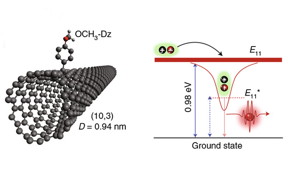 |
| June 18, 2018 Carbon nanotube Depiction of a carbon nanotube defect site generated by functionalization of a nanotube with a simple organic molecule. Altering the electronic structure at the defect enables room-temperature single photon emission at telecom wavelengths. |
Abstract:
Researchers at Los Alamos and partners in France and Germany are exploring the enhanced potential of carbon nanotubes as single-photon emitters for quantum information processing. Their analysis of progress in the field is published in this week’s edition of the journal Nature Materials.
Carbon nanotube optics poised to provide pathway to optical-based quantum cryptography and quantum computing: Researchers are exploring enhanced potential of carbon nanotubes for unique applications
Los Alamos, NM | Posted on June 18th, 2018“We are particularly interested in advances in nanotube integration into photonic cavities for manipulating and optimizing light-emission properties,” said Stephen Doorn, one of the authors, and a scientist with the Los Alamos National Laboratory site of the Center for Integrated Nanotechnologies (CINT). “In addition, nanotubes integrated into electroluminescent devices can provide greater control over timing of light emission and they can be feasibly integrated into photonic structures. We are highlighting the development and photophysical probing of carbon nanotube defect states as routes to room-temperature single photon emitters at telecom wavelengths.”
The team’s overview was produced in collaboration with colleagues in Paris (Christophe Voisin) who are advancing the integration of nanotubes into photonic cavities for modifying their emission rates, and at Karlsruhe (Ralph Krupke) where they are integrating nanotube-based electroluminescent devices with photonic waveguide structures. The Los Alamos focus is the analysis of nanotube defects for pushing quantum emission to room temperature and telecom wavelengths, he said.
As the paper notes, “With the advent of high-speed information networks, light has become the main worldwide information carrier. . . . Single-photon sources are a key building block for a variety of technologies, in secure quantum communications metrology or quantum computing schemes.”
The use of single-walled carbon nanotubes in this area has been a focus for the Los Alamos CINT team, where they developed the ability to chemically modify the nanotube structure to create deliberate defects, localizing excitons and controlling their release. Next steps, Doorn notes, involve integration of the nanotubes into photonic resonators, to provide increased source brightness and to generate indistinguishable photons. “We need to create single photons that are indistinguishable from one another, and that relies on our ability to functionalize tubes that are well-suited for device integration and to minimize environmental interactions with the defect sites,” he said.
“In addition to defining the state of the art, we wanted to highlight where the challenges are for future progress and lay out some of what may be the most promising future directions for moving forward in this area. Ultimately, we hope to draw more researchers into this field,” Doorn said.
Publication: Carbon nanotubes as emerging quantum-light sources, Nature Materials, DOI 10.1038/s41563-018-0109-2
Funding: Los Alamos National Laboratory Directed Research and Development funding, and support from the Center for Integrated Nanotechnologies, a U.S. Department of Energy, Office of Science user facility.
####
About Los Alamos National Laboratory
Los Alamos National Laboratory, a multidisciplinary research institution engaged in strategic science on behalf of national security, is operated by Los Alamos National Security, LLC, a team composed of Bechtel National, the University of California, BWXT Government Group, and URS, an AECOM company, for the Department of Energy’s National Nuclear Security Administration.
Los Alamos enhances national security by ensuring the safety and reliability of the U.S. nuclear stockpile, developing technologies to reduce threats from weapons of mass destruction, and solving problems related to energy, environment, infrastructure, health, and global security concerns.
For more information, please click here
Contacts:
Nancy Ambrosiano
(505) 667-0471
Copyright © Los Alamos National Laboratory
If you have a comment, please Contact us.Issuers of news releases, not 7th Wave, Inc. or Nanotechnology Now, are solely responsible for the accuracy of the content.
Bookmark:


| Related News Press |
News and information
 Quantum computer improves AI predictions April 17th, 2026
Flexible sensor gains sensitivity under pressure April 17th, 2026
A reusable chip for particulate matter sensing April 17th, 2026
Detecting vibrational quantum beating in the predissociation dynamics of SF6 using time-resolved photoelectron spectroscopy April 17th, 2026
Quantum Physics
Detecting vibrational quantum beating in the predissociation dynamics of SF6 using time-resolved photoelectron spectroscopy April 17th, 2026
Beyond silicon: Electronics at the scale of a single molecule January 30th, 2026
ICFO researchers overcome long-standing bottleneck in single photon detection with twisted 2D materials August 8th, 2025
Laboratories
Researchers develop molecular qubits that communicate at telecom frequencies October 3rd, 2025
Govt.-Legislation/Regulation/Funding/Policy
Quantum computer improves AI predictions April 17th, 2026
Metasurfaces smooth light to boost magnetic sensing precision January 30th, 2026
New imaging approach transforms study of bacterial biofilms August 8th, 2025
Possible Futures
A fundamentally new therapeutic approach to cystic fibrosis: Nanobody repairs cellular defect April 17th, 2026
UC Irvine physicists discover method to reverse ‘quantum scrambling’ : The work addresses the problem of information loss in quantum computing system April 17th, 2026
Chip Technology
A reusable chip for particulate matter sensing April 17th, 2026
Metasurfaces smooth light to boost magnetic sensing precision January 30th, 2026
Quantum Computing
Quantum computer improves AI predictions April 17th, 2026
UC Irvine physicists discover method to reverse ‘quantum scrambling’ : The work addresses the problem of information loss in quantum computing system April 17th, 2026
Researchers develop molecular qubits that communicate at telecom frequencies October 3rd, 2025
Optical computing/Photonic computing
ICFO researchers overcome long-standing bottleneck in single photon detection with twisted 2D materials August 8th, 2025
Programmable electron-induced color router array May 14th, 2025
Discoveries
Quantum computer improves AI predictions April 17th, 2026
Flexible sensor gains sensitivity under pressure April 17th, 2026
A reusable chip for particulate matter sensing April 17th, 2026
Detecting vibrational quantum beating in the predissociation dynamics of SF6 using time-resolved photoelectron spectroscopy April 17th, 2026
Announcements
A fundamentally new therapeutic approach to cystic fibrosis: Nanobody repairs cellular defect April 17th, 2026
UC Irvine physicists discover method to reverse ‘quantum scrambling’ : The work addresses the problem of information loss in quantum computing system April 17th, 2026
Interviews/Book Reviews/Essays/Reports/Podcasts/Journals/White papers/Posters
A fundamentally new therapeutic approach to cystic fibrosis: Nanobody repairs cellular defect April 17th, 2026
UC Irvine physicists discover method to reverse ‘quantum scrambling’ : The work addresses the problem of information loss in quantum computing system April 17th, 2026
Photonics/Optics/Lasers
Metasurfaces smooth light to boost magnetic sensing precision January 30th, 2026
From sensors to smart systems: the rise of AI-driven photonic noses January 30th, 2026
Quantum nanoscience
Beyond silicon: Electronics at the scale of a single molecule January 30th, 2026
MXene nanomaterials enter a new dimension Multilayer nanomaterial: MXene flakes created at Drexel University show new promise as 1D scrolls January 30th, 2026
ICFO researchers overcome long-standing bottleneck in single photon detection with twisted 2D materials August 8th, 2025
 |
||
 |
||
| The latest news from around the world, FREE | ||
 |
||
|
|
||
| Premium Products | ||
 |
||
|
Only the news you want to read!
Learn More |
||
 |
||
|
Full-service, expert consulting
Learn More |
||
|
|
||