Home > Press > Scientists use photonic chip to make virtual movies of molecular motion
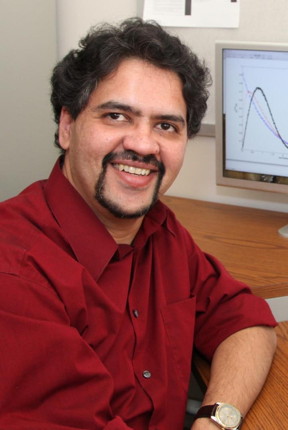 |
| Yogesh Joglekar, Ph.D., Associate Professor of Physics, IUPUI is a theoretical physicist with interests in graphene, PT-waveguides, memristors, and mathematics. CREDIT School of Science, IUPUI |
Abstract:
Scientists from IUPUI, MIT, Nokia Bell Labs, NTT and the University of Bristol in England, which led the study, have shown how an optical chip can simulate the motion of atoms within molecules at the quantum level. The study is published in the May 31 issue of the journal Nature.
Scientists use photonic chip to make virtual movies of molecular motion
Indianapolis, IN | Posted on June 6th, 2018The work described in the new study could lead to new methods of molecular modeling, which may help in the creation of new chemicals for use as pharmaceuticals.
The new methods of simulation exploit a similarity between the vibrations of atoms in molecules and the way photons of light move in an optical chip. Using analogies between photonics and molecular vibrations as a starting point provided the researchers with a head start in implementing intriguing simulations. Building on this, they hope to create quantum simulation and modeling tools that provide a practical advantage in the coming years.
"With this platform, in addition to vibrations of a stand-alone molecule, we are able to model the effects of environment on these quantum vibrations," said study co-author and IUPUI physicist Yogesh Joglekar. "The chip allows us to study open quantum systems, an extremely challenging subject."
Understanding the behavior of molecules requires an understanding of how they vibrate at the quantum level. But modeling these dynamics requires massive computational power, beyond what exists or is expected from coming generations of supercomputers.
An optical chip uses light instead of electricity and can operate as a quantum computing circuit. In the study published in Nature, data from the chip allows a frame-by-frame reconstruction of atomic motions to create a virtual movie of how a molecule vibrates.
"We can think of the atoms in molecules as being connected by springs," said Bristol physicist Anthony Laing, who led the project. "Across the whole molecule, the connected atoms will collectively vibrate, like a complicated dance routine. At a quantum level, the energy of the dance goes up or down in well-defined levels, as if the beat of the music has moved up or down a notch. Each notch represents a quantum of vibration.
"We can program a photonic chip to mimic the vibrations of a molecule mapping its components to the structure of a particular molecule, say ammonia, and then simulate how a particular vibrational pattern evolves over some time interval. By taking many time intervals, we essentially build up a movie of the molecular dynamics."
Co-first author Chris Sparrow, who was a student on the project, noted the simulator's versatility: "The chip can be reprogrammed in a few seconds to simulate different molecules. Because time is a controllable parameter, we can immediately jump to the most interesting points of the movie, or play the simulation in slow motion. We can even rewind the simulation to understand the origins of a particular vibrational pattern."
The photonic chip used in the experiments was fabricated by NTT. "Part of this study was to demonstrate techniques that go beyond the standard harmonic approximation of molecular dynamics," Laing said. "We need to develop these methods to increase the real-world accuracy of our models."
###
Funding sources of all co-authors of "Simulating the vibrational quantum dynamics of molecules using photonics" are listed in the paper. IUPUI's Joglekar was supported by a National Science Foundation CAREER award.
####
For more information, please click here
Contacts:
Lauren Kay
317-274-9234
Copyright © INDIANA UNIVERSITY-PURDUE UNIVERSITY INDIANAPOLIS SCHOOL OF SCIENCE
If you have a comment, please Contact us.Issuers of news releases, not 7th Wave, Inc. or Nanotechnology Now, are solely responsible for the accuracy of the content.
Bookmark:


| Related News Press |
News and information
 Quantum computer improves AI predictions April 17th, 2026
Flexible sensor gains sensitivity under pressure April 17th, 2026
A reusable chip for particulate matter sensing April 17th, 2026
Detecting vibrational quantum beating in the predissociation dynamics of SF6 using time-resolved photoelectron spectroscopy April 17th, 2026
Imaging
Simple algorithm paired with standard imaging tool could predict failure in lithium metal batteries August 8th, 2025
Govt.-Legislation/Regulation/Funding/Policy
Quantum computer improves AI predictions April 17th, 2026
Metasurfaces smooth light to boost magnetic sensing precision January 30th, 2026
New imaging approach transforms study of bacterial biofilms August 8th, 2025
Discoveries
Quantum computer improves AI predictions April 17th, 2026
Flexible sensor gains sensitivity under pressure April 17th, 2026
A reusable chip for particulate matter sensing April 17th, 2026
Detecting vibrational quantum beating in the predissociation dynamics of SF6 using time-resolved photoelectron spectroscopy April 17th, 2026
Announcements
A fundamentally new therapeutic approach to cystic fibrosis: Nanobody repairs cellular defect April 17th, 2026
UC Irvine physicists discover method to reverse ‘quantum scrambling’ : The work addresses the problem of information loss in quantum computing system April 17th, 2026
Tools
Metasurfaces smooth light to boost magnetic sensing precision January 30th, 2026
From sensors to smart systems: the rise of AI-driven photonic noses January 30th, 2026
Japan launches fully domestically produced quantum computer: Expo visitors to experience quantum computing firsthand August 8th, 2025
Photonics/Optics/Lasers
Metasurfaces smooth light to boost magnetic sensing precision January 30th, 2026
From sensors to smart systems: the rise of AI-driven photonic noses January 30th, 2026
Research partnerships
Lab to industry: InSe wafer-scale breakthrough for future electronics August 8th, 2025
HKU physicists uncover hidden order in the quantum world through deconfined quantum critical points April 25th, 2025
 |
||
 |
||
| The latest news from around the world, FREE | ||
 |
||
|
|
||
| Premium Products | ||
 |
||
|
Only the news you want to read!
Learn More |
||
 |
||
|
Full-service, expert consulting
Learn More |
||
|
|
||