Home > Press > Newly improved glass slide turns microscopes into thermometers: Advancement could streamline and boost scientific research all over the world, help computing industry
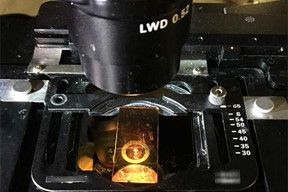 |
| A photo of the experiment using a glass slide with the new coating. CREDIT University at Buffalo |
Abstract:
The humble glass microscope slide may be primed for a makeover.
Newly improved glass slide turns microscopes into thermometers: Advancement could streamline and boost scientific research all over the world, help computing industry
Buffalo, NY | Posted on May 2nd, 2018A study published online today (May 2, 2018) in the journal Nature Communications describes how an updated version of this centuries-old tool can now enable scientists to see tiny objects while also measuring their temperature.
The advancement, made possible by a new transparent coating at the forefront of optics theory, has the potential to streamline and enhance scientific research worldwide, from clandestine government biology labs to high school chemistry classes.
It may also have implications in other industries, such as computers and electronics, whose products require measurement and control of heat in highly confined spaces.
"We have instruments that magnify incredibly small objects. And we have tools that measure heat, like infrared thermometers. But we haven't been able to combine them in a low-cost and reliable manner. This new coating takes a big step in that direction," says the study's co-lead author Ruogang Zhao, PhD, assistant professor in the University at Buffalo Department of Biomedical Engineering.
The department is a multidisciplinary unit formed by UB's School of Engineering and Applied Sciences and the Jacobs School of Medicine and Biomedical Sciences at UB.
Zhao collaborated with researchers at the University of Pennsylvania, including co-lead author Liang Feng, PhD, assistant professor of materials science and engineering, and electrical and systems engineering.
For decades, researchers have tried to combine thermal imaging and microscopy. Images produced from systems that use thermocouples lack resolution and are often too coarse for modern science. Terahertz and infrared thermal mapping techniques interfere with the microscope's lenses. Other techniques are expensive and time-consuming.
The new coating is made of a layer of acrylic glass (the same material used in most eyeglasses) that's sandwiched between two layers of transparent gold. The gold is transparent because it's only 20 nanometers thick; a typical sheet of paper is 100,000 nanometers thick.
Engineers fabricated the coating so that "exceptional points" -- the sweet spots where unusual light behavior happens -- can develop within the tri-layered structure. The coating, which significantly enhances the slide's sensitivity to light detection, would be added to slides during the manufacturing process. Either the slide or cover slip could receive the coating.
To make use of the new coating, a laser is needed. Zhao says a common helium-neon laser, which can be seamlessly integrated with most microscopes, will do the job.
Common slides, which are often bought in bulk, typically cost around 5 cents. The new coating would likely add a few pennies to the cost, Zhao says.
###
The research is supported by funding from the National Science Foundation and the National Institutes of Health.
####
For more information, please click here
Contacts:
Cory Nealon
716-645-4614
Copyright © University at Buffalo
If you have a comment, please Contact us.Issuers of news releases, not 7th Wave, Inc. or Nanotechnology Now, are solely responsible for the accuracy of the content.
Bookmark:


| Related Links |
| Related News Press |
News and information
 Quantum computer improves AI predictions April 17th, 2026
Flexible sensor gains sensitivity under pressure April 17th, 2026
A reusable chip for particulate matter sensing April 17th, 2026
Detecting vibrational quantum beating in the predissociation dynamics of SF6 using time-resolved photoelectron spectroscopy April 17th, 2026
Imaging
Simple algorithm paired with standard imaging tool could predict failure in lithium metal batteries August 8th, 2025
Govt.-Legislation/Regulation/Funding/Policy
Quantum computer improves AI predictions April 17th, 2026
Metasurfaces smooth light to boost magnetic sensing precision January 30th, 2026
New imaging approach transforms study of bacterial biofilms August 8th, 2025
Possible Futures
A fundamentally new therapeutic approach to cystic fibrosis: Nanobody repairs cellular defect April 17th, 2026
UC Irvine physicists discover method to reverse ‘quantum scrambling’ : The work addresses the problem of information loss in quantum computing system April 17th, 2026
Discoveries
Quantum computer improves AI predictions April 17th, 2026
Flexible sensor gains sensitivity under pressure April 17th, 2026
A reusable chip for particulate matter sensing April 17th, 2026
Detecting vibrational quantum beating in the predissociation dynamics of SF6 using time-resolved photoelectron spectroscopy April 17th, 2026
Announcements
A fundamentally new therapeutic approach to cystic fibrosis: Nanobody repairs cellular defect April 17th, 2026
UC Irvine physicists discover method to reverse ‘quantum scrambling’ : The work addresses the problem of information loss in quantum computing system April 17th, 2026
Interviews/Book Reviews/Essays/Reports/Podcasts/Journals/White papers/Posters
A fundamentally new therapeutic approach to cystic fibrosis: Nanobody repairs cellular defect April 17th, 2026
UC Irvine physicists discover method to reverse ‘quantum scrambling’ : The work addresses the problem of information loss in quantum computing system April 17th, 2026
Tools
Metasurfaces smooth light to boost magnetic sensing precision January 30th, 2026
From sensors to smart systems: the rise of AI-driven photonic noses January 30th, 2026
Japan launches fully domestically produced quantum computer: Expo visitors to experience quantum computing firsthand August 8th, 2025
 |
||
 |
||
| The latest news from around the world, FREE | ||
 |
||
|
|
||
| Premium Products | ||
 |
||
|
Only the news you want to read!
Learn More |
||
 |
||
|
Full-service, expert consulting
Learn More |
||
|
|
||