Home > Press > Individual quantum dots imaged in 3-D for first time
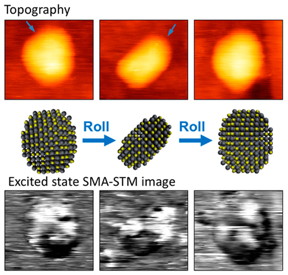 |
| Conventional STM image of a quantum dot, top, compared with an image produced using the new excited-state SMA-STM technique. Graphic courtesy Martin Gruebele |
Abstract:
Researchers have developed an imaging technique that uses a tiny, super sharp needle to nudge a single nanoparticle into different orientations and capture 2-D images to help reconstruct a 3-D picture. The method demonstrates imaging of individual nanoparticles at different orientations while in a laser-induced excited state.
Individual quantum dots imaged in 3-D for first time
Champaign, IL | Posted on February 28th, 2018The findings, published in The Journal of Chemical Physics, brought together researchers from the University of Illinois and the University of Washington, Seattle in a collaborative project through the Beckman Institute for Advanced Science and Technology at the U. of I.
Nanostructures like microchip semiconductors, carbon nanotubes and large protein molecules contain defects that form during synthesis that cause them to differ in composition from one another. However, these defects are not always a bad thing, said Martin Gruebele, the lead author and an Illinois chemistry professor and chair.
“The term ‘defect’ is a bit of a misnomer,” Gruebele said. “For example, semiconductors are manufactured with intentional defects that form the ‘holes’ that electrons jump into to produce electrical conductivity. Having the ability to image those defects could let us better characterize them and control their production.”
As advances in technology allow for smaller and smaller nanoparticles, it is critical for engineers to know the precise number and location of these defects to assure quality and functionality.
The study focused on a class of nanoparticles called quantum dots. These dots are tiny, near-spherical semiconductors used in technology like solar panels, live cell imaging and molecular electronics – the basis for quantum computing.
The team observed the quantum dots using a single-molecule absorption scanning tunneling microscope fitted with a needle sharpened to a thickness of only one atom at its tip. The needle nudges the individual particles around on a surface and scans them to get a view of the quantum dot from different orientations to produce a 3-D image.
The researchers said there are two distinct advantages of the new SMA-STM method when compared with the current technology – the Nobel Prize-winning technique called cryogenic electron tomography.
“Instead of an image produced using an average of thousands of different particles, as is done with CryoET, SMA-STM can produce an image from a single particle in about 20 different orientations,” Gruebele said. “And because we are not required to chill the particles to near-absolute zero temperatures, we can capture the particles at room temperature, not frozen and motionless.”
The researchers looked at semiconductor quantum dots for this study, but SMA-STM can also be used to explore other nanostructures such as carbon nanotubes, metal nanoparticles or synthetic macromolecules. The group believes the technique can be refined for use with soft materials like protein molecules, Gruebele said.
The researchers are working to advance SMA-STM into a single-particle tomography technique, meaning that they will need to prove that method is noninvasive.
“For SMA-STM to become a true single-particle tomography technique, we will need to prove that our nudges do not damage or score the nanoparticle in any way while rolled around,” Gruebele said. “Knocking off just one atom can fundamentally alter the defect structure of the nanoparticle.”
The National Science Foundation, the Eiszner Family Foundation and the Beckman Institute supported this research.
####
Contacts:
LOIS YOKSOULIAN
PHYSICAL SCIENCES EDITOR
17-244-2788
Copyright © University of Illinois at Urbana-Champaign
If you have a comment, please Contact us.Issuers of news releases, not 7th Wave, Inc. or Nanotechnology Now, are solely responsible for the accuracy of the content.
Bookmark:


| Related News Press |
News and information
 Quantum computer improves AI predictions April 17th, 2026
Flexible sensor gains sensitivity under pressure April 17th, 2026
A reusable chip for particulate matter sensing April 17th, 2026
Detecting vibrational quantum beating in the predissociation dynamics of SF6 using time-resolved photoelectron spectroscopy April 17th, 2026
Imaging
Simple algorithm paired with standard imaging tool could predict failure in lithium metal batteries August 8th, 2025
First real-time observation of two-dimensional melting process: Researchers at Mainz University unveil new insights into magnetic vortex structures August 8th, 2025
New imaging approach transforms study of bacterial biofilms August 8th, 2025
Videos/Movies
ICFO researchers overcome long-standing bottleneck in single photon detection with twisted 2D materials August 8th, 2025
Govt.-Legislation/Regulation/Funding/Policy
Quantum computer improves AI predictions April 17th, 2026
Metasurfaces smooth light to boost magnetic sensing precision January 30th, 2026
New imaging approach transforms study of bacterial biofilms August 8th, 2025
Possible Futures
A fundamentally new therapeutic approach to cystic fibrosis: Nanobody repairs cellular defect April 17th, 2026
UC Irvine physicists discover method to reverse ‘quantum scrambling’ : The work addresses the problem of information loss in quantum computing system April 17th, 2026
Discoveries
Quantum computer improves AI predictions April 17th, 2026
Flexible sensor gains sensitivity under pressure April 17th, 2026
A reusable chip for particulate matter sensing April 17th, 2026
Detecting vibrational quantum beating in the predissociation dynamics of SF6 using time-resolved photoelectron spectroscopy April 17th, 2026
Announcements
A fundamentally new therapeutic approach to cystic fibrosis: Nanobody repairs cellular defect April 17th, 2026
UC Irvine physicists discover method to reverse ‘quantum scrambling’ : The work addresses the problem of information loss in quantum computing system April 17th, 2026
Interviews/Book Reviews/Essays/Reports/Podcasts/Journals/White papers/Posters
A fundamentally new therapeutic approach to cystic fibrosis: Nanobody repairs cellular defect April 17th, 2026
UC Irvine physicists discover method to reverse ‘quantum scrambling’ : The work addresses the problem of information loss in quantum computing system April 17th, 2026
Tools
Metasurfaces smooth light to boost magnetic sensing precision January 30th, 2026
From sensors to smart systems: the rise of AI-driven photonic noses January 30th, 2026
Japan launches fully domestically produced quantum computer: Expo visitors to experience quantum computing firsthand August 8th, 2025
Grants/Sponsored Research/Awards/Scholarships/Gifts/Contests/Honors/Records
Quantum computer improves AI predictions April 17th, 2026
Detecting vibrational quantum beating in the predissociation dynamics of SF6 using time-resolved photoelectron spectroscopy April 17th, 2026
Metasurfaces smooth light to boost magnetic sensing precision January 30th, 2026
Quantum Dots/Rods
A new kind of magnetism November 17th, 2023
IOP Publishing celebrates World Quantum Day with the announcement of a special quantum collection and the winners of two prestigious quantum awards April 14th, 2023
Qubits on strong stimulants: Researchers find ways to improve the storage time of quantum information in a spin rich material January 27th, 2023
NIST’s grid of quantum islands could reveal secrets for powerful technologies November 18th, 2022
 |
||
 |
||
| The latest news from around the world, FREE | ||
 |
||
|
|
||
| Premium Products | ||
 |
||
|
Only the news you want to read!
Learn More |
||
 |
||
|
Full-service, expert consulting
Learn More |
||
|
|
||