Home > Press > Laboratory Management Web Application Goes Nationwide
 |
Abstract:
Making reservations, accessing tools, and maintaining equipment at the CNST’s NanoFab got a lot easier five years ago when the CNST developed a customized laboratory management web application. Now other NanoFabs and laboratories across the nation can reap the same benefits. The NanoFab Equipment Management & Operations (NEMO) web application will be released as open source and free software on January 8th, 2018.
Laboratory Management Web Application Goes Nationwide
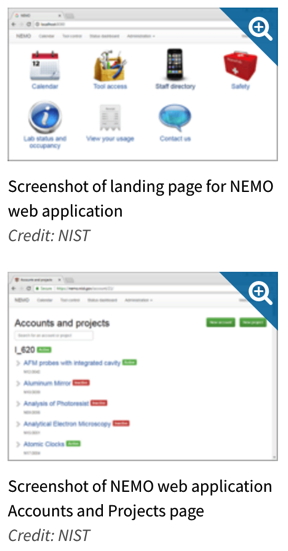
Gaithersburg, MD | Posted on January 9th, 2018Users can customize NEMO for their own laboratory, enabling any customer with a desktop or mobile device to reserve tools, view the operating status of instruments, and seek assistance from laboratory staff.
NEMO is hosted at https://github.com/usnistgov/NEMO (link is external). The web application is written in the Python programming language and uses the Django web framework. It is system independent (can run on Linux, Windows, or Mac) and does not require special hardware to operate.
The CNST hopes to foster a developer community to collaborate on new features and improvements to NEMO. Source code contributions are welcome via GitHub pull requests. The CNST will compile and evaluate these suggestions, modifying NEMO as needed.
“We hope the nanofabrication community will be excited about the release of this software, and we look forward to sharing it,” says CNST’s software engineer Dylan Klomparens, who developed NEMO.
####
For more information, please click here
Contacts:
Ben P. Stein
Managing Editor
Public Affairs Office
National Institute of Standards and Technology
Gaithersburg, Maryland
Office: (301) 975-2763
Copyright © National Institute of Standards and Technology (NIST)
If you have a comment, please Contact us.Issuers of news releases, not 7th Wave, Inc. or Nanotechnology Now, are solely responsible for the accuracy of the content.
Bookmark:


| Related News Press |
News and information
 Quantum computer improves AI predictions April 17th, 2026
Flexible sensor gains sensitivity under pressure April 17th, 2026
A reusable chip for particulate matter sensing April 17th, 2026
Detecting vibrational quantum beating in the predissociation dynamics of SF6 using time-resolved photoelectron spectroscopy April 17th, 2026
Laboratories
Researchers develop molecular qubits that communicate at telecom frequencies October 3rd, 2025
A battery’s hopping ions remember where they’ve been: Seen in atomic detail, the seemingly smooth flow of ions through a battery’s electrolyte is surprisingly complicated February 16th, 2024
Software
Visualizing nanoscale structures in real time: Open-source software enables researchers to see materials in 3D while they're still on the electron microscope August 19th, 2022
Luisier wins SNSF Advanced Grant to develop simulation tools for nanoscale devices July 8th, 2022
Oxford Instruments’ Atomfab® system is production-qualified at a market-leading GaN power electronics device manufacturer December 17th, 2021
Govt.-Legislation/Regulation/Funding/Policy
Quantum computer improves AI predictions April 17th, 2026
Metasurfaces smooth light to boost magnetic sensing precision January 30th, 2026
New imaging approach transforms study of bacterial biofilms August 8th, 2025
Announcements
A fundamentally new therapeutic approach to cystic fibrosis: Nanobody repairs cellular defect April 17th, 2026
UC Irvine physicists discover method to reverse ‘quantum scrambling’ : The work addresses the problem of information loss in quantum computing system April 17th, 2026
 |
||
 |
||
| The latest news from around the world, FREE | ||
 |
||
|
|
||
| Premium Products | ||
 |
||
|
Only the news you want to read!
Learn More |
||
 |
||
|
Full-service, expert consulting
Learn More |
||
|
|
||