Home > Press > Error-free into the quantum computer age
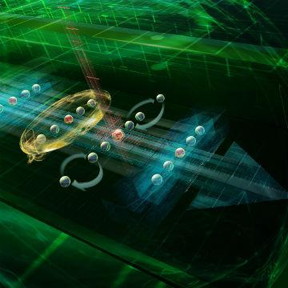 |
| Error-free into the Quantum Computer Age. CREDIT H. Ritsch/IQOQI |
Abstract:
A study led by physicists at Swansea University in Wales, carried out by an international team of researchers and published in the journal Physical Review X shows that ion-trap technologies available today are suitable for building large-scale quantum computers. The scientists introduce trapped-ion quantum error correction protocols that detect and correct processing errors.
Error-free into the quantum computer age
Swansea, UK | Posted on December 15th, 2017In order to reach their full potential, today's quantum computer prototypes have to meet specific criteria: First, they have to be made bigger, which means they need to consist of a considerably higher number of quantum bits. Second, they have to be capable of processing errors. "We still fail in running complex computations because environmental noise and errors cause the system to get out of control," says quantum physicist Rainer Blatt in Innsbruck. "By using quantum error correction, we can respond to this challenge better." Classical computers use similar schemes to detect and correct errors during data storage and transfer: Before data is stored and transferred, redundancy is added to the data usually in the form of additional bits detecting and correcting errors. Scientists have developed comparable schemes for quantum computers, where quantum information is encoded in several entangled physical quantum bits. "Here we exploit quantum mechanical properties for error detection and correction," explains Markus Müller from Swansea University, Wales. "If we can keep the noise below a certain threshold, we will be able to build quantum computers that can perform quantum computations of arbitrary complexity by increasing the number of entangled quantum bits accordingly."
Trapping ions in a maze
Markus Müller and his colleague Alejandro Bermudez Carballo explain that in order to achieve this goal, the capabilities of the technological platforms have to be optimally exploited. "For beneficial error correction we need quantum circuits that are stable and work reliably under realistic conditions even if additional errors occur during the error correction," explains Bermudez. They introduced new variants of fault-tolerant protocols and investigated how these can be implemented with currently available operations on quantum computers. The researchers found that a new generation of segmented ion traps offers ideal conditions for the process: Ions can be shuttled quickly across different segments of the trap array. Precisely timed processes allow parallel operations in different storage and processing regions. By using two different types of ions in a trap, scientists may use one type as carriers of the data qubits while the other one may be used for error measurement, noise suppression and cooling.
A new generation of quantum computers
Building on the experimental experience of research groups in Innsbruck, Mainz, Zurich und Sydney the researchers defined criteria that will allow the scientists to determine whether the quantum error correction is beneficial. By using this information they can guide the development of future ion-trap quantum computers with the goal to realize a logical quantum bit in the near future that, owed to error correction, exceeds the properties of a pure physical quantum bit.
Simon Benjamin's research group at the University of Oxford showed through complex numerical simulations of the new error correction protocols how the hardware of next generation ion-trap quantum computers has to be built to be able to process information fault-tolerantly. "Our numerical results clearly show that state-of-the-art ion-trap technologies are well suited to serve as platforms for constructing large-scale fault-tolerant quantum computers," explains Benjamin.
####
For more information, please click here
Contacts:
Mari Hooson
01-792-513-455
Copyright © Swansea University
If you have a comment, please Contact us.Issuers of news releases, not 7th Wave, Inc. or Nanotechnology Now, are solely responsible for the accuracy of the content.
Bookmark:


| Related Links |
| Related News Press |
News and information
 Quantum computer improves AI predictions April 17th, 2026
Flexible sensor gains sensitivity under pressure April 17th, 2026
A reusable chip for particulate matter sensing April 17th, 2026
Detecting vibrational quantum beating in the predissociation dynamics of SF6 using time-resolved photoelectron spectroscopy April 17th, 2026
Quantum communication
Next-generation quantum communication October 3rd, 2025
Nanophotonic platform boosts efficiency of nonlinear-optical quantum teleportation April 25th, 2025
Physicists unlock the secret of elusive quantum negative entanglement entropy using simple classical hardware August 16th, 2024
Possible Futures
A fundamentally new therapeutic approach to cystic fibrosis: Nanobody repairs cellular defect April 17th, 2026
UC Irvine physicists discover method to reverse ‘quantum scrambling’ : The work addresses the problem of information loss in quantum computing system April 17th, 2026
Chip Technology
A reusable chip for particulate matter sensing April 17th, 2026
Metasurfaces smooth light to boost magnetic sensing precision January 30th, 2026
Discoveries
Quantum computer improves AI predictions April 17th, 2026
Flexible sensor gains sensitivity under pressure April 17th, 2026
A reusable chip for particulate matter sensing April 17th, 2026
Detecting vibrational quantum beating in the predissociation dynamics of SF6 using time-resolved photoelectron spectroscopy April 17th, 2026
Announcements
A fundamentally new therapeutic approach to cystic fibrosis: Nanobody repairs cellular defect April 17th, 2026
UC Irvine physicists discover method to reverse ‘quantum scrambling’ : The work addresses the problem of information loss in quantum computing system April 17th, 2026
Interviews/Book Reviews/Essays/Reports/Podcasts/Journals/White papers/Posters
A fundamentally new therapeutic approach to cystic fibrosis: Nanobody repairs cellular defect April 17th, 2026
UC Irvine physicists discover method to reverse ‘quantum scrambling’ : The work addresses the problem of information loss in quantum computing system April 17th, 2026
 |
||
 |
||
| The latest news from around the world, FREE | ||
 |
||
|
|
||
| Premium Products | ||
 |
||
|
Only the news you want to read!
Learn More |
||
 |
||
|
Full-service, expert consulting
Learn More |
||
|
|
||