Home > Press > Nano-sized gold particles have been shaped to behave as clones in biomedicine
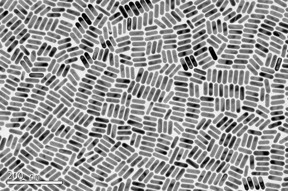 |
| These are ultramonodisperse gold nanorods that behave as clones from an optical point of view. CREDIT Guillermo González Rubio. |
Abstract:
Shaping nanometric gold particles - of the size of millionths of a millimeter - to improve their properties in biomedicine and photonics has been made possible thanks to a special laser system in a work carried out at the Universidad Complutense de Madrid (UCM) and now published in Science.
Nano-sized gold particles have been shaped to behave as clones in biomedicine
Madrid, Spain | Posted on November 3rd, 2017The research, in which the CIC biomaGUNE and the Universidad Politécnica de Madrid also participate, not only represents a record in optical quality in which billions of gold nanoparticles behave as a single one, but introduces a new way to manipulate and improve nanomaterials by employing lasers as chisels in the hands of a sculptor.
"By using ultrafast lasers, which are very intense but very short in duration (of the order of a billion trillion flashes per second), we have realized a world record in optical quality, where all the obtained shaped particles behave like nano-sized clones", explains Andrés Guerrero Martínez, researcher of the Ramón y Cajal Program at the Faculty of Chemical Sciences of the UCM.
The study provides the physical and chemical clues required to understand and control such nanomaterials, considered to be "perfect" from an optical point of view.
"We have tried during the last fifteen years to obtain identical nanoparticles, so that they all present the same color and their applications are more efficient. In this work, we have focused on the use of gold nanorods, in which minimal variations in their length or width result in significant changes in the color of the light they absorb", says Luis Liz Marzán, scientific director of CIC biomaGUNE and researcher at the Ikerbasque Program.
From tumor treatment to pollution remediation
The applications of nanoparticles rely on their ability to absorb and reflect light of a specific color in a surprisingly efficient way. These so-called plasmonic effects result in optical properties that cannot be achieved with metals of larger dimensions, even at the millimeter scale.
These properties can be used for a large number of useful applications that, in many cases, were not possible until now. In medicine, not only the light reflected by these particles can be used to diagnose diseases, but their light absorption properties can also be exploited to induce the release of heat for, for example, the treatment of tumors in a localized way, thus minimizing the usual side effects of current treatments.
"Plasmonic particles have also found applications in areas such as information technology, energy production, or environmental pollution control, among others", says Guillermo González Rubio, co-author of the paper who has obtained his PhD at the UCM under the supervision of Andrés Guerrero Martínez and Luis Liz Marzán.
Another novelty of this work is the application of ultrafast lasers to shape the geometry of the particles and refine their properties. In this case, Luis Bañares, professor at the UCM and co-author of the article, works at the Ultrafast Laser Center (CLUR) at the UCM.
Furthermore, so as to understand the chemical and physical nature of the shaping process, standard characterization techniques (spectroscopy and electron microscopy) have been employed, as well as new theoretical models and advanced computer simulation techniques.
According to Ovidio Rodríguez Peña, a researcher at the UPM, "the demonstration of this goal and the explanation of the processes that allow it to happen represent a paradigm shift that may open new avenues for the development of nanomaterials with improved properties and applications".
####
For more information, please click here
Contacts:
Andrés Guerrero Martínez
Copyright © Universidad Complutense de Madrid
If you have a comment, please Contact us.Issuers of news releases, not 7th Wave, Inc. or Nanotechnology Now, are solely responsible for the accuracy of the content.
Bookmark:


| Related Links |
| Related News Press |
News and information
 Quantum computer improves AI predictions April 17th, 2026
Flexible sensor gains sensitivity under pressure April 17th, 2026
A reusable chip for particulate matter sensing April 17th, 2026
Detecting vibrational quantum beating in the predissociation dynamics of SF6 using time-resolved photoelectron spectroscopy April 17th, 2026
Imaging
Simple algorithm paired with standard imaging tool could predict failure in lithium metal batteries August 8th, 2025
Cancer
New molecular technology targets tumors and simultaneously silences two ‘undruggable’ cancer genes August 8th, 2025
Possible Futures
A fundamentally new therapeutic approach to cystic fibrosis: Nanobody repairs cellular defect April 17th, 2026
UC Irvine physicists discover method to reverse ‘quantum scrambling’ : The work addresses the problem of information loss in quantum computing system April 17th, 2026
Nanomedicine
A fundamentally new therapeutic approach to cystic fibrosis: Nanobody repairs cellular defect April 17th, 2026
New molecular technology targets tumors and simultaneously silences two ‘undruggable’ cancer genes August 8th, 2025
New imaging approach transforms study of bacterial biofilms August 8th, 2025
Electrifying results shed light on graphene foam as a potential material for lab grown cartilage June 6th, 2025
Discoveries
Quantum computer improves AI predictions April 17th, 2026
Flexible sensor gains sensitivity under pressure April 17th, 2026
A reusable chip for particulate matter sensing April 17th, 2026
Detecting vibrational quantum beating in the predissociation dynamics of SF6 using time-resolved photoelectron spectroscopy April 17th, 2026
Announcements
A fundamentally new therapeutic approach to cystic fibrosis: Nanobody repairs cellular defect April 17th, 2026
UC Irvine physicists discover method to reverse ‘quantum scrambling’ : The work addresses the problem of information loss in quantum computing system April 17th, 2026
Interviews/Book Reviews/Essays/Reports/Podcasts/Journals/White papers/Posters
A fundamentally new therapeutic approach to cystic fibrosis: Nanobody repairs cellular defect April 17th, 2026
UC Irvine physicists discover method to reverse ‘quantum scrambling’ : The work addresses the problem of information loss in quantum computing system April 17th, 2026
Tools
Metasurfaces smooth light to boost magnetic sensing precision January 30th, 2026
From sensors to smart systems: the rise of AI-driven photonic noses January 30th, 2026
Japan launches fully domestically produced quantum computer: Expo visitors to experience quantum computing firsthand August 8th, 2025
Environment
A reusable chip for particulate matter sensing April 17th, 2026
Researchers unveil a groundbreaking clay-based solution to capture carbon dioxide and combat climate change June 6th, 2025
Nanobiotechnology
A fundamentally new therapeutic approach to cystic fibrosis: Nanobody repairs cellular defect April 17th, 2026
New molecular technology targets tumors and simultaneously silences two ‘undruggable’ cancer genes August 8th, 2025
New imaging approach transforms study of bacterial biofilms August 8th, 2025
Electrifying results shed light on graphene foam as a potential material for lab grown cartilage June 6th, 2025
 |
||
 |
||
| The latest news from around the world, FREE | ||
 |
||
|
|
||
| Premium Products | ||
 |
||
|
Only the news you want to read!
Learn More |
||
 |
||
|
Full-service, expert consulting
Learn More |
||
|
|
||