Home > Press > First on-chip nanoscale optical quantum memory developed: Smallest-yet optical quantum memory device is a storage medium for optical quantum networks with the potential to be scaled up for commercial use
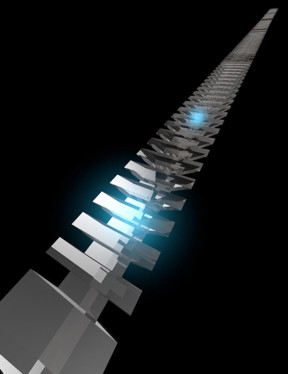 |
| Artist's representation of the quantum memory device. CREDIT Ella Maru Studio |
Abstract:
For the first time, an international team led by engineers at Caltech has developed a computer chip with nanoscale optical quantum memory.
First on-chip nanoscale optical quantum memory developed: Smallest-yet optical quantum memory device is a storage medium for optical quantum networks with the potential to be scaled up for commercial use
Pasadena. CA | Posted on September 11th, 2017Quantum memory stores information in a similar fashion to the way traditional computer memory does, but on individual quantum particles--in this case, photons of light. This allows it to take advantage of the peculiar features of quantum mechanics (such as superposition, in which a quantum element can exist in two distinct states simultaneously) to store data more efficiently and securely.
"Such a device is an essential component for the future development of optical quantum networks that could be used to transmit quantum information," says Andrei Faraon (BS '04), assistant professor of applied physics and materials science in the Division of Engineering and Applied Science at Caltech, and the corresponding author of a paper describing the new chip.
The study appeared online ahead of publication by Science magazine on August 31.
"This technology not only leads to extreme miniaturization of quantum memory devices, it also enables better control of the interactions between individual photons and atoms," says Tian Zhong, lead author of the study and a Caltech postdoctoral scholar. Zhong is also an acting assistant professor of molecular engineering at the University of Chicago, where he will set up a laboratory to develop quantum photonic technologies in March 2018.
The use of individual photons to store and transmit data has long been a goal of engineers and physicists because of their potential to carry information reliably and securely. Because photons lack charge and mass, they can be transmitted across a fiber optic network with minimal interactions with other particles.
The new quantum memory chip is analogous to a traditional memory chip in a computer. Both store information in a binary code. With traditional memory, information is stored by flipping billions of tiny electronic switches either on or off, representing either a 1 or a 0. That 1 or 0 is known as a bit. By contrast, quantum memory stores information via the quantum properties of individual elementary particles (in this case, a light particle). A fundamental characteristic of those quantum properties--which include polarization and orbital angular momentum--is that they can exist in multiple states at the same time. This means that a quantum bit (known as a qubit) can represent a 1 and a 0 at the same time.
To store photons, Faraon's team created memory modules using optical cavities made from crystals doped with rare-earth ions. Each memory module is like a miniature racetrack, measuring just 700 nanometers wide by 15 microns long--on the scale of a red blood cell. Each module was cooled to about 0.5 Kelvin--just above Absolute Zero (0 Kelvin, or -273.15 Celsius)--and then a heavily filtered laser pumped single photons into the modules. Each photon was absorbed efficiently by the rare-earth ions with the help of the cavity.
The photons were released 75 nanoseconds later, and checked to see whether they had faithfully retained the information recorded on them. Ninety-seven percent of the time, they had, Faraon says.
Next, the team plans to extend the time that the memory can store information, as well as its efficiency. To create a viable quantum network that sends information over hundreds of kilometers, the memory will need to accurately store data for at least one millisecond. The team also plans to work on ways to integrate the quantum memory into more complex circuits, taking the first steps toward deploying this technology in quantum networks.
####
For more information, please click here
Contacts:
Robert Perkins
626-395-1862
Copyright © California Institute of Technology
If you have a comment, please Contact us.Issuers of news releases, not 7th Wave, Inc. or Nanotechnology Now, are solely responsible for the accuracy of the content.
Bookmark:


| Related Links |
| Related News Press |
News and information
 Quantum computer improves AI predictions April 17th, 2026
Flexible sensor gains sensitivity under pressure April 17th, 2026
A reusable chip for particulate matter sensing April 17th, 2026
Detecting vibrational quantum beating in the predissociation dynamics of SF6 using time-resolved photoelectron spectroscopy April 17th, 2026
Quantum Physics
Detecting vibrational quantum beating in the predissociation dynamics of SF6 using time-resolved photoelectron spectroscopy April 17th, 2026
ICFO researchers overcome long-standing bottleneck in single photon detection with twisted 2D materials August 8th, 2025
Quantum communication
Next-generation quantum communication October 3rd, 2025
Nanophotonic platform boosts efficiency of nonlinear-optical quantum teleportation April 25th, 2025
Govt.-Legislation/Regulation/Funding/Policy
Quantum computer improves AI predictions April 17th, 2026
Metasurfaces smooth light to boost magnetic sensing precision January 30th, 2026
New imaging approach transforms study of bacterial biofilms August 8th, 2025
Possible Futures
A fundamentally new therapeutic approach to cystic fibrosis: Nanobody repairs cellular defect April 17th, 2026
UC Irvine physicists discover method to reverse ‘quantum scrambling’ : The work addresses the problem of information loss in quantum computing system April 17th, 2026
Chip Technology
A reusable chip for particulate matter sensing April 17th, 2026
Metasurfaces smooth light to boost magnetic sensing precision January 30th, 2026
Memory Technology
Researchers tackle the memory bottleneck stalling quantum computing October 3rd, 2025
First real-time observation of two-dimensional melting process: Researchers at Mainz University unveil new insights into magnetic vortex structures August 8th, 2025
Utilizing palladium for addressing contact issues of buried oxide thin film transistors April 5th, 2024
Quantum Computing
Quantum computer improves AI predictions April 17th, 2026
UC Irvine physicists discover method to reverse ‘quantum scrambling’ : The work addresses the problem of information loss in quantum computing system April 17th, 2026
Researchers develop molecular qubits that communicate at telecom frequencies October 3rd, 2025
Optical computing/Photonic computing
ICFO researchers overcome long-standing bottleneck in single photon detection with twisted 2D materials August 8th, 2025
Programmable electron-induced color router array May 14th, 2025
Discoveries
Quantum computer improves AI predictions April 17th, 2026
Flexible sensor gains sensitivity under pressure April 17th, 2026
A reusable chip for particulate matter sensing April 17th, 2026
Detecting vibrational quantum beating in the predissociation dynamics of SF6 using time-resolved photoelectron spectroscopy April 17th, 2026
Announcements
A fundamentally new therapeutic approach to cystic fibrosis: Nanobody repairs cellular defect April 17th, 2026
UC Irvine physicists discover method to reverse ‘quantum scrambling’ : The work addresses the problem of information loss in quantum computing system April 17th, 2026
Interviews/Book Reviews/Essays/Reports/Podcasts/Journals/White papers/Posters
A fundamentally new therapeutic approach to cystic fibrosis: Nanobody repairs cellular defect April 17th, 2026
UC Irvine physicists discover method to reverse ‘quantum scrambling’ : The work addresses the problem of information loss in quantum computing system April 17th, 2026
Military
Quantum engineers ‘squeeze’ laser frequency combs to make more sensitive gas sensors January 17th, 2025
Chainmail-like material could be the future of armor: First 2D mechanically interlocked polymer exhibits exceptional flexibility and strength January 17th, 2025
Single atoms show their true color July 5th, 2024
NRL charters Navy’s quantum inertial navigation path to reduce drift April 5th, 2024
Photonics/Optics/Lasers
Metasurfaces smooth light to boost magnetic sensing precision January 30th, 2026
From sensors to smart systems: the rise of AI-driven photonic noses January 30th, 2026
 |
||
 |
||
| The latest news from around the world, FREE | ||
 |
||
|
|
||
| Premium Products | ||
 |
||
|
Only the news you want to read!
Learn More |
||
 |
||
|
Full-service, expert consulting
Learn More |
||
|
|
||