Home > Press > What the world's tiniest 'monster truck' reveals
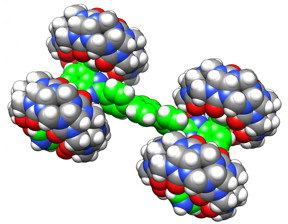 |
| Ohio University's nano-sized monster truck led to a curious finding. CREDIT Eric Masson, Ph.D. |
Abstract:
Title
Frame suspended into four Cucurbituril wheels: Meet the Ohio Bobcat Nanowagon
Abstract
We present the design, synthesis and characterization of the Ohio Bobcat Nanowagon, a [5]pseudorotaxane assembly bearing an H-shaped frame threaded into four Cucurbit[7]uril (CB[7]) wheels. The key motifs in the frame are two benzimidazolium groups, which link a terphenyl drive shaft (the horizontal bar of the "H" frame) to the axle shafts (the vertical bars of the "H" frame). Four pyridinium units terminate the latter. Positive charges at the pyridinium and benzimidazolium units allow the frame and the CB[7] wheels to assemble into the final nanowagon in water. The white solid obtained upon freeze-drying was used for successful scanning tunneling microscopy imaging (STM).
What the world's tiniest 'monster truck' reveals
Washington, DC | Posted on August 24th, 2017The world's shortest race by distance -- a fraction of the width of a human hair -- was run on gold and silver tracks, and took a whopping 30 hours. Given that the vehicles were invisible to the naked eye, your typical racing fan might have missed it. But the April "nanorace" was a huge success for scientists working at the nanoscale. It spurred interest in molecular machines and led to a surprising new discovery, reports the team that entered a nano-sized "monster truck."
The researchers are presenting their nanocar research today at the 254th National Meeting & Exposition of the American Chemical Society (ACS). ACS, the world's largest scientific society, is holding the meeting here through Thursday. It features nearly 9,400 presentations on a wide range of science topics.
"The overarching goal was to advertise nanoscience to the public," Eric Masson, Ph.D., says. "Then there was the technical challenge of manipulating multiple nanocars at the same time using a scanning tunneling microscope, or STM, instrument. Additionally, every team had its own goal. Ours was to see if we could deposit an intact supramolecular assembly onto a surface, and control its motion."
Masson and Saw-Wai Hla, Ph.D., co-led the team from Ohio University. They designed and built the largest car at about 3.5 nanometers in length. Officially called the Bobcat Nanowagon, it had a pseudorotaxane H-shaped frame with four relatively large cucurbituril molecules as wheels. Because of the size, it was ironically dubbed a monster truck. But unlike normal vehicles, it didn't have a motor. So to move the nanocar, the researchers used the STM instrument in Hla's lab.
"We incorporated positive charge receptors in the car," Hla says. "So if we injected a positive charge in the STM tip pointed at the car, there would be repulsion, and the car would move. We found it worked very well."
The competition, billed as the first-ever nanocar race, was held at the French National Center for Scientific Research (CNRS) in Toulouse on April 28. Six teams from three continents entered their molecule-sized racers. But because the STM instrument in Toulouse only had four tips that could each control only one nanocar, the Ohio team kept their nanowagon in Hla's lab but "drove" it remotely from CNRS.
"My understanding is that this was a first," Hla says. "We manipulated the car at the atomic scale from half a globe away."
Hla and Masson's nanowagon traveled 43 nanometers on the gold track before it got stuck due to a particularly rough section of the track and a power blip in the Midwest. Although it didn't complete the course, it went farther than three other contestants, earning the team a third-place showing.
Masson and Hla say the Ohio team uncovered something intriguing as a result of the race. They had assembled the nanowagon by suspending the chassis molecules in water, adding the wheel molecules and then evaporating the water. About 70 percent of the resulting structures looked like two-wheeled hover boards, a few had three wheels, and about 10 percent had all four wheels. They were surprised to find that very few wheels weren't connected to anything.
"That means that it was easier to break the chassis, a covalent bond, than to break the noncovalent bonds between the chassis and the wheels," Masson says. "That's completely counterintuitive because typically a noncovalent bond is much weaker than a covalent bond. It's a theoretical curiosity."
How this information might apply ultimately to molecular machines in the future remains unknown, although many scientists envision that tiny vehicles like these could be used in electronics and data storage. Masson and Hla both stress that the work is still in its early stages. Before applications come along, scientists need to understand how molecules behave at the atomic scale.
"Our excitement is really about the fundamental science," Hla says. "This is just the beginning."
The researchers acknowledge funding from the National Science Foundation, Ohio University, and the U.S. Department of Energy, Basic Energy Sciences grant DE-FG02-02ER46012.
####
About American Chemical Society
The American Chemical Society, the world's largest scientific society, is a not-for-profit organization chartered by the U.S. Congress. ACS is a global leader in providing access to chemistry-related information and research through its multiple databases, peer-reviewed journals and scientific conferences. ACS does not conduct research, but publishes and publicizes peer-reviewed scientific studies. Its main offices are in Washington, D.C., and Columbus, Ohio.
For more information, please click here
Contacts:
ACS Press Center in D.C., Aug. 20-23
202-249-4007
Katie Cottingham, Ph.D.
301-775-8455 (Cell)
Copyright © American Chemical Society
If you have a comment, please Contact us.Issuers of news releases, not 7th Wave, Inc. or Nanotechnology Now, are solely responsible for the accuracy of the content.
Bookmark:


| Related News Press |
News and information
 Quantum computer improves AI predictions April 17th, 2026
Flexible sensor gains sensitivity under pressure April 17th, 2026
A reusable chip for particulate matter sensing April 17th, 2026
Detecting vibrational quantum beating in the predissociation dynamics of SF6 using time-resolved photoelectron spectroscopy April 17th, 2026
Imaging
Simple algorithm paired with standard imaging tool could predict failure in lithium metal batteries August 8th, 2025
Hardware
The present and future of computing get a boost from new research July 21st, 2023
A Carbon Nanotube Microprocessor Mature Enough to Say Hello: Three new breakthroughs make commercial nanotube processors possible March 2nd, 2020
Powering the future: Smallest all-digital circuit opens doors to 5 nm next-gen semiconductor February 11th, 2020
Possible Futures
A fundamentally new therapeutic approach to cystic fibrosis: Nanobody repairs cellular defect April 17th, 2026
UC Irvine physicists discover method to reverse ‘quantum scrambling’ : The work addresses the problem of information loss in quantum computing system April 17th, 2026
Chip Technology
A reusable chip for particulate matter sensing April 17th, 2026
Metasurfaces smooth light to boost magnetic sensing precision January 30th, 2026
Memory Technology
Researchers tackle the memory bottleneck stalling quantum computing October 3rd, 2025
First real-time observation of two-dimensional melting process: Researchers at Mainz University unveil new insights into magnetic vortex structures August 8th, 2025
Utilizing palladium for addressing contact issues of buried oxide thin film transistors April 5th, 2024
Discoveries
Quantum computer improves AI predictions April 17th, 2026
Flexible sensor gains sensitivity under pressure April 17th, 2026
A reusable chip for particulate matter sensing April 17th, 2026
Detecting vibrational quantum beating in the predissociation dynamics of SF6 using time-resolved photoelectron spectroscopy April 17th, 2026
Announcements
A fundamentally new therapeutic approach to cystic fibrosis: Nanobody repairs cellular defect April 17th, 2026
UC Irvine physicists discover method to reverse ‘quantum scrambling’ : The work addresses the problem of information loss in quantum computing system April 17th, 2026
Interviews/Book Reviews/Essays/Reports/Podcasts/Journals/White papers/Posters
A fundamentally new therapeutic approach to cystic fibrosis: Nanobody repairs cellular defect April 17th, 2026
UC Irvine physicists discover method to reverse ‘quantum scrambling’ : The work addresses the problem of information loss in quantum computing system April 17th, 2026
Tools
Metasurfaces smooth light to boost magnetic sensing precision January 30th, 2026
From sensors to smart systems: the rise of AI-driven photonic noses January 30th, 2026
Japan launches fully domestically produced quantum computer: Expo visitors to experience quantum computing firsthand August 8th, 2025
 |
||
 |
||
| The latest news from around the world, FREE | ||
 |
||
|
|
||
| Premium Products | ||
 |
||
|
Only the news you want to read!
Learn More |
||
 |
||
|
Full-service, expert consulting
Learn More |
||
|
|
||