Home > Press > Lego proteins revealed: Self-assembling protein complexes based on a single mutation could provide scaffolding for nanostructures
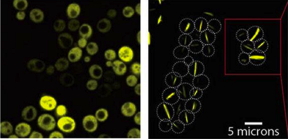 |
| Yeast cells producing a bacterial symmetric protein complex with eight units. When it is not mutated (left), the complex diffuses freely inside the cell, but a single mutation (right) triggers its assembly into long filaments. CREDIT Weizmann Institute of Science |
Abstract:
When hemoglobin undergoes just one mutation, these protein complexes stick to one another, stacking like Lego blocks to form long, stiff filaments. These filaments, in turn, elongate the red blood cells found in sickle-cell disease. For over 50 years, this has been the only known textbook example in which a mutation causes such filaments to form. According to Dr. Emmanuel Levy and his group in the Weizmann Institute of Science's Structural Biology Department, Lego-like assemblies should have formed relatively frequently during evolution. Could this assembly method be common, or even easy to reproduce? Their answer, which was recently published in Nature, may have implications for both biological research and nanoscience.
Lego proteins revealed: Self-assembling protein complexes based on a single mutation could provide scaffolding for nanostructures
Rehovot, Israel | Posted on August 23rd, 2017Hemoglobin and a fair number of other protein complexes are symmetric: made of identical units. And since identical units are produced from the same gene, each genetic mutation is repeated multiple times in the complex. Mutations that create sticky patches and are repeated on opposite sides of the complex can induce the proteins to stack into long protein fibers. Unlike amyloid-like protein fibers, the complexes in these stacks do not change shape or unfold in order to assemble.
The stickiness occurs because the mutation substitutes an amino acid that is normally hydrophilic -- "water-loving" -- with one that is hydrophobic -- "water-hating." In the watery environment in which proteins move, the hydrophobic regions on those proteins prefer to interact with one another, like foam bubbles in water.
In their experiments, Levy and his group, including Hector Garcia-Seisdedos, Charly Empereur-Mot (who is now at Conservatoire National des Arts et Métiers in Paris) and Nadav Elad of the Weizmann Institute's Chemical Research Support Department, began with an ultra-symmetric protein complex made up of eight identical units. They followed just one rule for mutating the proteins: Switch a hydrophilic amino acid with a hydrophobic, "sticky," one.
The team initially created proteins with three mutations to two different sticky amino acids and observed Lego-like self-assembly in both cases. Investigating further, the team experimented with each mutation individually and found that one was capable, on its own, of producing the long filaments.
So, are mutations that only do one thing -- increase the stickiness of the protein's surface -- likely to induce Lego-like self-assembly? The researchers mutated 11 additional proteins known to form symmetric complexes - creating 73 different mutations in all -- and produced them in baker's yeast cells, adding a fluorescent protein "label" to enable their visualization. In 30 of these variations, the researchers observed behavior that suggested self-assembly: Around half of these had stacked into long filaments, while the other half were bunched together in a more amorphous way, forming "foci."
If the researchers reproduced the phenomenon of sickle-cell filaments so easily in the lab, why is it not seen more in biomedical research? Levy proposes two answers: Firstly, the team revealed that naturally symmetric proteins evolved to have extra hydrophilic amino acids on their surfaces, thus minimizing the risk of self-assembly. Secondly, says Levy, researchers probably see more Lego assemblies than they think: "Now that researchers know they can evolve so readily, they may look at foci more carefully and see many more biologically relevant Lego-like assemblies."
"Also," he adds, "the filaments are produced so easily in the yeast, they could be good candidates for the scaffolding of nanostructures. Our study was unique in that it did not require complex computational design, nor did we have to scan thousands of mutations to find the one we wanted. We simply started with an existing structure and found a simple strategy to induce the assembly of filaments."
###
Dr. Emmanuel Levy's research is supported by the David and Fela Shapell Family Foundation INCPM Fund for Preclinical Studies; the Henry Chanoch Krenter Institute for Biomedical Imaging and Genomics; the Louis and Fannie Tolz Collaborative Research Project; the Richard Bar Laboratory; and Anne-Marie Boucher, Canada. Dr. Levy is the incumbent of the Recanati Career Development Chair of Cancer Research in Perpetuity.
####
About Weizmann Institute of Science
The Weizmann Institute of Science in Rehovot, Israel, is one of the world's top-ranking multidisciplinary research institutions. Noted for its wide-ranging exploration of the natural and exact sciences, the Institute is home to scientists, students, technicians and supporting staff. Institute research efforts include the search for new ways of fighting disease and hunger, examining leading questions in mathematics and computer science, probing the physics of matter and the universe, creating novel materials and developing new strategies for protecting the environment.
For more information, please click here
Contacts:
Gizel Maimon
972-893-43856
Copyright © Weizmann Institute of Science
If you have a comment, please Contact us.Issuers of news releases, not 7th Wave, Inc. or Nanotechnology Now, are solely responsible for the accuracy of the content.
Bookmark:


| Related News Press |
News and information
 Quantum computer improves AI predictions April 17th, 2026
Flexible sensor gains sensitivity under pressure April 17th, 2026
A reusable chip for particulate matter sensing April 17th, 2026
Detecting vibrational quantum beating in the predissociation dynamics of SF6 using time-resolved photoelectron spectroscopy April 17th, 2026
Possible Futures
A fundamentally new therapeutic approach to cystic fibrosis: Nanobody repairs cellular defect April 17th, 2026
UC Irvine physicists discover method to reverse ‘quantum scrambling’ : The work addresses the problem of information loss in quantum computing system April 17th, 2026
Nanomedicine
A fundamentally new therapeutic approach to cystic fibrosis: Nanobody repairs cellular defect April 17th, 2026
New molecular technology targets tumors and simultaneously silences two ‘undruggable’ cancer genes August 8th, 2025
New imaging approach transforms study of bacterial biofilms August 8th, 2025
Electrifying results shed light on graphene foam as a potential material for lab grown cartilage June 6th, 2025
Discoveries
Quantum computer improves AI predictions April 17th, 2026
Flexible sensor gains sensitivity under pressure April 17th, 2026
A reusable chip for particulate matter sensing April 17th, 2026
Detecting vibrational quantum beating in the predissociation dynamics of SF6 using time-resolved photoelectron spectroscopy April 17th, 2026
Materials/Metamaterials/Magnetoresistance
First real-time observation of two-dimensional melting process: Researchers at Mainz University unveil new insights into magnetic vortex structures August 8th, 2025
Researchers unveil a groundbreaking clay-based solution to capture carbon dioxide and combat climate change June 6th, 2025
A 1960s idea inspires NBI researchers to study hitherto inaccessible quantum states June 6th, 2025
Institute for Nanoscience hosts annual proposal planning meeting May 16th, 2025
Announcements
A fundamentally new therapeutic approach to cystic fibrosis: Nanobody repairs cellular defect April 17th, 2026
UC Irvine physicists discover method to reverse ‘quantum scrambling’ : The work addresses the problem of information loss in quantum computing system April 17th, 2026
Interviews/Book Reviews/Essays/Reports/Podcasts/Journals/White papers/Posters
A fundamentally new therapeutic approach to cystic fibrosis: Nanobody repairs cellular defect April 17th, 2026
UC Irvine physicists discover method to reverse ‘quantum scrambling’ : The work addresses the problem of information loss in quantum computing system April 17th, 2026
Grants/Sponsored Research/Awards/Scholarships/Gifts/Contests/Honors/Records
Quantum computer improves AI predictions April 17th, 2026
Detecting vibrational quantum beating in the predissociation dynamics of SF6 using time-resolved photoelectron spectroscopy April 17th, 2026
Metasurfaces smooth light to boost magnetic sensing precision January 30th, 2026
Nanobiotechnology
A fundamentally new therapeutic approach to cystic fibrosis: Nanobody repairs cellular defect April 17th, 2026
New molecular technology targets tumors and simultaneously silences two ‘undruggable’ cancer genes August 8th, 2025
New imaging approach transforms study of bacterial biofilms August 8th, 2025
Electrifying results shed light on graphene foam as a potential material for lab grown cartilage June 6th, 2025
Research partnerships
Lab to industry: InSe wafer-scale breakthrough for future electronics August 8th, 2025
HKU physicists uncover hidden order in the quantum world through deconfined quantum critical points April 25th, 2025
 |
||
 |
||
| The latest news from around the world, FREE | ||
 |
||
|
|
||
| Premium Products | ||
 |
||
|
Only the news you want to read!
Learn More |
||
 |
||
|
Full-service, expert consulting
Learn More |
||
|
|
||