Home > Press > Landscapes give latitude to 2-D material designers: Rice University, Oak Ridge scientists show growing atom-thin sheets on cones allows control of defects
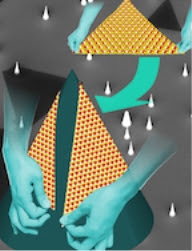 |
| Two-dimensional materials grown onto a cone allow control over where defects called grain boundaries appear. These defects can be used to enhance the materials' useful properties. (Credit: Yakobson Research Group/Rice University) |
Abstract:
Rice University researchers have learned to manipulate two-dimensional materials to design in defects that enhance the materials' properties.
Landscapes give latitude to 2-D material designers: Rice University, Oak Ridge scientists show growing atom-thin sheets on cones allows control of defects
Houston, TX | Posted on August 9th, 2017The Rice lab of theoretical physicist Boris Yakobson and colleagues at Oak Ridge National Laboratory are combining theory and experimentation to prove it’s possible to give 2-D materials specific defects, especially atomic-scale seams called grain boundaries. These boundaries may be used to enhance the materials' electronic, magnetic, mechanical, catalytic and optical properties.
The key is introducing curvature to the landscape that constrains the way defects propagate. The researchers call this "tilt grain boundary topology," and they achieve it by growing their materials onto a topographically curved substrate -- in this case, a cone. The angle of the cone dictates if, what kind and where the boundaries appear.
The research is the subject of a paper in the American Chemical Society journal ACS Nano.
Grain boundaries are the borders that appear in a material where edges meet in a mismatch. These boundaries are a series of defects; for example, when two sheets of hexagonal graphene meet at an angle, the carbon atoms compensate for it by forming nonhexagonal (five- or seven-member) rings.
Yakobson and his team have already demonstrated that these boundaries can be electronically significant. They can, for instance, turn perfectly conducting graphene into a semiconductor. In some cases, the boundary itself may be a conductive subnanoscale wire or take on magnetic properties.
But until now researchers had little control over where those boundaries would appear when growing graphene, molybdenum disulfide or other 2-D materials by chemical vapor deposition.
The theory developed at Rice showed growing 2-D material on a cone would force the boundaries to appear in certain places. The width of the cone controlled the placement and, more importantly, the tilt angle, a crucial parameter in tuning the materials' electronic and magnetic properties, Yakobson said.
Experimental collaborators from Oak Ridge led by co-author David Geohegan provided evidence backing key aspects of the theory. They achieved this by growing tungsten disulfide onto small cones similar to those in Rice's computer models. The boundaries that appeared in the real materials matched those predicted by theory.
"The nonplanar shape of the substrate forces the 2-D crystal to grow in a curved 'non-Euclidian' space," Yakobson said. "This strains the crystal, which occasionally yields by giving a way to the seams, or grain boundaries. It's no different from the way a tailor would add a seam to a suit or a dress to fit a curvy customer."
Modeling cones of different widths also revealed a "magic cone" of 38.9 degrees upon which growing a 2-D material would leave no grain boundary at all.
The Rice team extended its theory to see what would happen if the cones sat on a plane. They predicted how grain boundaries would form over the entire surface, and again, Oak Ridge experiments confirmed their results.
Yakobson said both the Rice and Oak Ridge teams were working on aspects of the research independently. "It was slow going until we met at a conference in Florida a couple of years back and realized that we should continue together," he said. "It was certainly gratifying to see how experiments confirmed the models, while sometimes offering important surprises. Now we need to do the additional work to comprehend them as well."
Rice graduate students Henry Yu and Nitant Gupta are co-lead authors of the paper. Co-authors are former Rice postdoctoral researcher Zhili Hu, now at Nanjing University of Aeronautics and Astronautics, and researchers Kai Wang, Bernadeta Srijanto and Kai Xiao of Oak Ridge National Laboratory. Geohegan is the functional hybrid nanomaterials group leader at Oak Ridge's Center for Nanophase Materials Sciences. Yakobson is the Karl F. Hasselmann Professor of Materials Science and NanoEngineering and a professor of chemistry.
The U.S. Department of Energy Basic Energy Sciences and its Center for Nanophase Materials Sciences and the Office of Naval Research supported the research.
Computer resources were provided by the Night Owls Time-Sharing Service and its National Science Foundation-supported DAVinCI supercomputer, both administered by Rice’s Center for Research Computing; the resources were procured in partnership with Rice’s Ken Kennedy Institute for Information Technology.
####
About Rice University
Located on a 300-acre forested campus in Houston, Rice University is consistently ranked among the nation’s top 20 universities by U.S. News & World Report. Rice has highly respected schools of Architecture, Business, Continuing Studies, Engineering, Humanities, Music, Natural Sciences and Social Sciences and is home to the Baker Institute for Public Policy. With 3,879 undergraduates and 2,861 graduate students, Rice’s undergraduate student-to-faculty ratio is 6-to-1. Its residential college system builds close-knit communities and lifelong friendships, just one reason why Rice is ranked No. 1 for happiest students and for lots of race/class interaction by the Princeton Review. Rice is also rated as a best value among private universities by Kiplinger’s Personal Finance. To read “What they’re saying about Rice,” go to http://tinyurl.com/RiceUniversityoverview .
Follow Rice News and Media Relations via Twitter @RiceUNews
For more information, please click here
Contacts:
Jeff Falk
713-348-6775
Mike Williams
713-348-6728
Copyright © Rice University
If you have a comment, please Contact us.Issuers of news releases, not 7th Wave, Inc. or Nanotechnology Now, are solely responsible for the accuracy of the content.
Bookmark:


| Related Links |
 Rice University Materials Science and NanoEngineering:
| Related News Press |
News and information
Quantum computer improves AI predictions April 17th, 2026
Flexible sensor gains sensitivity under pressure April 17th, 2026
A reusable chip for particulate matter sensing April 17th, 2026
Detecting vibrational quantum beating in the predissociation dynamics of SF6 using time-resolved photoelectron spectroscopy April 17th, 2026
2 Dimensional Materials
Flexible sensor gains sensitivity under pressure April 17th, 2026
ICFO researchers overcome long-standing bottleneck in single photon detection with twisted 2D materials August 8th, 2025
First real-time observation of two-dimensional melting process: Researchers at Mainz University unveil new insights into magnetic vortex structures August 8th, 2025
Lab to industry: InSe wafer-scale breakthrough for future electronics August 8th, 2025
Laboratories
Researchers develop molecular qubits that communicate at telecom frequencies October 3rd, 2025
Govt.-Legislation/Regulation/Funding/Policy
Quantum computer improves AI predictions April 17th, 2026
Metasurfaces smooth light to boost magnetic sensing precision January 30th, 2026
New imaging approach transforms study of bacterial biofilms August 8th, 2025
Possible Futures
A fundamentally new therapeutic approach to cystic fibrosis: Nanobody repairs cellular defect April 17th, 2026
UC Irvine physicists discover method to reverse ‘quantum scrambling’ : The work addresses the problem of information loss in quantum computing system April 17th, 2026
Discoveries
Quantum computer improves AI predictions April 17th, 2026
Flexible sensor gains sensitivity under pressure April 17th, 2026
A reusable chip for particulate matter sensing April 17th, 2026
Detecting vibrational quantum beating in the predissociation dynamics of SF6 using time-resolved photoelectron spectroscopy April 17th, 2026
Materials/Metamaterials/Magnetoresistance
First real-time observation of two-dimensional melting process: Researchers at Mainz University unveil new insights into magnetic vortex structures August 8th, 2025
Researchers unveil a groundbreaking clay-based solution to capture carbon dioxide and combat climate change June 6th, 2025
A 1960s idea inspires NBI researchers to study hitherto inaccessible quantum states June 6th, 2025
Institute for Nanoscience hosts annual proposal planning meeting May 16th, 2025
Announcements
A fundamentally new therapeutic approach to cystic fibrosis: Nanobody repairs cellular defect April 17th, 2026
UC Irvine physicists discover method to reverse ‘quantum scrambling’ : The work addresses the problem of information loss in quantum computing system April 17th, 2026
Interviews/Book Reviews/Essays/Reports/Podcasts/Journals/White papers/Posters
A fundamentally new therapeutic approach to cystic fibrosis: Nanobody repairs cellular defect April 17th, 2026
UC Irvine physicists discover method to reverse ‘quantum scrambling’ : The work addresses the problem of information loss in quantum computing system April 17th, 2026
Military
Quantum engineers ‘squeeze’ laser frequency combs to make more sensitive gas sensors January 17th, 2025
Chainmail-like material could be the future of armor: First 2D mechanically interlocked polymer exhibits exceptional flexibility and strength January 17th, 2025
Single atoms show their true color July 5th, 2024
NRL charters Navy’s quantum inertial navigation path to reduce drift April 5th, 2024
Grants/Sponsored Research/Awards/Scholarships/Gifts/Contests/Honors/Records
Quantum computer improves AI predictions April 17th, 2026
Detecting vibrational quantum beating in the predissociation dynamics of SF6 using time-resolved photoelectron spectroscopy April 17th, 2026
Metasurfaces smooth light to boost magnetic sensing precision January 30th, 2026
 |
||
 |
||
| The latest news from around the world, FREE | ||
 |
||
|
|
||
| Premium Products | ||
 |
||
|
Only the news you want to read!
Learn More |
||
 |
||
|
Full-service, expert consulting
Learn More |
||
|
|
||