Home > Press > JPK reports on how the University of Glasgow is using their NanoWizard® AFM and CellHesion module to study how cells interact with their surroundings
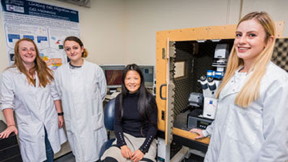 |
| Professor Huabing Yin (seated) and her students with their JPK NanoWizard® AFM with the CellHesion® module at the University of Glasgow. |
Abstract:
JPK Instruments, a world-leading manufacturer of nanoanalytic instrumentation for research in life sciences and soft matter, is pleased to report on the Yin group in the Division of Biomedical Engineering at the University of Glasgow. They are studying cells and how they react with their surroundings using JPK's NanoWizard® AFM and CellHesion® module.
JPK reports on how the University of Glasgow is using their NanoWizard® AFM and CellHesion module to study how cells interact with their surroundings
Berlin, Germany | Posted on August 2nd, 2017Professor Huabing Yin is a senior lecturer in the Division of Biomedical Engineering at the University of Glasgow. Her research aims to understand how a cell interacts with its surroundings at the microscale level since this process is fundamental to a vast number of applications in health care. “We take a multidisciplinary approach, developing technologies to study cells in well-controlled microenvironments that resemble key features in their native habitats. Our research converges on micro-/nanofabrication, microfluidics, and advanced microscopic and spectroscopy technologies. These allow us to develop various integrated approaches for single cell analysis, linking biological function with chemistry and the physics of a cell.”
Professor Yin describes her work with JPK's NanoWizard® AFM. “We use our AFM to quantify physical and mechanical properties (e.g. stiffness, viscoelasticity) of cells and their associated extracellular matrix. These properties are closely linked with cell functions in physiological (e.g. growth, differentiation; McPhee et al 2010) and pathological conditions. In collaboration with scientists in the Beatson Cancer Institute, we have shown the roles of cell stiffness (Cameron et al 2015) and extracellular matrix (Hernandez-Fernaud et al 2017) in cancer invasion. We also use our CellHesion® module to quantify the interaction between living cells and extracellular matrix. This offers a great capability for dynamic monitoring of cell-matrix interaction with nanoscale resolution.”
The NanoWizard® has been particularly flexible for integration with other techniques. Professor Yin continues: “We have used various optical microscopic and spectroscopic techniques (such as Raman). We combine some of them, in particularly, fluorescence and TIRF imaging with AFM. This significantly enhances our ability to associate biological activity with the physics of cells. The JPK system is very reliable and easy to use. Our NanoWizard® AFM has been used intensively for over ten years and it has never let us down.”
For more details about JPK's AFM systems and their applications for the materials, life & nano sciences, please contact JPK on +49 30726243 500. Alternatively, please visit the web site: http://www.jpk.com/ or see more on Facebook: www.jpk.com/facebook and on You Tube: http://www.youtube.com/jpkinstruments .
References
McPhee G, Dalby MJ, Riehle M, Yin HB (2010). Can common adhesion molecules and microtopography affect cellular elasticity? A combined atomic force microscopy and optical study. Medical & Biological Engineering & Computing 48: 1043-1053.
Cameron JM, Gabrielsen M, Chim YH, Munro J, McGhee EJ, Sumpton D et al (2015). Polarized Cell Motility Induces Hydrogen Peroxide to Inhibit Cofilin via Cysteine Oxidation. Current Biology 25: 1520-1525.
Hernandez-Fernaud JR, Ruengeler E, Casazza A, Neilson LJ, Pulleine E, Santi A et al (2017). Secreted CLIC3 drives cancer progression through its glutathione-dependent oxidoreductase activity. Nat Commun 8: 17.
####
About JPK Instruments
JPK Instruments AG is a world-leading manufacturer of nanoanalytic instruments - particularly atomic force microscope (AFM) systems and optical tweezers - for a broad range of applications reaching from soft matter physics to nano-optics, from surface chemistry to cell and molecular biology. From its earliest days applying atomic force microscope (AFM) technology, JPK has recognized the opportunities provided by nanotechnology for transforming life sciences and soft matter research. This focus has driven JPK's success in uniting the worlds of nanotechnology tools and life science applications by offering cutting-edge technology and unique applications expertise. Headquartered in Berlin and with direct operations in Dresden, Cambridge (UK), Singapore, Tokyo, Shanghai (China), Paris (France) and Carpinteria (USA), JPK maintains a global network of distributors and support centers and provides on the spot applications and service support to an ever-growing community of researchers.
For more information, please click here
Contacts:
JPK Instruments AG
Colditzstrasse 34-36
Haus 13, Eingang B
Berlin 12099
Germany
T +49 30726243 500
F +49 30726243 999
http://www.jpk.com/
Talking Science Limited
39 de Bohun Court
Saffron Walden
Essex CB10 2BA UK
T +44(0)1799 521881
M +44(0)7843 012997
www.talking-science.com.
Copyright © JPK Instruments
If you have a comment, please Contact us.Issuers of news releases, not 7th Wave, Inc. or Nanotechnology Now, are solely responsible for the accuracy of the content.
Bookmark:


| Related News Press |
News and information
 Quantum computer improves AI predictions April 17th, 2026
Flexible sensor gains sensitivity under pressure April 17th, 2026
A reusable chip for particulate matter sensing April 17th, 2026
Detecting vibrational quantum beating in the predissociation dynamics of SF6 using time-resolved photoelectron spectroscopy April 17th, 2026
Imaging
Simple algorithm paired with standard imaging tool could predict failure in lithium metal batteries August 8th, 2025
Nanomedicine
A fundamentally new therapeutic approach to cystic fibrosis: Nanobody repairs cellular defect April 17th, 2026
New molecular technology targets tumors and simultaneously silences two ‘undruggable’ cancer genes August 8th, 2025
New imaging approach transforms study of bacterial biofilms August 8th, 2025
Electrifying results shed light on graphene foam as a potential material for lab grown cartilage June 6th, 2025
Discoveries
Quantum computer improves AI predictions April 17th, 2026
Flexible sensor gains sensitivity under pressure April 17th, 2026
A reusable chip for particulate matter sensing April 17th, 2026
Detecting vibrational quantum beating in the predissociation dynamics of SF6 using time-resolved photoelectron spectroscopy April 17th, 2026
Announcements
A fundamentally new therapeutic approach to cystic fibrosis: Nanobody repairs cellular defect April 17th, 2026
UC Irvine physicists discover method to reverse ‘quantum scrambling’ : The work addresses the problem of information loss in quantum computing system April 17th, 2026
Interviews/Book Reviews/Essays/Reports/Podcasts/Journals/White papers/Posters
A fundamentally new therapeutic approach to cystic fibrosis: Nanobody repairs cellular defect April 17th, 2026
UC Irvine physicists discover method to reverse ‘quantum scrambling’ : The work addresses the problem of information loss in quantum computing system April 17th, 2026
Tools
Metasurfaces smooth light to boost magnetic sensing precision January 30th, 2026
From sensors to smart systems: the rise of AI-driven photonic noses January 30th, 2026
Japan launches fully domestically produced quantum computer: Expo visitors to experience quantum computing firsthand August 8th, 2025
Nanobiotechnology
A fundamentally new therapeutic approach to cystic fibrosis: Nanobody repairs cellular defect April 17th, 2026
New molecular technology targets tumors and simultaneously silences two ‘undruggable’ cancer genes August 8th, 2025
New imaging approach transforms study of bacterial biofilms August 8th, 2025
Electrifying results shed light on graphene foam as a potential material for lab grown cartilage June 6th, 2025
 |
||
 |
||
| The latest news from around the world, FREE | ||
 |
||
|
|
||
| Premium Products | ||
 |
||
|
Only the news you want to read!
Learn More |
||
 |
||
|
Full-service, expert consulting
Learn More |
||
|
|
||