Home > Press > CCNY physicists demonstrate photonic hypercrystals for control of light-matter interaction
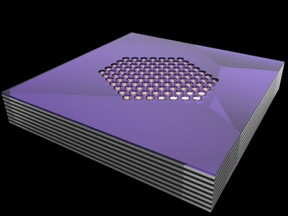 |
| Image of photonic hypercrystals courtesy of Tal Galfsky |
Abstract:
Control of light-matter interaction is central to fundamental phenomena and technologies such as photosynthesis, lasers, LEDs and solar cells. City College of New York researchers have now demonstrated a new class of artificial media called photonic hypercrystals that can control light-matter interaction in unprecedented ways.
CCNY physicists demonstrate photonic hypercrystals for control of light-matter interaction
New York, NY | Posted on May 5th, 2017This could lead to such benefits as ultrafast LEDs for Li-Fi (a wireless technology that transmits high-speed data using visible light communication), enhanced absorption in solar cells and the development of single photon emitters for quantum information processing, said Vinod M. Menon, professor of physics in City College's Division of Science who led the research.
Photonic crystals and metamaterials are two of the most well-known artificial materials used to manipulate light. However, they suffer from drawbacks such as bandwidth limitation and poor light emission. In their research, Menon and his team overcame these drawbacks by developing hypercrystals that take on the best of both photonic crystals and metamaterials and do even better. They demonstrated significant increase in both light emission rate and intensity from nanomaterials embedded inside the hypercrystals.
The emergent properties of the hypercrystals arise from the unique combination of length scales of the features in the hypercrystal as well as the inherent properties of the nanoscale structures.
The CCNY research appears in the latest issue of the Proceedings of the National Academy of Sciences. The team included graduate students Tal Galfsky and Jie Gu from Menon's research group in CCNY's Physics Department and Evgenii Narimanov (Purdue University), who first theoretically predicted the hypercrystals. The research was supported by the Army Research Office, the National Science Foundation - Division of Materials Research MRSEC program, and the Gordon and Betty Moore Foundation.
####
For more information, please click here
Contacts:
Jay Mwamba
212-650-7580
Copyright © City College of New York
If you have a comment, please Contact us.Issuers of news releases, not 7th Wave, Inc. or Nanotechnology Now, are solely responsible for the accuracy of the content.
Bookmark:


| Related News Press |
News and information
 Quantum computer improves AI predictions April 17th, 2026
Flexible sensor gains sensitivity under pressure April 17th, 2026
A reusable chip for particulate matter sensing April 17th, 2026
Detecting vibrational quantum beating in the predissociation dynamics of SF6 using time-resolved photoelectron spectroscopy April 17th, 2026
Display technology/LEDs/SS Lighting/OLEDs
Spinel-type sulfide semiconductors to operate the next-generation LEDs and solar cells For solar-cell absorbers and green-LED source October 3rd, 2025
Efficient and stable hybrid perovskite-organic light-emitting diodes with external quantum efficiency exceeding 40 per cent July 5th, 2024
Wireless/telecommunications/RF/Antennas/Microwaves
Researchers develop molecular qubits that communicate at telecom frequencies October 3rd, 2025
Possible Futures
A fundamentally new therapeutic approach to cystic fibrosis: Nanobody repairs cellular defect April 17th, 2026
UC Irvine physicists discover method to reverse ‘quantum scrambling’ : The work addresses the problem of information loss in quantum computing system April 17th, 2026
Chip Technology
A reusable chip for particulate matter sensing April 17th, 2026
Metasurfaces smooth light to boost magnetic sensing precision January 30th, 2026
Optical computing/Photonic computing
ICFO researchers overcome long-standing bottleneck in single photon detection with twisted 2D materials August 8th, 2025
Programmable electron-induced color router array May 14th, 2025
Discoveries
Quantum computer improves AI predictions April 17th, 2026
Flexible sensor gains sensitivity under pressure April 17th, 2026
A reusable chip for particulate matter sensing April 17th, 2026
Detecting vibrational quantum beating in the predissociation dynamics of SF6 using time-resolved photoelectron spectroscopy April 17th, 2026
Materials/Metamaterials/Magnetoresistance
First real-time observation of two-dimensional melting process: Researchers at Mainz University unveil new insights into magnetic vortex structures August 8th, 2025
Researchers unveil a groundbreaking clay-based solution to capture carbon dioxide and combat climate change June 6th, 2025
A 1960s idea inspires NBI researchers to study hitherto inaccessible quantum states June 6th, 2025
Institute for Nanoscience hosts annual proposal planning meeting May 16th, 2025
Announcements
A fundamentally new therapeutic approach to cystic fibrosis: Nanobody repairs cellular defect April 17th, 2026
UC Irvine physicists discover method to reverse ‘quantum scrambling’ : The work addresses the problem of information loss in quantum computing system April 17th, 2026
Interviews/Book Reviews/Essays/Reports/Podcasts/Journals/White papers/Posters
A fundamentally new therapeutic approach to cystic fibrosis: Nanobody repairs cellular defect April 17th, 2026
UC Irvine physicists discover method to reverse ‘quantum scrambling’ : The work addresses the problem of information loss in quantum computing system April 17th, 2026
Energy
Sensors innovations for smart lithium-based batteries: advancements, opportunities, and potential challenges August 8th, 2025
Simple algorithm paired with standard imaging tool could predict failure in lithium metal batteries August 8th, 2025
Photonics/Optics/Lasers
Metasurfaces smooth light to boost magnetic sensing precision January 30th, 2026
From sensors to smart systems: the rise of AI-driven photonic noses January 30th, 2026
Research partnerships
Lab to industry: InSe wafer-scale breakthrough for future electronics August 8th, 2025
HKU physicists uncover hidden order in the quantum world through deconfined quantum critical points April 25th, 2025
 |
||
 |
||
| The latest news from around the world, FREE | ||
 |
||
|
|
||
| Premium Products | ||
 |
||
|
Only the news you want to read!
Learn More |
||
 |
||
|
Full-service, expert consulting
Learn More |
||
|
|
||