Home > Press > JPK reports on the use of STM to study surface plasmons in the Molecular Science Group at ISMO – Institut des Sciences Moléculaires d’Orsay
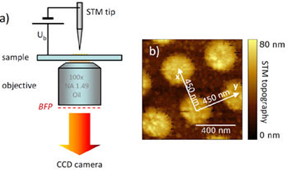 |
| STM plasmonic crystal: Schematic of the experiment and STM image of sample – a gold nanoparticle array (article Optics Express, 4, 26186 (2016)) |
Abstract:
JPK Instruments, a world-leading manufacturer of nanoanalytic instrumentation for research in life sciences and soft matter, reports on how STM is being used to study surface plasmons in the Molecular Nanoscience Group at ISMO – Institut des Sciences Moléculaires d’Orsay – CNRS and the Université Paris-Sud.
JPK reports on the use of STM to study surface plasmons in the Molecular Science Group at ISMO – Institut des Sciences Moléculaires d’Orsay
Berlin, Germany | Posted on February 8th, 2017One of the research goals of the Molecular Nanoscience Group at ISMO is to work towards circuits and devices in which surface plasmons (not electrons or photons) are used to transfer and manipulate information. However, why develop plasmonics when there are already solutions using electronics and photonics? Electronics has been extremely successful in the area of miniaturization, leading to computers which now fit in the palm of your hand. However, electronic devices are fundamentally limited in speed by the generation of heat. On the other hand, the use of photonics has successfully enabled fast data downloads from the Internet since optical fiber connections offer high bandwidth. Optical devices are also limited, this time in terms of size, due to the diffraction limit of light. The goal of this research group is the development of plasmonics which combines the advantages of electronics and photonics, thus producing miniaturized, high bandwidth circuits and devices which use surface plasmons. To bring this to a commercial reality, a local, low energy electrical source of surface plasmon polaritons is required.
For this research program to develop, group leader, Dr Elizabeth Boer-Duchemin takes up the story. “We propose to use an electrically biased tunnel junction as this local electrical plasmon source, and as a prototype, we consider the tunnel junction formed between the tip of a scanning tunneling microscope and a metallic sample. We chose to work with JPK for a number of reasons. First and foremost, the fact that the JPK STM is easily mounted on an inverted optical microscope (for surface plasmon detection) is essential for us. The design of the tip-assisted-optics (TAO) stage makes it easy to move both tip and sample independently. In our experiments, we use the STM to excite surface plasmons. These then radiate as photons which is the emitted light that we finally detect. I would also like to thank the engineering team at JPK who were extremely helpful in the project. This is a very unusual application and they played a vital part in the writing of specialised scripts to enable the work.”
The Group has been very active in publishing papers on this work. In 2016, these included publications such as Nanotechnology,1 and Optics Express2.
For more details about JPK's STM and AFM systems and their applications for the materials & nano sciences, please contact JPK on +49 30726243 500. Alternatively, please visit the web site: www.jpk.com/ or see more on Facebook: www.jpk.com/facebook and on You Tube: www.youtube.com/jpkinstruments.
References
1 “The mechanism of light emission from a scanning tunnelling microscope operating in air”, B. Rogez, S. Cao, G. Dujardin, G. Comtet, E. Le Moal, A. Mayne and E. Boer-Duchemin, Nanotechnology, 27, 465201 (2016).
2 “Surface plasmon polariton beams from an electrically excited plasmonic crystal”, D Canneson, E Le Moal, S Cao, X Quelin, H Dallaporta, G Dujardin & Elizabeth Boer-Duchemin, Optics Express, 4, 26186 (2016)
####
About JPK Instruments
JPK Instruments AG is a world-leading manufacturer of nanoanalytic instruments - particularly atomic force microscope (AFM) systems and optical tweezers - for a broad range of applications reaching from soft matter physics to nano-optics, from surface chemistry to cell and molecular biology. From its earliest days applying atomic force microscope (AFM) technology, JPK has recognized the opportunities provided by nanotechnology for transforming life sciences and soft matter research. This focus has driven JPK's success in uniting the worlds of nanotechnology tools and life science applications by offering cutting-edge technology and unique applications expertise. Headquartered in Berlin and with direct operations in Dresden, Cambridge (UK), Singapore, Tokyo, Shanghai (China), Paris (France) and Carpinteria (USA), JPK maintains a global network of distributors and support centers and provides on the spot applications and service support to an ever-growing community of researchers.
For more information, please click here
Contacts:
JPK Instruments AG
Colditzstrasse 34-36
Haus 13, Eingang B
Berlin 12099
Germany
T +49 30726243 500
F +49 30726243 999
http://www.jpk.com/
Talking Science Limited
39 de Bohun Court
Saffron Walden
Essex CB10 2BA UK
T +44(0)1799 521881
M +44(0)7843 012997
www.talking-science.com.
Copyright © JPK Instruments
If you have a comment, please Contact us.Issuers of news releases, not 7th Wave, Inc. or Nanotechnology Now, are solely responsible for the accuracy of the content.
Bookmark:


| Related News Press |
News and information
 Quantum computer improves AI predictions April 17th, 2026
Flexible sensor gains sensitivity under pressure April 17th, 2026
A reusable chip for particulate matter sensing April 17th, 2026
Detecting vibrational quantum beating in the predissociation dynamics of SF6 using time-resolved photoelectron spectroscopy April 17th, 2026
Imaging
Simple algorithm paired with standard imaging tool could predict failure in lithium metal batteries August 8th, 2025
Discoveries
Quantum computer improves AI predictions April 17th, 2026
Flexible sensor gains sensitivity under pressure April 17th, 2026
A reusable chip for particulate matter sensing April 17th, 2026
Detecting vibrational quantum beating in the predissociation dynamics of SF6 using time-resolved photoelectron spectroscopy April 17th, 2026
Announcements
A fundamentally new therapeutic approach to cystic fibrosis: Nanobody repairs cellular defect April 17th, 2026
UC Irvine physicists discover method to reverse ‘quantum scrambling’ : The work addresses the problem of information loss in quantum computing system April 17th, 2026
Interviews/Book Reviews/Essays/Reports/Podcasts/Journals/White papers/Posters
A fundamentally new therapeutic approach to cystic fibrosis: Nanobody repairs cellular defect April 17th, 2026
UC Irvine physicists discover method to reverse ‘quantum scrambling’ : The work addresses the problem of information loss in quantum computing system April 17th, 2026
Tools
Metasurfaces smooth light to boost magnetic sensing precision January 30th, 2026
From sensors to smart systems: the rise of AI-driven photonic noses January 30th, 2026
Japan launches fully domestically produced quantum computer: Expo visitors to experience quantum computing firsthand August 8th, 2025
 |
||
 |
||
| The latest news from around the world, FREE | ||
 |
||
|
|
||
| Premium Products | ||
 |
||
|
Only the news you want to read!
Learn More |
||
 |
||
|
Full-service, expert consulting
Learn More |
||
|
|
||