Home > Press > Seeing the quantum future... literally: What if big data could help you see the future and prevent your mobile phone from breaking before it happened?
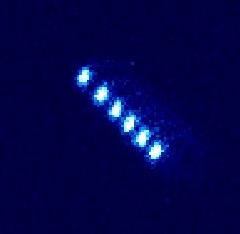 |
| Trapped Ytterbium ions were used as one of the most advanced laboratory quantum systems for this study. Professor Biercuk's research laboratories are now located in the Sydney Nanoscience Hub, after six years as a visiting scientist at the National Measurement Institute. CREDIT University of Sydney. |
Abstract:
Scientists at the University of Sydney have demonstrated the ability to "see" the future of quantum systems, and used that knowledge to preempt their demise, in a major achievement that could help bring the strange and powerful world of quantum technology closer to reality.
Seeing the quantum future... literally: What if big data could help you see the future and prevent your mobile phone from breaking before it happened?
Sydney, Australia | Posted on January 16th, 2017The applications of quantum-enabled technologies are compelling and already demonstrating significant impacts - especially in the realm of sensing and metrology. And the potential to build exceptionally powerful quantum computers using quantum bits, or qubits, is driving investment from the world's largest companies.
However a significant obstacle to building reliable quantum technologies has been the randomisation of quantum systems by their environments, or decoherence, which effectively destroys the useful quantum character.
The physicists have taken a technical quantum leap in addressing this, using techniques from big data to predict how quantum systems will change and then preventing the system's breakdown from occurring.
The research is published today in Nature Communications.
"Much the way the individual components in mobile phones will eventually fail, so too do quantum systems," said the paper's senior author Professor Michael J. Biercuk.
"But in quantum technology the lifetime is generally measured in fractions of a second, rather than years."
Professor Biercuk, from the University of Sydney's School of Physics and a chief investigator at the Australian Research Council's Centre for Engineered Quantum Systems, said his group had demonstrated it was possible to suppress decoherence in a preventive manner. The key was to develop a technique to predict how the system would disintegrate.
Professor Biercuk highlighted the challenges of making predictions in a quantum world: "Humans routinely employ predictive techniques in our daily experience; for instance, when we play tennis we predict where the ball will end up based on observations of the airborne ball," he said.
"This works because the rules that govern how the ball will move, like gravity, are regular and known. But what if the rules changed randomly while the ball was on its way to you? In that case it's next to impossible to predict the future behavior of that ball.
"And yet this situation is exactly what we had to deal with because the disintegration of quantum systems is random. Moreover, in the quantum realm observation erases quantumness, so our team needed to be able to guess how and when the system would randomly break.
"We effectively needed to swing at the randomly moving tennis ball while blindfolded."
The team turned to machine learning for help in keeping their quantum systems - qubits realised in trapped atoms - from breaking.
What might look like random behavior actually contained enough information for a computer program to guess how the system would change in the future. It could then predict the future without direct observation, which would otherwise erase the system's useful characteristics.
The predictions were remarkably accurate, allowing the team to use their guesses preemptively to compensate for the anticipated changes.
Doing this in real time allowed the team to prevent the disintegration of the quantum character, extending the useful lifetime of the qubits.
"We know that building real quantum technologies will require major advances in our ability to control and stabilise qubits - to make them useful in applications," Professor Biercuk said.
Our techniques apply to any qubit, built in any technology, including the special superconducting circuits being used by major corporations.
"We're excited to be developing new capabilities that turn quantum systems from novelties into useful technologies. The quantum future is looking better all the time," Professor Biercuk said.
####
For more information, please click here
Contacts:
Vivienne Reiner
61-438-021-390
Copyright © University of Sydney
If you have a comment, please Contact us.Issuers of news releases, not 7th Wave, Inc. or Nanotechnology Now, are solely responsible for the accuracy of the content.
Bookmark:


| Related Links |
| Related News Press |
News and information
 Quantum computer improves AI predictions April 17th, 2026
Flexible sensor gains sensitivity under pressure April 17th, 2026
A reusable chip for particulate matter sensing April 17th, 2026
Detecting vibrational quantum beating in the predissociation dynamics of SF6 using time-resolved photoelectron spectroscopy April 17th, 2026
Quantum Physics
Detecting vibrational quantum beating in the predissociation dynamics of SF6 using time-resolved photoelectron spectroscopy April 17th, 2026
Beyond silicon: Electronics at the scale of a single molecule January 30th, 2026
MXene nanomaterials enter a new dimension Multilayer nanomaterial: MXene flakes created at Drexel University show new promise as 1D scrolls January 30th, 2026
Physics
UC Irvine physicists discover method to reverse ‘quantum scrambling’ : The work addresses the problem of information loss in quantum computing system April 17th, 2026
Possible Futures
A fundamentally new therapeutic approach to cystic fibrosis: Nanobody repairs cellular defect April 17th, 2026
UC Irvine physicists discover method to reverse ‘quantum scrambling’ : The work addresses the problem of information loss in quantum computing system April 17th, 2026
Chip Technology
A reusable chip for particulate matter sensing April 17th, 2026
Metasurfaces smooth light to boost magnetic sensing precision January 30th, 2026
Quantum Computing
Quantum computer improves AI predictions April 17th, 2026
UC Irvine physicists discover method to reverse ‘quantum scrambling’ : The work addresses the problem of information loss in quantum computing system April 17th, 2026
Researchers develop molecular qubits that communicate at telecom frequencies October 3rd, 2025
Discoveries
Quantum computer improves AI predictions April 17th, 2026
Flexible sensor gains sensitivity under pressure April 17th, 2026
A reusable chip for particulate matter sensing April 17th, 2026
Detecting vibrational quantum beating in the predissociation dynamics of SF6 using time-resolved photoelectron spectroscopy April 17th, 2026
Announcements
A fundamentally new therapeutic approach to cystic fibrosis: Nanobody repairs cellular defect April 17th, 2026
UC Irvine physicists discover method to reverse ‘quantum scrambling’ : The work addresses the problem of information loss in quantum computing system April 17th, 2026
Interviews/Book Reviews/Essays/Reports/Podcasts/Journals/White papers/Posters
A fundamentally new therapeutic approach to cystic fibrosis: Nanobody repairs cellular defect April 17th, 2026
UC Irvine physicists discover method to reverse ‘quantum scrambling’ : The work addresses the problem of information loss in quantum computing system April 17th, 2026
 |
||
 |
||
| The latest news from around the world, FREE | ||
 |
||
|
|
||
| Premium Products | ||
 |
||
|
Only the news you want to read!
Learn More |
||
 |
||
|
Full-service, expert consulting
Learn More |
||
|
|
||