Home > Press > NIST Device for Detecting Subatomic-Scale Motion Has Potential Robotics, Homeland Security Applications
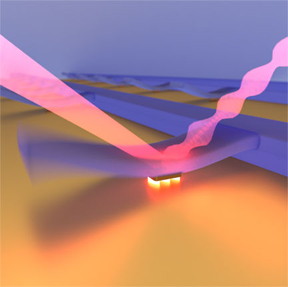 |
| Schematic shows laser light interacting with a plasmonic gap resonator, a miniature device designed at NIST to measure with unprecedented precision the nanoscale motions of nanoparticles. An incident laser beam (pink beam at left) strikes the resonator, which consists of two layers of gold separated by an air gap. The top gold layer is embedded in an array of tiny cantilevers (violet)—vibrating devices resembling a miniature diving board. When a cantilever moves, it changes the width of the air gap, which, in turn, changes the intensity of the laser light reflected from the resonator. The modulation of the light reveals the displacement of the tiny cantilever. Credit: NIST Center for Nanoscale Science and Technology |
Abstract:
Scientists at the National Institute of Standards and Technology (NIST) have developed a new device that measures the motion of super-tiny particles traversing distances almost unimaginably small—shorter than the diameter of a hydrogen atom, or less than one-millionth the width of a human hair. Not only can the handheld device sense the atomic-scale motion of its tiny parts with unprecedented precision, but the researchers have devised a method to mass produce the highly sensitive measuring tool.
NIST Device for Detecting Subatomic-Scale Motion Has Potential Robotics, Homeland Security Applications
Gaithersburg, MD | Posted on December 16th, 2016It’s relatively easy to measure small movements of large objects but much more difficult when the moving parts are on the scale of nanometers, or billionths of a meter. The ability to accurately measure tiny displacements of microscopic bodies has applications in sensing trace amounts of hazardous biological or chemical agents, perfecting the movement of miniature robots, accurately deploying airbags and detecting extremely weak sound waves traveling through thin films.
NIST physicists Brian Roxworthy and Vladimir Aksyuk describe their work (link is external) in the Dec. 6, 2016, Nature Communications.
The researchers measured subatomic-scale motion in a gold nanoparticle. They did this by engineering a small air gap, about 15 nanometers in width, between the gold nanoparticle and a gold sheet. This gap is so small that laser light cannot penetrate it.
However, the light energized surface plasmons—the collective, wave-like motion of groups of electrons confined to travel along the boundary between the gold surface and the air.
The researchers exploited the light’s wavelength, the distance between successive peaks of the light wave. With the right choice of wavelength, or equivalently, its frequency, the laser light causes plasmons of a particular frequency to oscillate back and forth, or resonate, along the gap, like the reverberations of a plucked guitar string. Meanwhile, as the nanoparticle moves, it changes the width of the gap and, like tuning a guitar string, changes the frequency at which the plasmons resonate.
The interaction between the laser light and the plasmons is critical for sensing tiny displacements from nanoscale particles, notes Aksyuk. Light can’t easily detect the location or motion of an object smaller than the wavelength of the laser, but converting the light to plasmons overcomes this limitation. Because the plasmons are confined to the tiny gap, they are more sensitive than light is for sensing the motion of small objects like the gold nanoparticle.
The amount of laser light reflected back from the plasmon device reveals the width of the gap and the motion of the nanoparticle. Suppose, for example, that the gap changes—due to the motion of the nanoparticle—in such a way that the natural frequency, or resonance, of the plasmons more closely matches the frequency of the laser light. In that case, the plasmons are able to absorb more energy from the laser light, and less light is reflected.
To use this motion-sensing technique in a practical device, Aksyuk and Roxworthy embedded the gold nanoparticle in a microscopic-scale mechanical structure—a vibrating cantilever, sort of a miniature diving board—that was a few micrometers long, made of silicon nitride. Even when they’re not set in motion, such devices never sit perfectly still, but vibrate at high frequency, jostled by the random motion of their molecules at room temperature. Even though the amplitude of the vibration was tiny—moving subatomic distances—it was easy to detect with the new plasmonic technique. Similar, though typically larger, mechanical structures are commonly used for both scientific measurements and practical sensors; for example, detecting motion and orientation in cars and smartphones. The NIST scientists hope their new way of measuring motion at the nanoscale will help to further miniaturize and improve performance of many such micromechanical systems.
“This architecture paves the way for advances in nanomechanical sensing,” the researchers write. “We can detect tiny motion more locally and precisely with these plasmonic resonators than any other way of doing it,” said Aksyuk.
The team’s fabrication approach allows production of some 25,000 of the devices on a computer chip, with each device tailored to detect motion according to the needs of the manufacturer.
Roxworthy and Aksyuk, the two authors of the new paper, work in NIST’s Center for Nanoscale Science and Technology (CNST).
####
For more information, please click here
Contacts:
Ben Stein
(link sends e-mail)
(301) 975-2763
Copyright © National Institute of Standards and Technology (NIST)
If you have a comment, please Contact us.Issuers of news releases, not 7th Wave, Inc. or Nanotechnology Now, are solely responsible for the accuracy of the content.
Bookmark:


| Related Links |
| Related News Press |
News and information
 Quantum computer improves AI predictions April 17th, 2026
Flexible sensor gains sensitivity under pressure April 17th, 2026
A reusable chip for particulate matter sensing April 17th, 2026
Detecting vibrational quantum beating in the predissociation dynamics of SF6 using time-resolved photoelectron spectroscopy April 17th, 2026
Laboratories
Researchers develop molecular qubits that communicate at telecom frequencies October 3rd, 2025
A battery’s hopping ions remember where they’ve been: Seen in atomic detail, the seemingly smooth flow of ions through a battery’s electrolyte is surprisingly complicated February 16th, 2024
Govt.-Legislation/Regulation/Funding/Policy
Quantum computer improves AI predictions April 17th, 2026
Metasurfaces smooth light to boost magnetic sensing precision January 30th, 2026
New imaging approach transforms study of bacterial biofilms August 8th, 2025
Possible Futures
A fundamentally new therapeutic approach to cystic fibrosis: Nanobody repairs cellular defect April 17th, 2026
UC Irvine physicists discover method to reverse ‘quantum scrambling’ : The work addresses the problem of information loss in quantum computing system April 17th, 2026
Optical computing/Photonic computing
ICFO researchers overcome long-standing bottleneck in single photon detection with twisted 2D materials August 8th, 2025
Programmable electron-induced color router array May 14th, 2025
Discoveries
Quantum computer improves AI predictions April 17th, 2026
Flexible sensor gains sensitivity under pressure April 17th, 2026
A reusable chip for particulate matter sensing April 17th, 2026
Detecting vibrational quantum beating in the predissociation dynamics of SF6 using time-resolved photoelectron spectroscopy April 17th, 2026
Announcements
A fundamentally new therapeutic approach to cystic fibrosis: Nanobody repairs cellular defect April 17th, 2026
UC Irvine physicists discover method to reverse ‘quantum scrambling’ : The work addresses the problem of information loss in quantum computing system April 17th, 2026
Interviews/Book Reviews/Essays/Reports/Podcasts/Journals/White papers/Posters
A fundamentally new therapeutic approach to cystic fibrosis: Nanobody repairs cellular defect April 17th, 2026
UC Irvine physicists discover method to reverse ‘quantum scrambling’ : The work addresses the problem of information loss in quantum computing system April 17th, 2026
Tools
Metasurfaces smooth light to boost magnetic sensing precision January 30th, 2026
From sensors to smart systems: the rise of AI-driven photonic noses January 30th, 2026
Japan launches fully domestically produced quantum computer: Expo visitors to experience quantum computing firsthand August 8th, 2025
Photonics/Optics/Lasers
Metasurfaces smooth light to boost magnetic sensing precision January 30th, 2026
From sensors to smart systems: the rise of AI-driven photonic noses January 30th, 2026
 |
||
 |
||
| The latest news from around the world, FREE | ||
 |
||
|
|
||
| Premium Products | ||
 |
||
|
Only the news you want to read!
Learn More |
||
 |
||
|
Full-service, expert consulting
Learn More |
||
|
|
||