Home > Press > Quantum obstacle course changes material from superconductor to insulator
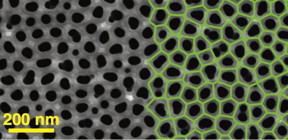 |
| Nanoscale defects in a superconducting material can interact with weak magnetic fields to put the brakes on superconducting electrons, new research shows. It's a demonstration of a phase change from superconducting to insulating that had been predicted in theory, but never before shown experimentally. CREDIT Valles Lab / Brown University |
Abstract:
Researchers from Brown University have demonstrated an unusual method of putting the brakes on superconductivity, the ability of a material to conduct an electrical current with zero resistance.
Quantum obstacle course changes material from superconductor to insulator
Providence, RI | Posted on December 1st, 2016The research shows that weak magnetic fields -- far weaker than those that normally interrupt superconductivity -- can interact with defects in a material to create a "random gauge field," a kind of quantum obstacle course that generates resistance for superconducting electrons.
"We're disrupting superconductivity in a way that people haven't done before," said Jim Valles, a professor of physics at Brown who directed the work. "This kind of phase transition involving a random gauge field had been predicted theoretically, but this is the first time it has been demonstrated in an experiment."
The research is published in the journal Scientific Reports.
The superconducting state depends on the formation and propagation of "Cooper pairs," coupled electrons that, at very low temperatures, behave more like waves than particles. Their wavelike property enables them to travel across the structure of a material without banging into atomic nuclei along way, reducing the resistance they encounter to zero. Cooper pairs are named for Leon Cooper, a Brown University physicist who shared the 1972 Nobel Prize in physics for explaining their behavior.
The bonds between paired electrons are not particularly strong. A small increase in temperature or the presence of a magnetic field with a strength above a critical value (the value varies a bit for different materials) can break the pairs apart, which in turn breaks the superconducting state.
But Valles and his colleagues were investigating a different method of destroying superconductivity. Instead of breaking the Cooper pairs apart, Valles's team wanted to see if they could disrupt the way in which the pairs propagate.
When a material is superconducting, Cooper pairs propagate "in phase," meaning the peaks and troughs of their quantum waves are correlated. Knocking the waves out of phase would render them unable to propagate in a way that would sustain the superconducting state, thereby converting the material to an insulator.
To demonstrate the phenomenon, Valles and his colleagues created small superconducting chips made of amorphous bismuth. The chips were made with nanoscale holes in them, arranged in a randomly repeating honeycomb-like pattern. The team then applied a weak magnetic field to the chips. Under normal circumstances, a superconductor will repel any magnetic field below a critical value and go right on superconducting. But the defects in the bismuth caused the material to repel the magnetic field in a peculiar way, forming tiny vortices of electrical current surrounding each hole.
To superconducting Cooper pairs, those vortices form a quantum obstacle course too difficult to cross. The current vortices push and pull on the wave fronts of passing Cooper pairs in random patterns, knocking the waves out of phase with each other.
"We're disrupting the coherent motion of the wave fronts," Valles said. "As a result the Cooper pairs become localized -- unable to propagate -- and the system goes from superconducting to insulating."
The research may help scientists understand the fundamental properties of superconducting materials -- in particular, how defects in those materials could interrupt superconductivity in certain situations. Understanding how these materials behave will be important as their use increases in applications like quantum computers, which will rely on consistent superconducting states.
"In technology, we're trying to eke more and more out of the quantum properties of materials, but those materials all have these messy impurities in them," Valles said. "We've shown the effects of a certain kind of quantum randomness in a superconductor that is driven by a magnetic field and random defects. So this work may be interesting for understanding what limitations there are in exploiting the quantum properties of materials."
Valles is hopeful that the findings and the technique described in the paper will lead to other fundamental advances.
"We can tune this phase shifter in a well-defined way that's straightforward to model, which can allow us to understand quantum phase transitions a little bit better," Valles said. "So in a sense, we've created a new knob we can twist to affect the properties of these materials and see how they react."
###
The work was led by Hung Nguyen, a former graduate student at Brown, and Shawna Hollen of the University of New Hampshire. Additional co-authors were Jeffrey Shainline (National Institute of Standards and Technology) and Jimmy Xu (Brown). The work was supported by the National Science Foundation (DMR-1307290, DMR-0907357), the Air Force Office of Scientific Research and the Asian Office of Aerospace Research and Development.
####
For more information, please click here
Contacts:
Kevin Stacey
401-863-3766
Copyright © Brown University
If you have a comment, please Contact us.Issuers of news releases, not 7th Wave, Inc. or Nanotechnology Now, are solely responsible for the accuracy of the content.
Bookmark:


| Related News Press |
News and information
 Quantum computer improves AI predictions April 17th, 2026
Flexible sensor gains sensitivity under pressure April 17th, 2026
A reusable chip for particulate matter sensing April 17th, 2026
Detecting vibrational quantum beating in the predissociation dynamics of SF6 using time-resolved photoelectron spectroscopy April 17th, 2026
Superconductivity
MXene nanomaterials enter a new dimension Multilayer nanomaterial: MXene flakes created at Drexel University show new promise as 1D scrolls January 30th, 2026
Magnetism/Magnons
Metasurfaces smooth light to boost magnetic sensing precision January 30th, 2026
Researchers develop molecular qubits that communicate at telecom frequencies October 3rd, 2025
Govt.-Legislation/Regulation/Funding/Policy
Quantum computer improves AI predictions April 17th, 2026
Metasurfaces smooth light to boost magnetic sensing precision January 30th, 2026
New imaging approach transforms study of bacterial biofilms August 8th, 2025
Possible Futures
A fundamentally new therapeutic approach to cystic fibrosis: Nanobody repairs cellular defect April 17th, 2026
UC Irvine physicists discover method to reverse ‘quantum scrambling’ : The work addresses the problem of information loss in quantum computing system April 17th, 2026
Chip Technology
A reusable chip for particulate matter sensing April 17th, 2026
Metasurfaces smooth light to boost magnetic sensing precision January 30th, 2026
Discoveries
Quantum computer improves AI predictions April 17th, 2026
Flexible sensor gains sensitivity under pressure April 17th, 2026
A reusable chip for particulate matter sensing April 17th, 2026
Detecting vibrational quantum beating in the predissociation dynamics of SF6 using time-resolved photoelectron spectroscopy April 17th, 2026
Announcements
A fundamentally new therapeutic approach to cystic fibrosis: Nanobody repairs cellular defect April 17th, 2026
UC Irvine physicists discover method to reverse ‘quantum scrambling’ : The work addresses the problem of information loss in quantum computing system April 17th, 2026
Interviews/Book Reviews/Essays/Reports/Podcasts/Journals/White papers/Posters
A fundamentally new therapeutic approach to cystic fibrosis: Nanobody repairs cellular defect April 17th, 2026
UC Irvine physicists discover method to reverse ‘quantum scrambling’ : The work addresses the problem of information loss in quantum computing system April 17th, 2026
Military
Quantum engineers ‘squeeze’ laser frequency combs to make more sensitive gas sensors January 17th, 2025
Chainmail-like material could be the future of armor: First 2D mechanically interlocked polymer exhibits exceptional flexibility and strength January 17th, 2025
Single atoms show their true color July 5th, 2024
NRL charters Navy’s quantum inertial navigation path to reduce drift April 5th, 2024
Grants/Sponsored Research/Awards/Scholarships/Gifts/Contests/Honors/Records
Quantum computer improves AI predictions April 17th, 2026
Detecting vibrational quantum beating in the predissociation dynamics of SF6 using time-resolved photoelectron spectroscopy April 17th, 2026
Metasurfaces smooth light to boost magnetic sensing precision January 30th, 2026
Research partnerships
Lab to industry: InSe wafer-scale breakthrough for future electronics August 8th, 2025
HKU physicists uncover hidden order in the quantum world through deconfined quantum critical points April 25th, 2025
 |
||
 |
||
| The latest news from around the world, FREE | ||
 |
||
|
|
||
| Premium Products | ||
 |
||
|
Only the news you want to read!
Learn More |
||
 |
||
|
Full-service, expert consulting
Learn More |
||
|
|
||