Home > Press > Precise quantum cloning: possible pathway to secure communication: Physicists create best ever quantum clones
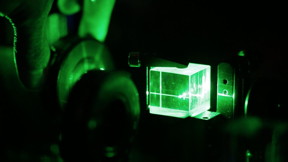 |
| Beam of light passing through splitter. CREDIT Lee Henderson/UNSW |
Abstract:
Physicists at The Australian National University (ANU) and University of Queensland (UQ) have produced near-perfect clones of quantum information using a new method to surpass previous cloning limits.
Precise quantum cloning: possible pathway to secure communication: Physicists create best ever quantum clones
Sydney, Australia | Posted on October 26th, 2016A global race is on to use quantum physics for ultra-secure encryption over long distances according to Prof Ping Koy Lam, node director of the ARC Centre of Excellence for Quantum Computation and Communication Technology (CQC2T) at ANU.
The new cloning method uses high performance optical amplifiers to clone light encoded with quantum information -- it is possible this technique could allow quantum encryption to be implemented with existing fibre optic infrastructure.
"One obstacle to sending quantum information is that the quantum state degrades before reaching its destination. Our cloner has many possible applications, and could help overcome this problem to achieve secure long distance communication," said Prof Lam.
The laws of physics -- in particular the 'No Cloning Theorem' -- prevent high quality clones being produced with a 100 percent success rate. The team, led by Prof Lam, uses a probabilistic method to demonstrate that it's possible to produce clones that exceed theoretical quality limits. The method was initially proposed by CQC2T researchers led by Prof Timothy Ralph at UQ.
"Imagine Olympic archers being able to choose the shots that land closest to the target's centre to increase their average score," said Prof Ralph.
"By designing our experiment to have probabilistic outputs, we sometimes 'get lucky' and recover more information than is possible using existing deterministic cloning methods. We use the results closest to a 'bullseye' and discard the rest," he said.
quantum information is that the probabilistic method is permitted, and is useful in many crypto-communication situations, such as generating secret keys.
"Our probabilistic cloning method generates higher quality quantum clones than have ever been made before, with a success rate of about 5 percent. We can now create up to five clones of a single quantum state," said lead author Jing Yan Haw, ANU PhD researcher.
"We first encode information onto a light beam. Because this information is in a fragile quantum state, it is difficult to observe or measure," said Haw.
"At the heart of the demonstration is a 'noiseless optical amplifier'. When the amplification is good enough, we can then split a light beam into clones. 'Amplify-then-split' allows us to clone the light beam with minimal distortion, so that it can still be read with exquisite precision," said Prof Ralph.
Quantum cloning opens up important experimental possibilities as well as having applications in ultra-secure long distance quantum networks.
"One of the problems with quantum encryption is its limited communication range. We hope this technology could be used to extend the range of communication, and one day lead to impenetrable privacy between two communicating parties," said Prof Lam.
This latest achievement follows the success of fellow CQC2T researchers at ANU, who last month were the first to demonstrate self-stabilising stationary light.
####
For more information, please click here
Contacts:
Kristin O'Connell
61-293-857-551
Copyright © Centre of Excellence for Quantum Computation and Communication Technology
If you have a comment, please Contact us.Issuers of news releases, not 7th Wave, Inc. or Nanotechnology Now, are solely responsible for the accuracy of the content.
Bookmark:


| Related Links |
 The quantum cloning results are published in Nature Communications:
| Related News Press |
News and information
Quantum computer improves AI predictions April 17th, 2026
Flexible sensor gains sensitivity under pressure April 17th, 2026
A reusable chip for particulate matter sensing April 17th, 2026
Detecting vibrational quantum beating in the predissociation dynamics of SF6 using time-resolved photoelectron spectroscopy April 17th, 2026
Physics
UC Irvine physicists discover method to reverse ‘quantum scrambling’ : The work addresses the problem of information loss in quantum computing system April 17th, 2026
Quantum computers simulate fundamental physics: shedding light on the building blocks of nature June 6th, 2025
A 1960s idea inspires NBI researchers to study hitherto inaccessible quantum states June 6th, 2025
Quantum communication
Next-generation quantum communication October 3rd, 2025
Govt.-Legislation/Regulation/Funding/Policy
Quantum computer improves AI predictions April 17th, 2026
Metasurfaces smooth light to boost magnetic sensing precision January 30th, 2026
New imaging approach transforms study of bacterial biofilms August 8th, 2025
Possible Futures
A fundamentally new therapeutic approach to cystic fibrosis: Nanobody repairs cellular defect April 17th, 2026
UC Irvine physicists discover method to reverse ‘quantum scrambling’ : The work addresses the problem of information loss in quantum computing system April 17th, 2026
Discoveries
Quantum computer improves AI predictions April 17th, 2026
Flexible sensor gains sensitivity under pressure April 17th, 2026
A reusable chip for particulate matter sensing April 17th, 2026
Detecting vibrational quantum beating in the predissociation dynamics of SF6 using time-resolved photoelectron spectroscopy April 17th, 2026
Announcements
A fundamentally new therapeutic approach to cystic fibrosis: Nanobody repairs cellular defect April 17th, 2026
UC Irvine physicists discover method to reverse ‘quantum scrambling’ : The work addresses the problem of information loss in quantum computing system April 17th, 2026
Interviews/Book Reviews/Essays/Reports/Podcasts/Journals/White papers/Posters
A fundamentally new therapeutic approach to cystic fibrosis: Nanobody repairs cellular defect April 17th, 2026
UC Irvine physicists discover method to reverse ‘quantum scrambling’ : The work addresses the problem of information loss in quantum computing system April 17th, 2026
 |
||
 |
||
| The latest news from around the world, FREE | ||
 |
||
|
|
||
| Premium Products | ||
 |
||
|
Only the news you want to read!
Learn More |
||
 |
||
|
Full-service, expert consulting
Learn More |
||
|
|
||