Home > Press > Nanoantenna lighting-rod effect produces fast optical switches
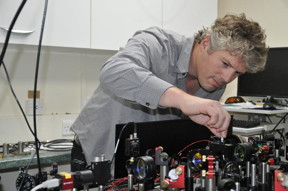 |
| This is Professor Otto Muskens. CREDIT University of Southampton |
Abstract:
A team of scientists, led by the University of Southampton, have produced a fast nanoscale optical transistor using gold nanoantenna assisted phase transition.
Nanoantenna lighting-rod effect produces fast optical switches
Southampton, UK | Posted on October 24th, 2016The work, published in the journal Light, Science and Applications, opens up new directions in antenna-assisted switches and optical memory.
Small nanostructures that can interact strongly with light are of interest for a range of emerging new applications including small optical circuits and metasurface flat optics. Nanoantennas are designed to have strong optical resonances where energy is concentrated far below the diffraction limit, the smallest scale possible using conventional optics. Such extreme concentration of light can be used to enhance all kinds of effects related to localised energy conversion and harvesting, coupling of light to small molecules and quantum dots, and generating new frequencies of light through nonlinear optics.
Next to precise tuning of these antennas by design, an ability to actively tune their properties is of great interest.
Lead author Professor Otto Muskens, from the University of Southampton, said: "If we are able to actively tune a nanoantenna using an electrical or optical signal, we could achieve transistor-type switches for light with nanometer-scale footprint for datacommunication. Such active devices could also be used to tune the antenna's light-concentration effects leading to new applications in switchable and tuneable antenna-assisted processes."
The Southampton team used the properties of the antenna itself to achieve low energy optical switching of a phase-change material. The material used to achieve this effect was vanadium dioxide.
Vanadium dioxide is a special material with properties that can be switched from an insulator to a metal by increasing the temperature above the phase transition point (68 °C). Fabrication of this material is challenging and was produced by a team at the University of Salford, who specialise in thin-film deposition and who were able to grow very high quality films of this material.
Gold nanoantennas were fabricated on top of this thin film and were used to locally drive the phase transition of the vanadium dioxide.
Professor Muskens explained: "The nanoantenna assists the phase transition of the vanadium dioxide by locally concentrating energy near the tips of the antenna. It is like a lightning-rod effect. These positions are also where the antenna resonances are the most sensitive to local perturbations. Antenna-assisted switching thus results a large effect while requiring only a small amount of energy."
The theoretical modelling was done by a team from the University of the Basque Country in San Sebastian, Spain. Their detailed calculations revealed that the nanoantennas provided a new pathway by local absorption around the antenna. The antenna-assisted mechanism resulted in a much lower switching energy compared to just the VO2 film, corresponding to picojoule energies and a calculated efficiency of over 40 per cent.
####
For more information, please click here
Contacts:
Glenn Harris
44-023-805-93212
Copyright © University of Southampton
If you have a comment, please Contact us.Issuers of news releases, not 7th Wave, Inc. or Nanotechnology Now, are solely responsible for the accuracy of the content.
Bookmark:


| Related Links |
| Related News Press |
News and information
 Quantum computer improves AI predictions April 17th, 2026
Flexible sensor gains sensitivity under pressure April 17th, 2026
A reusable chip for particulate matter sensing April 17th, 2026
Detecting vibrational quantum beating in the predissociation dynamics of SF6 using time-resolved photoelectron spectroscopy April 17th, 2026
Possible Futures
A fundamentally new therapeutic approach to cystic fibrosis: Nanobody repairs cellular defect April 17th, 2026
UC Irvine physicists discover method to reverse ‘quantum scrambling’ : The work addresses the problem of information loss in quantum computing system April 17th, 2026
Chip Technology
A reusable chip for particulate matter sensing April 17th, 2026
Metasurfaces smooth light to boost magnetic sensing precision January 30th, 2026
Optical computing/Photonic computing
ICFO researchers overcome long-standing bottleneck in single photon detection with twisted 2D materials August 8th, 2025
Programmable electron-induced color router array May 14th, 2025
Discoveries
Quantum computer improves AI predictions April 17th, 2026
Flexible sensor gains sensitivity under pressure April 17th, 2026
A reusable chip for particulate matter sensing April 17th, 2026
Detecting vibrational quantum beating in the predissociation dynamics of SF6 using time-resolved photoelectron spectroscopy April 17th, 2026
Announcements
A fundamentally new therapeutic approach to cystic fibrosis: Nanobody repairs cellular defect April 17th, 2026
UC Irvine physicists discover method to reverse ‘quantum scrambling’ : The work addresses the problem of information loss in quantum computing system April 17th, 2026
Interviews/Book Reviews/Essays/Reports/Podcasts/Journals/White papers/Posters
A fundamentally new therapeutic approach to cystic fibrosis: Nanobody repairs cellular defect April 17th, 2026
UC Irvine physicists discover method to reverse ‘quantum scrambling’ : The work addresses the problem of information loss in quantum computing system April 17th, 2026
Photonics/Optics/Lasers
Metasurfaces smooth light to boost magnetic sensing precision January 30th, 2026
From sensors to smart systems: the rise of AI-driven photonic noses January 30th, 2026
Research partnerships
Lab to industry: InSe wafer-scale breakthrough for future electronics August 8th, 2025
HKU physicists uncover hidden order in the quantum world through deconfined quantum critical points April 25th, 2025
 |
||
 |
||
| The latest news from around the world, FREE | ||
 |
||
|
|
||
| Premium Products | ||
 |
||
|
Only the news you want to read!
Learn More |
||
 |
||
|
Full-service, expert consulting
Learn More |
||
|
|
||