Home > Press > Silver nanoparticle concentration too low to be harmful in water supply, paper finds
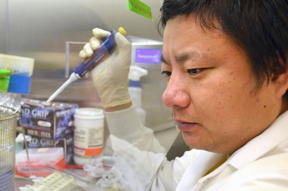 |
| Chiqian Zhang and his team analyzed the results of approximately 300 published works on the subject of silver nanoparticles and wastewater. CREDIT: MU College of Engineering |
Abstract:
Silver nanoparticles have a wide array of uses, one of which is to treat drinking water for harmful bacteria and viruses. But do silver nanoparticles also kill off potentially beneficial bacteria or cause other harmful effects to water-based ecosystems? A new paper from a team of University of Missouri College of Engineering researchers says that's not the case.
Silver nanoparticle concentration too low to be harmful in water supply, paper finds
Columbia, MO | Posted on October 14th, 2016In their paper, "Governing factors affecting the impacts of silver nanoparticles on wastewater treatment," recently published in Science of the Total Environment, Civil and Environmental Engineering Department doctoral students Chiqian Zhang and Shashikanth Gajaraj and Department Chair and Professor Zhiqiang Hu worked with Ping Li of the South China University of Technology to analyze the results of approximately 300 published works on the subject of silver nanoparticles and wastewater. What they found was while silver nanoparticles can have moderately or even significantly adverse effects in large concentrations, the amount of silver nanoparticles found in our wastewater at present isn't harmful to humans or the ecosystem as a whole.
"If the concentration remains low, it's not a serious problem," Zhang said.
Silver nanoparticles are used in wastewater treatment and found increasingly in everyday products in order to combat bacteria. In terms of wastewater treatment, silver nanoparticles frequently react with sulfides in biosolids, vastly limiting their toxicity.
Zhang said many of the studies looked at high concentrations and added that if, over time, the concentration rose to much higher levels of several milligrams per liter or higher), toxicity could become a problem. But he explained that it would take decades or even longer potentially to get to that point.
"People evaluate the toxicity in a small-scale system," he said. "But with water collection systems, much of the silver nanoparticles become silver sulfide and not be harmful."
####
For more information, please click here
Contacts:
Jeff Sossamon
573-882-3346
Copyright © University of Missouri-Columbia
If you have a comment, please Contact us.Issuers of news releases, not 7th Wave, Inc. or Nanotechnology Now, are solely responsible for the accuracy of the content.
Bookmark:


| Related News Press |
News and information
 Quantum computer improves AI predictions April 17th, 2026
Flexible sensor gains sensitivity under pressure April 17th, 2026
A reusable chip for particulate matter sensing April 17th, 2026
Detecting vibrational quantum beating in the predissociation dynamics of SF6 using time-resolved photoelectron spectroscopy April 17th, 2026
Govt.-Legislation/Regulation/Funding/Policy
Quantum computer improves AI predictions April 17th, 2026
Metasurfaces smooth light to boost magnetic sensing precision January 30th, 2026
New imaging approach transforms study of bacterial biofilms August 8th, 2025
Discoveries
Quantum computer improves AI predictions April 17th, 2026
Flexible sensor gains sensitivity under pressure April 17th, 2026
A reusable chip for particulate matter sensing April 17th, 2026
Detecting vibrational quantum beating in the predissociation dynamics of SF6 using time-resolved photoelectron spectroscopy April 17th, 2026
Announcements
A fundamentally new therapeutic approach to cystic fibrosis: Nanobody repairs cellular defect April 17th, 2026
UC Irvine physicists discover method to reverse ‘quantum scrambling’ : The work addresses the problem of information loss in quantum computing system April 17th, 2026
Interviews/Book Reviews/Essays/Reports/Podcasts/Journals/White papers/Posters
A fundamentally new therapeutic approach to cystic fibrosis: Nanobody repairs cellular defect April 17th, 2026
UC Irvine physicists discover method to reverse ‘quantum scrambling’ : The work addresses the problem of information loss in quantum computing system April 17th, 2026
Environment
A reusable chip for particulate matter sensing April 17th, 2026
Researchers unveil a groundbreaking clay-based solution to capture carbon dioxide and combat climate change June 6th, 2025
Safety-Nanoparticles/Risk management
Tiny nanosheets, big leap: A new sensor detects ethanol at ultra-low levels January 30th, 2026
Onion-like nanoparticles found in aircraft exhaust May 14th, 2025
Closing the gaps — MXene-coating filters can enhance performance and reusability February 28th, 2025
 |
||
 |
||
| The latest news from around the world, FREE | ||
 |
||
|
|
||
| Premium Products | ||
 |
||
|
Only the news you want to read!
Learn More |
||
 |
||
|
Full-service, expert consulting
Learn More |
||
|
|
||