Home > Press > Towards Stable Propagation of Light in Nano-Photonic Fibers
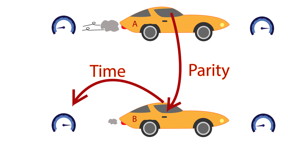 |
| Simplification to represent PT (Parity-Time) symmetry. Imagine a situation where two cars are traveling at the same speed at some instant in time, but car A is speeding up, and car B is slowing down. In order to go at the same speed, you can jump from one car to the other (Parity reversal) and back in time (Time reversal). The cars are like the light waves inside the fiber, the speed of the cars is a representation of the intensity of light and the jump symbolizes a phenomenon called tunneling. Graphics modified from freepiks |
Abstract:
Devices based on light, rather than electrons, could revolutionize the speed and security of our future computers. However, one of the major challenges in today's physics is the design of photonic devices, able to transport and switch light through circuits in a stable way. Sergej Flach, Director of the Center for Theoretical Physics of Complex Systems, within the Institute for Basic Science (IBS) and colleagues from the National Technical University of Athens and the University of Patras (Greece) have studied how to achieve a more stable propagation of light for future optical technologies. Their model was recently published in Scientific Reports.
Towards Stable Propagation of Light in Nano-Photonic Fibers
Daejeon, Korea | Posted on September 20th, 2016Optical fibers can carry a large amount of information and are already used in many countries for communications via phone, internet and TV. However, when light travels long distances through these fibers, it suffers from losses and leakages, which could lead to a loss of information. In order to compensate for this problem, amplifiers are positioned at specific intervals to amplify the signal. For example, amplifiers are needed in submarine communications cables that allow the transfer of digital data between all continents (except for Antarctica). Researchers have tried to build fibers where the signal is stable along the pathway and does not need amplifiers, using the so-called “PT symmetry”. P stands for parity reversal and T for time reversal.
The PT symmetry can be simplified with an example. Imagine a situation where two cars are traveling at the same speed at some instant in time. However, one car is speeding up and the other one is slowing down. Using parity reversal (P) we exchange one car for the other. Using time reversal (T) we go back in time. If you are in the car that is accelerating, you can jump to the car that is slowing down (P) and you also go back in time (T). As a result, you will end up with the same speed as the accelerating car. The cars are like light waves inside the optical fibers and the speed is a representation of the intensity of light. The jumping symbolizes of the transfer of light from one fiber to another, which happens when the light waves propagating in each fiber overlap partially with each other, through a phenomenon called tunneling.
The PT symmetry idea is that one can carefully balance the intensity of light inside the fibers and achieve a stable propagation. Researchers expected PT symmetry to be the solution to achieve stable propagation in all-optical devices (diodes, transistors, switches etc.). However, stable propagation is still a challenge because the PT symmetry conditions have to be balanced extremely carefully, and because the material of the fibers reacts and destroys the exact balance. In the example of the cars, in order to achieve perfect PT symmetry, you would need really identical cars and street conditions. Reality is of course much different.
The team led by IBS found that the stability of light propagation can be achieved by breaking the PT symmetry in a controlled way. In the example of the cars, you would have to choose two cars that are actually different (for example, one has a better engine than the other), but you choose the differences deliberately.
“You have the potential to realize a lot of the items of the wish-list of the PT symmetry, by breaking the PT symmetry. But you have to break it in the right way,” explains Professor Flach. “Now we know how to tune the characteristics of the fiber couplers to achieve a long-lasting constant light propagation.”
Full bibliographic information
Yannis Kominis, Tassos Bountis, Sergej Flach. The Asymmetric Active Coupler: Stable Nonlinear Supermodes and Directed Transport. Scientific Reports (2016).
####
About Institute for Basic Science
Founded in November 2011 by the South Korean government, the Institute for Basic Science (IBS) supports basic research within the entire range of natural sciences including physics, life science, chemistry, mathematics, earth science, and astronomy by providing highly advanced, supportive, self-directed research environments.
For more information, please click here
Contacts:
Dahee Carol Kim
Copyright © AlphaGalileo
If you have a comment, please Contact us.Issuers of news releases, not 7th Wave, Inc. or Nanotechnology Now, are solely responsible for the accuracy of the content.
Bookmark:


| Related News Press |
News and information
 Quantum computer improves AI predictions April 17th, 2026
Flexible sensor gains sensitivity under pressure April 17th, 2026
A reusable chip for particulate matter sensing April 17th, 2026
Detecting vibrational quantum beating in the predissociation dynamics of SF6 using time-resolved photoelectron spectroscopy April 17th, 2026
Possible Futures
A fundamentally new therapeutic approach to cystic fibrosis: Nanobody repairs cellular defect April 17th, 2026
UC Irvine physicists discover method to reverse ‘quantum scrambling’ : The work addresses the problem of information loss in quantum computing system April 17th, 2026
Chip Technology
A reusable chip for particulate matter sensing April 17th, 2026
Metasurfaces smooth light to boost magnetic sensing precision January 30th, 2026
Optical computing/Photonic computing
ICFO researchers overcome long-standing bottleneck in single photon detection with twisted 2D materials August 8th, 2025
Programmable electron-induced color router array May 14th, 2025
Discoveries
Quantum computer improves AI predictions April 17th, 2026
Flexible sensor gains sensitivity under pressure April 17th, 2026
A reusable chip for particulate matter sensing April 17th, 2026
Detecting vibrational quantum beating in the predissociation dynamics of SF6 using time-resolved photoelectron spectroscopy April 17th, 2026
Announcements
A fundamentally new therapeutic approach to cystic fibrosis: Nanobody repairs cellular defect April 17th, 2026
UC Irvine physicists discover method to reverse ‘quantum scrambling’ : The work addresses the problem of information loss in quantum computing system April 17th, 2026
Interviews/Book Reviews/Essays/Reports/Podcasts/Journals/White papers/Posters
A fundamentally new therapeutic approach to cystic fibrosis: Nanobody repairs cellular defect April 17th, 2026
UC Irvine physicists discover method to reverse ‘quantum scrambling’ : The work addresses the problem of information loss in quantum computing system April 17th, 2026
Photonics/Optics/Lasers
Metasurfaces smooth light to boost magnetic sensing precision January 30th, 2026
From sensors to smart systems: the rise of AI-driven photonic noses January 30th, 2026
 |
||
 |
||
| The latest news from around the world, FREE | ||
 |
||
|
|
||
| Premium Products | ||
 |
||
|
Only the news you want to read!
Learn More |
||
 |
||
|
Full-service, expert consulting
Learn More |
||
|
|
||