Home > Press > New breed of optical soliton wave discovered
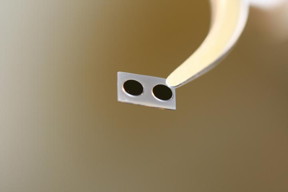 |
| Optical microcavities in which the solitons were created CREDIT: Qi-Fan Yang/Caltech |
Abstract:
Applied scientists led by Caltech's Kerry Vahala have discovered a new type of optical soliton wave that travels in the wake of other soliton waves, hitching a ride on and feeding off of the energy of the other wave.
New breed of optical soliton wave discovered
Pasadena. CA | Posted on September 9th, 2016Solitons are localized waves that act like particles: as they travel across space, they hold their shape and form rather than dispersing as other waves do. They were first discovered in 1834 when Scottish engineer John Scott Russell noted an unusual wave that formed after the sudden stop of a barge in the Union Canal that runs between Falkirk and Edinburgh. Russell tracked the resulting wave for one or two miles, and noted that it preserved its shape as it traveled, until he ultimately lost sight of it.
He dubbed his discovery a "wave of translation." By the end of the century, the phenomenon had been described mathematically, ultimately giving birth to the concept of the soliton wave. Under normal conditions, waves tend to dissipate as they travel through space. Toss a stone into a pond, and the ripples will slowly die down as they spread out away from the point of impact. Solitons, on the other hand, do not.
In addition to water waves, solitons can occur as light waves. Vahala's team studies light solitons by having them recirculate indefinitely in micrometer-scale circular circuits called optical microcavities. Solitons have applications in the creation of highly accurate optical clocks, and can be used in microwave oscillators that are used for navigation and radar systems, among other things.
But despite decades of study, a soliton has never been observed behaving in a dependent -- almost parasitic--manner.
"This new soliton rides along with another soliton -- essentially, in the other soliton's wake. It also syphons energy off of the other soliton so that it is self-sustaining. It can eventually grow larger than its host," says Vahala, Ted and Ginger Jenkins Professor of Information Science and Technology and Applied Physics and executive officer for applied physics and materials science in the Division of Engineering and Applied Science.
Vahala likens these newly discovered solitons to pilot fish, carnivorous tropical fish that swim next to a shark so they can pick up scraps from the shark's meals. And by swimming in the shark's wake, the pilot fish reduce the drag of water on their own body, so they can travel with less effort.
Vahala is the corresponding author of a paper in the journal Nature Physics announcing and describing the new type of soliton, dubbed the "Stokes soliton." (The name "Stokes" was chosen for technical reasons having to do with how the soliton syphons energy from the host.) The new soliton was first observed by Caltech graduate students Qi-Fan Yang and Xu Yi. Because of the soliton's ability to closely match the position and shape of the original soliton, Yang's and Yi's initial reaction to the wave was to suspect that laboratory instrumentation was malfunctioning.
"We confirmed that the signal was not an artifact of the instrumentation by observing the signal on two spectrometers. We then knew it was real and had to figure out why a new soliton would spontaneously appear like this," Yang says.
The microcavities that Vahala and his team use include a laser input that provides the solitons with energy. This energy cannot be directly absorbed by the Stokes soliton -- the "pilot fish." Instead, the energy is consumed by the "shark" soliton. But then, Vahala and his team found, the energy is pulled away by the pilot fish soliton, which grows in size while the other soliton shrinks.
"Once we understood the environment required to sustain the new soliton, it actually became possible to design the microcavities to guarantee their formation and even their properties like wavelength -- effectively, color," Yi says. Yi and Yang collaborated with graduate student Ki Youl Yang on the research.
His research was funded by the Defense Advanced Research Projects Agency under the PULSE Program; NASA; the Kavli Nanoscience Institute; and the Institute for Quantum Information and Matter, a National Science Foundation Physics Frontiers Center supported by the Gordon and Betty Moore Foundation.
####
For more information, please click here
Contacts:
Robert Perkins
626-395-1862
Copyright © California Institute of Technology
If you have a comment, please Contact us.Issuers of news releases, not 7th Wave, Inc. or Nanotechnology Now, are solely responsible for the accuracy of the content.
Bookmark:


| Related Links |
| Related News Press |
News and information
 Quantum computer improves AI predictions April 17th, 2026
Flexible sensor gains sensitivity under pressure April 17th, 2026
A reusable chip for particulate matter sensing April 17th, 2026
Detecting vibrational quantum beating in the predissociation dynamics of SF6 using time-resolved photoelectron spectroscopy April 17th, 2026
Physics
UC Irvine physicists discover method to reverse ‘quantum scrambling’ : The work addresses the problem of information loss in quantum computing system April 17th, 2026
Quantum computers simulate fundamental physics: shedding light on the building blocks of nature June 6th, 2025
Govt.-Legislation/Regulation/Funding/Policy
Quantum computer improves AI predictions April 17th, 2026
Metasurfaces smooth light to boost magnetic sensing precision January 30th, 2026
New imaging approach transforms study of bacterial biofilms August 8th, 2025
Possible Futures
A fundamentally new therapeutic approach to cystic fibrosis: Nanobody repairs cellular defect April 17th, 2026
UC Irvine physicists discover method to reverse ‘quantum scrambling’ : The work addresses the problem of information loss in quantum computing system April 17th, 2026
Announcements
A fundamentally new therapeutic approach to cystic fibrosis: Nanobody repairs cellular defect April 17th, 2026
UC Irvine physicists discover method to reverse ‘quantum scrambling’ : The work addresses the problem of information loss in quantum computing system April 17th, 2026
Interviews/Book Reviews/Essays/Reports/Podcasts/Journals/White papers/Posters
A fundamentally new therapeutic approach to cystic fibrosis: Nanobody repairs cellular defect April 17th, 2026
UC Irvine physicists discover method to reverse ‘quantum scrambling’ : The work addresses the problem of information loss in quantum computing system April 17th, 2026
Aerospace/Space
Decoding hydrogen‑bond network of electrolyte for cryogenic durable aqueous zinc‑ion batteries January 30th, 2026
ICFO researchers overcome long-standing bottleneck in single photon detection with twisted 2D materials August 8th, 2025
Onion-like nanoparticles found in aircraft exhaust May 14th, 2025
Grants/Sponsored Research/Awards/Scholarships/Gifts/Contests/Honors/Records
Quantum computer improves AI predictions April 17th, 2026
Detecting vibrational quantum beating in the predissociation dynamics of SF6 using time-resolved photoelectron spectroscopy April 17th, 2026
Metasurfaces smooth light to boost magnetic sensing precision January 30th, 2026
Photonics/Optics/Lasers
Metasurfaces smooth light to boost magnetic sensing precision January 30th, 2026
From sensors to smart systems: the rise of AI-driven photonic noses January 30th, 2026
 |
||
 |
||
| The latest news from around the world, FREE | ||
 |
||
|
|
||
| Premium Products | ||
 |
||
|
Only the news you want to read!
Learn More |
||
 |
||
|
Full-service, expert consulting
Learn More |
||
|
|
||