Home > Press > Colors from darkness: Researchers develop alternative approach to quantum computing
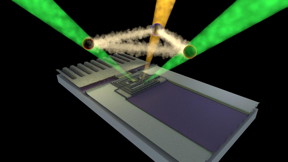 |
| Artistic depiction of the generation of three correlated photons from quantum vacuum.
Image by Antti Paraoanu |
Abstract:
Researchers at Aalto University have demonstrated the suitability of microwave signals in the coding of information for quantum computing. Previous development of the field has been focusing on optical systems.
Colors from darkness: Researchers develop alternative approach to quantum computing
Aalto, Finland | Posted on August 31st, 2016Researchers used a microwave resonator based on extremely sensitive measurement devices known as superconductive quantum interference devices (SQUIDs). In their studies, the resonator was cooled down and kept near absolute zero, where any thermal motion freezes. This state corresponds to perfect darkness where no photon - a real particle of electromagnetic radiation such as visible light or microwaves - is present.
However, in this state (called quantum vacuum) there exist fluctuations that bring photons in and out of existence for a very short time. The researchers have now managed to convert these fluctuations into real photons of microwave radiation with different frequencies, showing that, in a sense, darkness is more than just absence of light.
They also found out that these photons are correlated with each other, as if a magic connection exists between them.
'With our experimental setup we managed to create complex correlations of microwave signals in a controlled way,' says Dr Pasi Lähteenmäki, who performed the research during his doctoral studies at the Low Temperature Laboratory of Aalto University.
'This all hints at the possibility of using the different frequencies for quantum computing. The photons at different frequencies will play a similar role to the registers in classical computers, and logical gate operations can be performed between them,' says Doc. Sorin Paraoanu, Senior University Lecturer and one of the co-authors of the work.
The results provide a new approach for quantum computing.
'Today the basic architecture of future quantum computers is being developed very intensively around the world. By utilizing the multi-frequency microwave signals, an alternative approach can be pursued which realizes the logical gates by sequences of quantum measurements. Moreover, if we use the photons created in our resonator, the physical quantum bits or qubits become needless,' explains Professor Pertti Hakonen from the Low Temperature Laboratory of Aalto University.
These experiments utilized the OtaNANO infrastructure and the niobium superconducting technology of the Technical Research Centre of Finland (VTT). This work was done under the framework of the Centre of Quantum Engineering at Aalto University.
####
For more information, please click here
Contacts:
Pertti Hakonen
358-503-442-316
Docent Sorin Paraoanu
+358 50 3442 650
Copyright © Aalto University
If you have a comment, please Contact us.Issuers of news releases, not 7th Wave, Inc. or Nanotechnology Now, are solely responsible for the accuracy of the content.
Bookmark:


| Related Links |
 Research article: Pasi Lähteenmäki, Gheorghe Sorin Paraoanu, Juha Hassel, and Pertti J. Hakonen.
Centre of Excellence in Quantum Phenomena and Devices:
| Related News Press |
News and information
Quantum computer improves AI predictions April 17th, 2026
Flexible sensor gains sensitivity under pressure April 17th, 2026
A reusable chip for particulate matter sensing April 17th, 2026
Detecting vibrational quantum beating in the predissociation dynamics of SF6 using time-resolved photoelectron spectroscopy April 17th, 2026
Possible Futures
A fundamentally new therapeutic approach to cystic fibrosis: Nanobody repairs cellular defect April 17th, 2026
UC Irvine physicists discover method to reverse ‘quantum scrambling’ : The work addresses the problem of information loss in quantum computing system April 17th, 2026
Chip Technology
A reusable chip for particulate matter sensing April 17th, 2026
Metasurfaces smooth light to boost magnetic sensing precision January 30th, 2026
Quantum Computing
Quantum computer improves AI predictions April 17th, 2026
UC Irvine physicists discover method to reverse ‘quantum scrambling’ : The work addresses the problem of information loss in quantum computing system April 17th, 2026
Researchers develop molecular qubits that communicate at telecom frequencies October 3rd, 2025
Optical computing/Photonic computing
ICFO researchers overcome long-standing bottleneck in single photon detection with twisted 2D materials August 8th, 2025
Programmable electron-induced color router array May 14th, 2025
Discoveries
Quantum computer improves AI predictions April 17th, 2026
Flexible sensor gains sensitivity under pressure April 17th, 2026
A reusable chip for particulate matter sensing April 17th, 2026
Detecting vibrational quantum beating in the predissociation dynamics of SF6 using time-resolved photoelectron spectroscopy April 17th, 2026
Announcements
A fundamentally new therapeutic approach to cystic fibrosis: Nanobody repairs cellular defect April 17th, 2026
UC Irvine physicists discover method to reverse ‘quantum scrambling’ : The work addresses the problem of information loss in quantum computing system April 17th, 2026
Interviews/Book Reviews/Essays/Reports/Podcasts/Journals/White papers/Posters
A fundamentally new therapeutic approach to cystic fibrosis: Nanobody repairs cellular defect April 17th, 2026
UC Irvine physicists discover method to reverse ‘quantum scrambling’ : The work addresses the problem of information loss in quantum computing system April 17th, 2026
Photonics/Optics/Lasers
Metasurfaces smooth light to boost magnetic sensing precision January 30th, 2026
From sensors to smart systems: the rise of AI-driven photonic noses January 30th, 2026
 |
||
 |
||
| The latest news from around the world, FREE | ||
 |
||
|
|
||
| Premium Products | ||
 |
||
|
Only the news you want to read!
Learn More |
||
 |
||
|
Full-service, expert consulting
Learn More |
||
|
|
||