Home > Press > Diamonds and quantum information processing on the nano scale
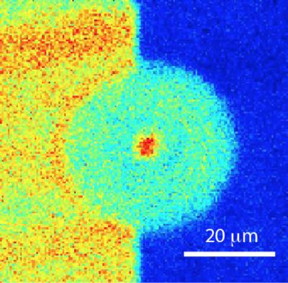 |
| This image shows the formation of singular charge patterns upon localized laser excitation. CREDIT: Harishankar Jayakumar |
Abstract:
City College of New York led-team headed by physicist Dr. Carlos Meriles has successfully demonstrated charge transport between Nitrogen-Vacancy color centers in diamond. The team developed a novel multi-color scanning microscopy technique to visualize the charge transport. The breakthrough experiment could potentially lead to room-temperature quantum information processing in diamond and optical data storage in three dimensions.
Diamonds and quantum information processing on the nano scale
New York, NY | Posted on August 31st, 2016The nitrogen-vacancy (NV) center is an optically active defect in diamond comprising a nitrogen atom and an adjacent vacancy, replacing carbon atoms in the diamond lattice. This defect has electrons that are capable of storing quantum information. To utilize this special property for quantum computation, it is required to create a network of interacting NV centers. The research so far has focused on using photons emitted by the NV centers to create this interaction under a special low temperature environment.
In a complementary approach the research team at City College in collaboration with researchers at the Australian National University (ANU) in Canberra are envisioning an electron-transport-based interaction that is realizable in ambient conditions. In one of the key experiments reported a focused green laser beam was used to remove the electrons from the NV centers, which later diffused radially in the diamond. A red laser scan was used to image NV centers that trapped these diffused charges as far as 30 microns. The team exploited the difference in luminescence intensities of the NV centers with and without the electron to create a map of the trapped carriers.
"These are very promising initial results" said lead author Dr. Harishankar Jayakumar, a postdoctoral fellow at the Meriles group. Other key contributors are CCNY team members Dr. Siddharth Dhomkar, and graduate student Jacob Henshaw, as well as Dr. Marcus Doherty and Prof. Neil Manson at ANU.
####
For more information, please click here
Contacts:
Shante Booker
Copyright © City College of New York
If you have a comment, please Contact us.Issuers of news releases, not 7th Wave, Inc. or Nanotechnology Now, are solely responsible for the accuracy of the content.
Bookmark:


| Related Links |
| Related News Press |
News and information
 Quantum computer improves AI predictions April 17th, 2026
Flexible sensor gains sensitivity under pressure April 17th, 2026
A reusable chip for particulate matter sensing April 17th, 2026
Detecting vibrational quantum beating in the predissociation dynamics of SF6 using time-resolved photoelectron spectroscopy April 17th, 2026
Imaging
Simple algorithm paired with standard imaging tool could predict failure in lithium metal batteries August 8th, 2025
Chip Technology
A reusable chip for particulate matter sensing April 17th, 2026
Metasurfaces smooth light to boost magnetic sensing precision January 30th, 2026
Memory Technology
Researchers tackle the memory bottleneck stalling quantum computing October 3rd, 2025
First real-time observation of two-dimensional melting process: Researchers at Mainz University unveil new insights into magnetic vortex structures August 8th, 2025
Utilizing palladium for addressing contact issues of buried oxide thin film transistors April 5th, 2024
Quantum Computing
Quantum computer improves AI predictions April 17th, 2026
UC Irvine physicists discover method to reverse ‘quantum scrambling’ : The work addresses the problem of information loss in quantum computing system April 17th, 2026
Researchers develop molecular qubits that communicate at telecom frequencies October 3rd, 2025
Optical computing/Photonic computing
ICFO researchers overcome long-standing bottleneck in single photon detection with twisted 2D materials August 8th, 2025
Programmable electron-induced color router array May 14th, 2025
Discoveries
Quantum computer improves AI predictions April 17th, 2026
Flexible sensor gains sensitivity under pressure April 17th, 2026
A reusable chip for particulate matter sensing April 17th, 2026
Detecting vibrational quantum beating in the predissociation dynamics of SF6 using time-resolved photoelectron spectroscopy April 17th, 2026
Announcements
A fundamentally new therapeutic approach to cystic fibrosis: Nanobody repairs cellular defect April 17th, 2026
UC Irvine physicists discover method to reverse ‘quantum scrambling’ : The work addresses the problem of information loss in quantum computing system April 17th, 2026
Interviews/Book Reviews/Essays/Reports/Podcasts/Journals/White papers/Posters
A fundamentally new therapeutic approach to cystic fibrosis: Nanobody repairs cellular defect April 17th, 2026
UC Irvine physicists discover method to reverse ‘quantum scrambling’ : The work addresses the problem of information loss in quantum computing system April 17th, 2026
Tools
Metasurfaces smooth light to boost magnetic sensing precision January 30th, 2026
From sensors to smart systems: the rise of AI-driven photonic noses January 30th, 2026
Japan launches fully domestically produced quantum computer: Expo visitors to experience quantum computing firsthand August 8th, 2025
Photonics/Optics/Lasers
Metasurfaces smooth light to boost magnetic sensing precision January 30th, 2026
From sensors to smart systems: the rise of AI-driven photonic noses January 30th, 2026
 |
||
 |
||
| The latest news from around the world, FREE | ||
 |
||
|
|
||
| Premium Products | ||
 |
||
|
Only the news you want to read!
Learn More |
||
 |
||
|
Full-service, expert consulting
Learn More |
||
|
|
||