Home > Press > Lehigh engineer discovers a high-speed nano-avalanche: New findings published in the Journal of Electrochemical Society about the process involving transformations in glass that occur under intense electrical and thermal conditions could lead the way to more energy-efficient glas
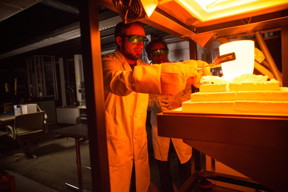 |
| As part of his doctoral research, Charles McLaren discovered that applying a direct current field across glass reduced its melting temperature. In their experiments, they placed a block of glass between a cathode and anode, and then exerted steady pressure on the glass while gradually heating it.>BR> CREDIT: Douglas Benedict of Academic Image |
Abstract:
Charles McLaren, a doctoral student in materials science and engineering at Lehigh University, arrived last fall for his semester of research at the University of Marburg in Germany with his language skills significantly lagging behind his scientific prowess. "It was my first trip to Germany, and I barely spoke a word of German," he confessed.
Lehigh engineer discovers a high-speed nano-avalanche: New findings published in the Journal of Electrochemical Society about the process involving transformations in glass that occur under intense electrical and thermal conditions could lead the way to more energy-efficient glas
Bethlehem, PA | Posted on August 24th, 2016The main purpose of McLaren's exchange study in Marburg was to learn more about a complex process involving transformations in glass that occur under intense electrical and thermal conditions. New understanding of these mechanisms could lead the way to more energy-efficient glass manufacturing, and even glass supercapacitors that leapfrog the performance of batteries now used for electric cars and solar energy.
"This technology is relevant to companies seeking the next wave of portable, reliable energy," said Himanshu Jain, McLaren's advisor and the T. L. Diamond Distinguished Chair in Materials Science and Engineering at Lehigh and director of its International Materials Institute for New Functionality in Glass. "A breakthrough in the use of glass for power storage could unleash a torrent of innovation in the transportation and energy sectors, and even support efforts to curb global warming."
As part of his doctoral research, McLaren discovered that applying a direct current field across glass reduced its melting temperature. In their experiments, they placed a block of glass between a cathode and anode, and then exerted steady pressure on the glass while gradually heating it. McLaren and Jain, together with colleagues at the University of Colorado, published their discovery in Applied Physics Letters.
The implications for the finding were intriguing. In addition to making glass formulation viable at lower temperatures and reducing energy needs, designers using electrical current in glass manufacturing would have a tool to make precise manipulations not possible with heat alone.
"You could make a mask for the glass, for example, and apply an electrical field on a micron scale," said Jain. "This would allow you to deform the glass with high precision, and soften it in a far more selective way than you could with heat, which gets distributed throughout the glass."
Though McLaren and Jain had isolated the phenomenon and determined how to dial up the variables for optimal results, they did not yet fully understand the mechanisms behind it. McLaren and Jain had been following the work of Dr. Bernard Roling at the University of Marburg, who had discovered some remarkable characteristics of glass using electro-thermal poling, a technique that employs both temperature manipulation and electrical current to create a charge in normally inert glass. The process imparts useful optical and even bioactive qualities to glass.
Roling invited McLaren to spend a semester at Marburg to analyze the behavior of glass under electro-thermal poling, to see if it would reveal more about the fundamental science underlying what McLaren and Jain had observed in their Lehigh lab.
A high-speed avalanche
McLaren's work in Marburg revealed a two-step process in which a thin sliver of the glass nearest the anode, called a depletion layer, becomes much more resistant to electrical current than the rest of the glass as alkali ions in the glass migrate away. This is followed by a catastrophic change in the layer, known as dielectric breakdown, which dramatically increases its conductivity. McLaren likens the process of dielectric breakdown to a high-speed avalanche, and using spectroscopic analysis with electro-thermal poling as a way to see what is happening in slow motion.
"The results in Germany gave us a very good model for what is going on in the electric field induced softening that we did here. It told us about the start conditions for where dielectric breakdown can begin," explained McLaren.
"Charlie's work in Marburg has helped us see the kinetics of the process," Jain said. "We could see it happening abruptly in our experiments here at Lehigh, but we now have a way to separate out what occurs specifically with the depletion layer."
McLaren, Jain, Roling and his Marburg team members published their findings in the September 2016 issue of the Journal of Electrochemical Society.
"The Marburg trip was incredibly useful professionally and enlightening personally," said McLaren. "Scientifically, it's always good to see your work from another vantage point, and see how other research groups interpret data or perform experiments. The group in Marburg was extremely hardworking, which I loved, and they were very supportive of each other. If someone submitted a paper, the whole group would have a barbecue to celebrate, and they always gave each other feedback on their work. Sometimes it was brutally honest--they didn't hold back--but they were things you needed to hear."
"Working in Marburg also showed me how to interact with a completely different group of people," he continued, "and you see differences in your own culture best when you have the chance to see other cultures close up. It's always a fresh perspective."
####
For more information, please click here
Contacts:
Lori Friedman
610-758-3224
Copyright © Lehigh University
If you have a comment, please Contact us.Issuers of news releases, not 7th Wave, Inc. or Nanotechnology Now, are solely responsible for the accuracy of the content.
Bookmark:


| Related Links |
| Related News Press |
News and information
 Quantum computer improves AI predictions April 17th, 2026
Flexible sensor gains sensitivity under pressure April 17th, 2026
A reusable chip for particulate matter sensing April 17th, 2026
Detecting vibrational quantum beating in the predissociation dynamics of SF6 using time-resolved photoelectron spectroscopy April 17th, 2026
Possible Futures
A fundamentally new therapeutic approach to cystic fibrosis: Nanobody repairs cellular defect April 17th, 2026
UC Irvine physicists discover method to reverse ‘quantum scrambling’ : The work addresses the problem of information loss in quantum computing system April 17th, 2026
Discoveries
Quantum computer improves AI predictions April 17th, 2026
Flexible sensor gains sensitivity under pressure April 17th, 2026
A reusable chip for particulate matter sensing April 17th, 2026
Detecting vibrational quantum beating in the predissociation dynamics of SF6 using time-resolved photoelectron spectroscopy April 17th, 2026
Materials/Metamaterials/Magnetoresistance
First real-time observation of two-dimensional melting process: Researchers at Mainz University unveil new insights into magnetic vortex structures August 8th, 2025
Researchers unveil a groundbreaking clay-based solution to capture carbon dioxide and combat climate change June 6th, 2025
A 1960s idea inspires NBI researchers to study hitherto inaccessible quantum states June 6th, 2025
Institute for Nanoscience hosts annual proposal planning meeting May 16th, 2025
Announcements
A fundamentally new therapeutic approach to cystic fibrosis: Nanobody repairs cellular defect April 17th, 2026
UC Irvine physicists discover method to reverse ‘quantum scrambling’ : The work addresses the problem of information loss in quantum computing system April 17th, 2026
Interviews/Book Reviews/Essays/Reports/Podcasts/Journals/White papers/Posters
A fundamentally new therapeutic approach to cystic fibrosis: Nanobody repairs cellular defect April 17th, 2026
UC Irvine physicists discover method to reverse ‘quantum scrambling’ : The work addresses the problem of information loss in quantum computing system April 17th, 2026
Energy
Sensors innovations for smart lithium-based batteries: advancements, opportunities, and potential challenges August 8th, 2025
Simple algorithm paired with standard imaging tool could predict failure in lithium metal batteries August 8th, 2025
Battery Technology/Capacitors/Generators/Piezoelectrics/Thermoelectrics/Energy storage
Decoding hydrogen‑bond network of electrolyte for cryogenic durable aqueous zinc‑ion batteries January 30th, 2026
COF scaffold membrane with gate‑lane nanostructure for efficient Li+/Mg2+ separation January 30th, 2026
MXene nanomaterials enter a new dimension Multilayer nanomaterial: MXene flakes created at Drexel University show new promise as 1D scrolls January 30th, 2026
 |
||
 |
||
| The latest news from around the world, FREE | ||
 |
||
|
|
||
| Premium Products | ||
 |
||
|
Only the news you want to read!
Learn More |
||
 |
||
|
Full-service, expert consulting
Learn More |
||
|
|
||