Home > Press > Lab team spins ginger into nanoparticles to heal inflammatory bowel disease
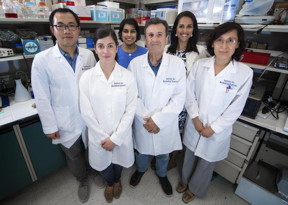 |
| Dr. Didier Merlin (front row, center) and colleagues with the Atlanta VA Medical Center and the Institute for Biomedical Sciences at Georgia State University are exploring the use of edible ginger-derived nanoparticles to treat inflammatory bowel disease. CREDIT: Lisa Pessin |
Abstract:
A recent study by researchers at the Atlanta Veterans Affairs Medical Center took them to a not-so-likely destination: local farmers markets. They went in search of fresh ginger root.
Lab team spins ginger into nanoparticles to heal inflammatory bowel disease
Atlanta, GA | Posted on August 19th, 2016Back at the lab, the scientists turned the ginger into what they are calling GDNPs, or ginger-derived nanoparticles. The process started simply enough, with your basic kitchen blender. But then it involved super-high-speed centrifuging and ultrasonic dispersion of the ginger juice, to break it up into single pellets. (Don't try this at home!)
The research team, led by Dr. Didier Merlin with VA and the Institute for Biomedical Sciences at Georgia State University, believes the particles may be good medicine for Crohn's disease and ulcerative colitis, the two main forms of inflammatory bowel disease (IBD). The particles may also help fight cancer linked to colitis, the scientists believe.
They report their findings, based on experiments with cells and mice, in the September 2016 issue of Biomaterials.
Each ginger-based nanoparticle was about 230 nanometers in diameter. More than 300 of them could fit across the width of a human hair.
Fed to lab mice, the particles appeared to be nontoxic and had significant therapeutic effects:
Importantly, they efficiently targeted the colon. They were absorbed mainly by cells in the lining of the intestines, where IBD inflammation occurs.
The particles reduced acute colitis and prevented chronic colitis and colitis-associated cancer.
They enhanced intestinal repair. Specifically, they boosted the survival and proliferation of the cells that make up the lining of the colon. They also lowered the production of proteins that promote inflammation, and raised the levels of proteins that fight inflammation.
Part of the therapeutic effect, say the researchers, comes from the high levels of lipids--fatty molecules--in the particles, a result of the natural lipids in the ginger plant. One of the lipids is phosphatidic acid, an important building block of cell membranes.
The particles also retained key active constituents found naturally in ginger, such as 6-gingerol and 6-shogaol. Past lab studies have shown the compounds to be active against oxidation, inflammation, and cancer. They are what make standard ginger an effective remedy for nausea and other digestion problems. Traditional cultures have used ginger medicinally for centuries, and health food stores carry ginger-based supplements--such as chews, or the herb mixed with honey in a syrup--as digestive aids.
Delivering these compounds in a nanoparticle, says Merlin's team, may be a more effective way to target colon tissue than simply providing the herb as a food or supplement.
The idea of fighting IBD with nanoparticles is not new. In recent years, Merlin's lab and others have explored how to deliver conventional drugs via nanotechnology. Some of this research is promising. The approach may allow low doses of drugs to be delivered only where they are needed--inflamed tissue in the colon--and thus avoid unwanted systemic effects.
The advantage of ginger, say the researchers, is that it's nontoxic, and could represent a very cost-effective source of medicine.
The group is looking at ginger, and other plants, as potential "nanofactories for the fabrication of medical nanoparticles."
Merlin and his VA and Georgia State University coauthors elaborated on the idea in a report earlier this year titled "Plant-derived edible nanoparticles as a new therapeutic approach against diseases." They wrote that plants are a "bio-renewable, sustainable, diversified platform for the production of therapeutic nanoparticles."
###
The ginger nanoparticle work was supported by VA, the National Institutes of Health, and the Crohn's and Colitis Foundation of America.
####
For more information, please click here
Contacts:
Greg Kendall
404-417-5385
Copyright © Veterans Affairs Research Communications
If you have a comment, please Contact us.Issuers of news releases, not 7th Wave, Inc. or Nanotechnology Now, are solely responsible for the accuracy of the content.
Bookmark:


| Related Links |
| Related News Press |
News and information
 Quantum computer improves AI predictions April 17th, 2026
Flexible sensor gains sensitivity under pressure April 17th, 2026
A reusable chip for particulate matter sensing April 17th, 2026
Detecting vibrational quantum beating in the predissociation dynamics of SF6 using time-resolved photoelectron spectroscopy April 17th, 2026
Govt.-Legislation/Regulation/Funding/Policy
Quantum computer improves AI predictions April 17th, 2026
Metasurfaces smooth light to boost magnetic sensing precision January 30th, 2026
New imaging approach transforms study of bacterial biofilms August 8th, 2025
Possible Futures
A fundamentally new therapeutic approach to cystic fibrosis: Nanobody repairs cellular defect April 17th, 2026
UC Irvine physicists discover method to reverse ‘quantum scrambling’ : The work addresses the problem of information loss in quantum computing system April 17th, 2026
Nanomedicine
A fundamentally new therapeutic approach to cystic fibrosis: Nanobody repairs cellular defect April 17th, 2026
New molecular technology targets tumors and simultaneously silences two ‘undruggable’ cancer genes August 8th, 2025
New imaging approach transforms study of bacterial biofilms August 8th, 2025
Electrifying results shed light on graphene foam as a potential material for lab grown cartilage June 6th, 2025
Discoveries
Quantum computer improves AI predictions April 17th, 2026
Flexible sensor gains sensitivity under pressure April 17th, 2026
A reusable chip for particulate matter sensing April 17th, 2026
Detecting vibrational quantum beating in the predissociation dynamics of SF6 using time-resolved photoelectron spectroscopy April 17th, 2026
Announcements
A fundamentally new therapeutic approach to cystic fibrosis: Nanobody repairs cellular defect April 17th, 2026
UC Irvine physicists discover method to reverse ‘quantum scrambling’ : The work addresses the problem of information loss in quantum computing system April 17th, 2026
Interviews/Book Reviews/Essays/Reports/Podcasts/Journals/White papers/Posters
A fundamentally new therapeutic approach to cystic fibrosis: Nanobody repairs cellular defect April 17th, 2026
UC Irvine physicists discover method to reverse ‘quantum scrambling’ : The work addresses the problem of information loss in quantum computing system April 17th, 2026
Military
Quantum engineers ‘squeeze’ laser frequency combs to make more sensitive gas sensors January 17th, 2025
Chainmail-like material could be the future of armor: First 2D mechanically interlocked polymer exhibits exceptional flexibility and strength January 17th, 2025
Single atoms show their true color July 5th, 2024
NRL charters Navy’s quantum inertial navigation path to reduce drift April 5th, 2024
Food/Agriculture/Supplements
New imaging approach transforms study of bacterial biofilms August 8th, 2025
SMART researchers pioneer first-of-its-kind nanosensor for real-time iron detection in plants February 28th, 2025
Grants/Sponsored Research/Awards/Scholarships/Gifts/Contests/Honors/Records
Quantum computer improves AI predictions April 17th, 2026
Detecting vibrational quantum beating in the predissociation dynamics of SF6 using time-resolved photoelectron spectroscopy April 17th, 2026
Metasurfaces smooth light to boost magnetic sensing precision January 30th, 2026
Nanobiotechnology
A fundamentally new therapeutic approach to cystic fibrosis: Nanobody repairs cellular defect April 17th, 2026
New molecular technology targets tumors and simultaneously silences two ‘undruggable’ cancer genes August 8th, 2025
New imaging approach transforms study of bacterial biofilms August 8th, 2025
Electrifying results shed light on graphene foam as a potential material for lab grown cartilage June 6th, 2025
 |
||
 |
||
| The latest news from around the world, FREE | ||
 |
||
|
|
||
| Premium Products | ||
 |
||
|
Only the news you want to read!
Learn More |
||
 |
||
|
Full-service, expert consulting
Learn More |
||
|
|
||