Home > Press > Lonely atoms, happily reunited
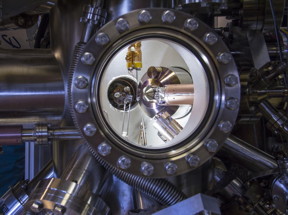 |
| Experiments in the vacuum chamber at TU Wien. CREDIT: TU Wien |
Abstract:
At first glance, magnetite appears to be a rather inconspicuous grey mineral. But on an atomic scale, it has remarkable properties: on magnetite, single metal atoms are held in place, or they can be made to move across the surface. Sometimes several metal atoms on magnetite form small clusters. Such phenomena can dramatically change the chemical activity of the material. Atomic processes on the magnetite surface determine how well certain metal atoms can serve as catalysts for chemical reactions.
Lonely atoms, happily reunited
Vienna, Austria | Posted on July 29th, 2016Scientists at TU Wien (Vienna), together with colleagues from Utrecht University, can now watch single platinum atoms form tiny clusters. Carbon monoxide plays a dual role in this process: It allows single platinum atoms to move and form pairs, and then it holds these pairs together for a long time. Only by increasing the temperature can the pair-bonds between platinum atoms can be broken.
Lonely Atoms
It sounds a bit like an unhappy love story: "Two platinum atoms would actually like to be together, but the magnetite surface keeps them apart", says Roland Bliem (TU Wien). Together with Professor Gareth Parkinson, Professor Ulrike Diebold and their colleagues, he analysed the behaviour of platinum atoms using a scanning tunnelling microscope.
"When a platinum atom hits the magnetite surface, it is kept in place by the oxygen atoms in the magnetite. The atoms always end up alone. On other surfaces, pair formation would be favoured, but magnetite does not allow that", says Roland Bliem. The platinum atoms sit on specific places on the magnetite crystal and cannot get away without outside help.
However, with the appearance of carbon monoxide, the situation changes completely: "A carbon monoxide molecule can attach to a platinum atom and lift it up", says Gareth Parkinson. "We call that the skyhook effect." The lifting process frees the atom from the tight grip of the magnetite, and together, the molecule and the platinum atom can start moving around randomly across the magnetite surface.
When one mobilized platinum atom finds another, they can form a bond - as long as both of them are being lifted up by carbon monoxide, diminishing the influence of the magnetite below.
When the temperature is increased to 250°C, the carbon monoxide separates from the platinum atom and the bond breaks up. The two platinum atoms must once again find separate places on the magnetite surface. This effect opens up a strategy to turn clusters into single atoms - an important process in so called "single-atom catalysts". Sometimes clusters of several atoms are formed. These larger clusters, however, cannot be broken up, even at high temperatures.
Movies with Atomic Resolution
"In our scanning tunnelling microscope, we can image the same part of the surface again and again, so that we can create a movie, showing the dancing atoms", says Roland Bliem. "This is crucial for understanding what really happens on the magnetite surface. We can watch single atoms as they wander across the magnetite surface or bond with each other. If we only had a picture of the end result, we could not say with certainty, whether one specific structure consists of one, two or more atoms. Only by following the time evolution of the atomic motion, we know which interpretation is correct." Bliem did not only conduct the experiments, he also performed complex theoretical calculations to explain the peculiar behaviour of the platinum atoms on a quantum mechanical level.
For chemical catalysis, such findings play an important role. "Metals such as platinum are frequently used as catalysts", says Gareth Parkinson. "But a large cluster of many metal atoms may have completely different chemical properties than single metal atoms sitting separately on a surface. When we want to optimize catalysts, so we must be able to understand and control the behaviour of the atoms. This work is one step further towards that goal."
####
For more information, please click here
Contacts:
Roland Bliem
43-158-801-13466
Dipl.-Ing. Roland Bliem
Institute of Applied Physics
TU Wien (Vienna)
Wiedner Hauptstraße 8-10, 1040 Vienna
T: +43-1-58801-13466
Gareth Parkinson, PhD
Institute of Applied Physics
TU Wien (Vienna)
Wiedner Hauptstraße 8-10, 1040 Vienna
T: +43-1-58801-13473
Copyright © Vienna University of Technology
If you have a comment, please Contact us.Issuers of news releases, not 7th Wave, Inc. or Nanotechnology Now, are solely responsible for the accuracy of the content.
Bookmark:


| Related Links |
| Related News Press |
News and information
 Quantum computer improves AI predictions April 17th, 2026
Flexible sensor gains sensitivity under pressure April 17th, 2026
A reusable chip for particulate matter sensing April 17th, 2026
Detecting vibrational quantum beating in the predissociation dynamics of SF6 using time-resolved photoelectron spectroscopy April 17th, 2026
Imaging
Chemistry
Projecting light to dispense liquids: A new route to ultra-precise microdroplets January 30th, 2026
From sensors to smart systems: the rise of AI-driven photonic noses January 30th, 2026
"Nanoreactor" cage uses visible light for catalytic and ultra-selective cross-cycloadditions October 3rd, 2025
Discoveries
Quantum computer improves AI predictions April 17th, 2026
Flexible sensor gains sensitivity under pressure April 17th, 2026
A reusable chip for particulate matter sensing April 17th, 2026
Detecting vibrational quantum beating in the predissociation dynamics of SF6 using time-resolved photoelectron spectroscopy April 17th, 2026
Materials/Metamaterials/Magnetoresistance
First real-time observation of two-dimensional melting process: Researchers at Mainz University unveil new insights into magnetic vortex structures August 8th, 2025
Researchers unveil a groundbreaking clay-based solution to capture carbon dioxide and combat climate change June 6th, 2025
A 1960s idea inspires NBI researchers to study hitherto inaccessible quantum states June 6th, 2025
Institute for Nanoscience hosts annual proposal planning meeting May 16th, 2025
Announcements
A fundamentally new therapeutic approach to cystic fibrosis: Nanobody repairs cellular defect April 17th, 2026
UC Irvine physicists discover method to reverse ‘quantum scrambling’ : The work addresses the problem of information loss in quantum computing system April 17th, 2026
Interviews/Book Reviews/Essays/Reports/Podcasts/Journals/White papers/Posters
A fundamentally new therapeutic approach to cystic fibrosis: Nanobody repairs cellular defect April 17th, 2026
UC Irvine physicists discover method to reverse ‘quantum scrambling’ : The work addresses the problem of information loss in quantum computing system April 17th, 2026
Tools
Metasurfaces smooth light to boost magnetic sensing precision January 30th, 2026
From sensors to smart systems: the rise of AI-driven photonic noses January 30th, 2026
Japan launches fully domestically produced quantum computer: Expo visitors to experience quantum computing firsthand August 8th, 2025
Research partnerships
Lab to industry: InSe wafer-scale breakthrough for future electronics August 8th, 2025
HKU physicists uncover hidden order in the quantum world through deconfined quantum critical points April 25th, 2025
 |
||
 |
||
| The latest news from around the world, FREE | ||
 |
||
|
|
||
| Premium Products | ||
 |
||
|
Only the news you want to read!
Learn More |
||
 |
||
|
Full-service, expert consulting
Learn More |
||
|
|
||