Home > Press > New reaction for the synthesis of nanostructures
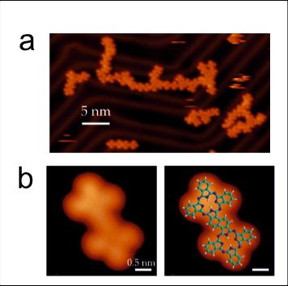 |
| a) STM image displaying the formation of quasi-unidimensional polymers. b) STM image and models of the majority of products between coupled monomers. CREDIT: Dr. David Ecija, IMDEA Nanoscience |
Abstract:
The collaboration between the research groups of professors Pau Ballester and José R. Galan-Mascaros at the Institute of Chemical Research of Catalonia (ICIQ), Dr. Jonas Björk at Linköping University and the group of Dr. David Ecija at Institute IMDEA Nanoscience has allowed the development of a new chemical reaction for the synthesis of low-dimensional polymers that can be rationalised as phthalocyanine derivatives. The results obtained have been published in Nature Communications.
New reaction for the synthesis of nanostructures
Tarragona, Spain | Posted on July 21st, 2016Surface-mediated synthesis of low-dimensional polymers from simple molecular precursors is a rapidly emerging field. In this work, the researchers introduce surface-confined thermally tunable reaction pathways as a route to select intramolecular versus intermolecular reactions yielding either monomeric phthalocyanines or low-dimensional phthalocyanine polymers, respectively.The precursor was designed and synthesised at ICIQ's laboratories. Next at IMDEA Nanoscience, it was deposited on a gold surface where it has been gently annealed to more than 300ºC in order to study its behaviour. When the temperature rises up to 275ºC, the polymerisation of the molecule occurs resulting in phthalocyanine unidimensional polymers (phthalocyanine tapes) that had not been synthesised so far. However, if the molecules are deposited on a substrate held at 300ºC, the polymeric growth is blocked and the precursor is transformed into individual phthalocyanines. This selectivity induced by temperature, despite being a promising strategy for increasing the synthetic versatility, had not been used on surfaces up to now. Nevertheless, this use could have huge advantages when engineering nanostructures with technological applications.
"On-surface synthesis is a promising strategy for the formation of nanostructures. This new thermally controlled reaction presents a very interesting alternative for the development of new polymeric materials, which will satisfy the growing demand from disciplines such as nanotechnology, information technology and biotechnology" -say Prof. Galan-Mascaros and Dr. David Ecija.
####
About Institute of Chemical Research of Catalonia (ICIQ)
The ICIQ is a member of the Barcelona Institute of Science and Technology and a leading international centre of chemical research. The institute has 19 research groups that work in the areas of catalysis (discovery and improvement of more sustainable chemical production processes and drug development) and renewable energies (generation of hydrogen from water, photovoltaic molecular, conversion of CO2 into materials and fuels of industrial interest). The ICIQ is a Centro de Excelencia Severo Ochoa, has received 14 grants from the European Research Council (ERC) and 9 of its researchers are ICREA professors.
About IMDEA Nanoscience:
IMDEA-Nanociencia is a private non profit Foundation created by initiative of the the regional Government of the Community of Madrid in November 2006 in order to shorten the distance between the research and society in the Madrid region and provide new capacity for research, technological development and innovation in the field of Nanoscience, Nanotechnology and Molecular Design. The Foundation manages the IMDEA-Nanociencia Institute, a new interdisciplinary research centre dedicated to the exploration of basic nanoscience and the development of applications of nanotechnology in connection with innovative industries.The IMDEA-Nanociencia Institute is part of one of the strategic lines of the Campus of International Excellence (CEI) UAM+CSIC.
For more information, please click here
Contacts:
Rosario Martinez
34-977-920-200-370
Corresponding authors:
Pablo Ballester
José R. Galan-Mascaros
David Ecija
Copyright © Institute of Chemical Research of Catalonia (ICIQ)
If you have a comment, please Contact us.Issuers of news releases, not 7th Wave, Inc. or Nanotechnology Now, are solely responsible for the accuracy of the content.
Bookmark:


| Related Links |
| Related News Press |
News and information
 Quantum computer improves AI predictions April 17th, 2026
Flexible sensor gains sensitivity under pressure April 17th, 2026
A reusable chip for particulate matter sensing April 17th, 2026
Detecting vibrational quantum beating in the predissociation dynamics of SF6 using time-resolved photoelectron spectroscopy April 17th, 2026
Chemistry
Projecting light to dispense liquids: A new route to ultra-precise microdroplets January 30th, 2026
From sensors to smart systems: the rise of AI-driven photonic noses January 30th, 2026
"Nanoreactor" cage uses visible light for catalytic and ultra-selective cross-cycloadditions October 3rd, 2025
Cambridge chemists discover simple way to build bigger molecules – one carbon at a time June 6th, 2025
Govt.-Legislation/Regulation/Funding/Policy
Quantum computer improves AI predictions April 17th, 2026
Metasurfaces smooth light to boost magnetic sensing precision January 30th, 2026
New imaging approach transforms study of bacterial biofilms August 8th, 2025
Possible Futures
A fundamentally new therapeutic approach to cystic fibrosis: Nanobody repairs cellular defect April 17th, 2026
UC Irvine physicists discover method to reverse ‘quantum scrambling’ : The work addresses the problem of information loss in quantum computing system April 17th, 2026
Chip Technology
A reusable chip for particulate matter sensing April 17th, 2026
Metasurfaces smooth light to boost magnetic sensing precision January 30th, 2026
Discoveries
Quantum computer improves AI predictions April 17th, 2026
Flexible sensor gains sensitivity under pressure April 17th, 2026
A reusable chip for particulate matter sensing April 17th, 2026
Detecting vibrational quantum beating in the predissociation dynamics of SF6 using time-resolved photoelectron spectroscopy April 17th, 2026
Materials/Metamaterials/Magnetoresistance
First real-time observation of two-dimensional melting process: Researchers at Mainz University unveil new insights into magnetic vortex structures August 8th, 2025
Researchers unveil a groundbreaking clay-based solution to capture carbon dioxide and combat climate change June 6th, 2025
A 1960s idea inspires NBI researchers to study hitherto inaccessible quantum states June 6th, 2025
Institute for Nanoscience hosts annual proposal planning meeting May 16th, 2025
Announcements
A fundamentally new therapeutic approach to cystic fibrosis: Nanobody repairs cellular defect April 17th, 2026
UC Irvine physicists discover method to reverse ‘quantum scrambling’ : The work addresses the problem of information loss in quantum computing system April 17th, 2026
Interviews/Book Reviews/Essays/Reports/Podcasts/Journals/White papers/Posters
A fundamentally new therapeutic approach to cystic fibrosis: Nanobody repairs cellular defect April 17th, 2026
UC Irvine physicists discover method to reverse ‘quantum scrambling’ : The work addresses the problem of information loss in quantum computing system April 17th, 2026
Grants/Sponsored Research/Awards/Scholarships/Gifts/Contests/Honors/Records
Quantum computer improves AI predictions April 17th, 2026
Detecting vibrational quantum beating in the predissociation dynamics of SF6 using time-resolved photoelectron spectroscopy April 17th, 2026
Metasurfaces smooth light to boost magnetic sensing precision January 30th, 2026
Nanobiotechnology
A fundamentally new therapeutic approach to cystic fibrosis: Nanobody repairs cellular defect April 17th, 2026
New molecular technology targets tumors and simultaneously silences two ‘undruggable’ cancer genes August 8th, 2025
New imaging approach transforms study of bacterial biofilms August 8th, 2025
Electrifying results shed light on graphene foam as a potential material for lab grown cartilage June 6th, 2025
 |
||
 |
||
| The latest news from around the world, FREE | ||
 |
||
|
|
||
| Premium Products | ||
 |
||
|
Only the news you want to read!
Learn More |
||
 |
||
|
Full-service, expert consulting
Learn More |
||
|
|
||