Home > Press > New nanoscale technologies could revolutionize microscopes, study of disease
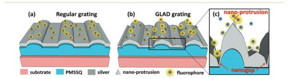 |
| This diagram shows the difference between regular and plasmonic gratings in terms of fluorescent intensity.
Photo courtesy of Shubhra Gangopadhyay/Nanoscale. |
Abstract:
Research completed through a collaboration with University of Missouri engineers, biologists, and chemists could transform how scientists study molecules and cells at sub-microscopic (nanoscale) levels. Shubra Gangopadhyay, an electrical and computer engineer and her team at MU recently published studies outlining a new, relatively inexpensive imaging platform that enables single molecule imaging. This patented method highlights Gangopadhyay's more than 30 years of nanoscale research that has proven invaluable in biological research and battling diseases.
New nanoscale technologies could revolutionize microscopes, study of disease
Columbia, MO | Posted on July 20th, 2016"Usually, scientists have to use very expensive microscopes to image at the sub-microscopic level," said Gangopadhyay, the C.W. LaPierre Endowed Chair of electrical and computer engineering in the MU College of Engineering. "The techniques we've established help to produce enhanced imaging results with ordinary microscopes. The relatively low production cost for the platform also means it could be used to detect a wide variety of diseases, particularly in developing countries."
The team's custom platform uses an interaction between light and the surface of the metal grating to generate surface plasmon resonance (SPR), a rapidly developing imaging technique that enables super-resolution imaging down to 65 nanometers--a resolution normally reserved for electron microscopes. Using HD-DVD and Blu-Ray discs as starting templates, a repeating grating pattern is transferred onto the microscope slides where the specimen will be placed. Since the patterns originate a widely used technology, the manufacturing process remains relatively inexpensive.
"In previous studies, we've used plasmonic gratings to detect cortisol and even tuberculosis," Gangopadhyay said. "Additionally, the relatively low production cost for the platform also means it could be used to further detect a wide variety of diseases, particularly in developing countries. Eventually, we might even be able to use smartphones to detect disease in the field."
Gangopadhyay's work also highlights the collaborations that are possible at the Mizzou. Working with the MU Departments of Bioengineering and Biochemistry, the team is helping to develop the next generation of undergraduate and graduate students. Patents and licenses developed by MU technologies help create and enhance relationships with industry, stimulate economic development, and impact the lives of state, national and international citizens.
"Plasmonic gratings with nano-protrusions made by glancing angle deposition (GLAD) for single-molecule super-resolution imaging" recently was published in Nanoscale, a journal of the Royal Society of Chemistry. The National Science Foundation provided partial funding for the studies. The content is solely the responsibility of the authors and does not necessarily represent the official views of the funding agency.
####
For more information, please click here
Contacts:
Jeff Sossamon
573-882-3346
Copyright © University of Missouri-Columbia
If you have a comment, please Contact us.Issuers of news releases, not 7th Wave, Inc. or Nanotechnology Now, are solely responsible for the accuracy of the content.
Bookmark:


| Related News Press |
News and information
 Quantum computer improves AI predictions April 17th, 2026
Flexible sensor gains sensitivity under pressure April 17th, 2026
A reusable chip for particulate matter sensing April 17th, 2026
Detecting vibrational quantum beating in the predissociation dynamics of SF6 using time-resolved photoelectron spectroscopy April 17th, 2026
Imaging
Simple algorithm paired with standard imaging tool could predict failure in lithium metal batteries August 8th, 2025
Govt.-Legislation/Regulation/Funding/Policy
Quantum computer improves AI predictions April 17th, 2026
Metasurfaces smooth light to boost magnetic sensing precision January 30th, 2026
New imaging approach transforms study of bacterial biofilms August 8th, 2025
Possible Futures
A fundamentally new therapeutic approach to cystic fibrosis: Nanobody repairs cellular defect April 17th, 2026
UC Irvine physicists discover method to reverse ‘quantum scrambling’ : The work addresses the problem of information loss in quantum computing system April 17th, 2026
Discoveries
Quantum computer improves AI predictions April 17th, 2026
Flexible sensor gains sensitivity under pressure April 17th, 2026
A reusable chip for particulate matter sensing April 17th, 2026
Detecting vibrational quantum beating in the predissociation dynamics of SF6 using time-resolved photoelectron spectroscopy April 17th, 2026
Announcements
A fundamentally new therapeutic approach to cystic fibrosis: Nanobody repairs cellular defect April 17th, 2026
UC Irvine physicists discover method to reverse ‘quantum scrambling’ : The work addresses the problem of information loss in quantum computing system April 17th, 2026
Interviews/Book Reviews/Essays/Reports/Podcasts/Journals/White papers/Posters
A fundamentally new therapeutic approach to cystic fibrosis: Nanobody repairs cellular defect April 17th, 2026
UC Irvine physicists discover method to reverse ‘quantum scrambling’ : The work addresses the problem of information loss in quantum computing system April 17th, 2026
Tools
Metasurfaces smooth light to boost magnetic sensing precision January 30th, 2026
From sensors to smart systems: the rise of AI-driven photonic noses January 30th, 2026
Japan launches fully domestically produced quantum computer: Expo visitors to experience quantum computing firsthand August 8th, 2025
Patents/IP/Tech Transfer/Licensing
Getting drugs across the blood-brain barrier using nanoparticles March 3rd, 2023
Metasurfaces control polarized light at will: New research unlocks the hidden potential of metasurfaces August 13th, 2021
Arrowhead Pharmaceuticals Announces Closing of Agreement with Takeda November 27th, 2020
 |
||
 |
||
| The latest news from around the world, FREE | ||
 |
||
|
|
||
| Premium Products | ||
 |
||
|
Only the news you want to read!
Learn More |
||
 |
||
|
Full-service, expert consulting
Learn More |
||
|
|
||