Home > Press > Yale scientists amplify light using sound on a silicon chip
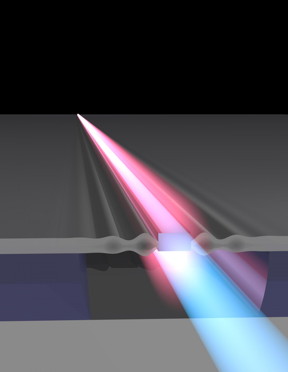 |
| Yale scientists have found a way to amplify the intensity of light waves on a silicon microchip. CREDIT: Yale University |
Abstract:
Yale scientists have found a way to greatly boost the intensity of light waves on a silicon microchip using the power of sound.
Yale scientists amplify light using sound on a silicon chip
New Haven, CT | Posted on June 17th, 2016Writing in the journal Nature Photonics, a team led by Peter Rakich describes a new waveguide system that harnesses the ability to precisely control the interaction of light and sound waves. This work solves a long-standing problem of how to utilize this interaction in a robust manner on a silicon chip as the basis for powerful new signal-processing technologies.
The prevalence of silicon chips in today's technology makes the new system particularly advantageous, the researchers note. "Silicon is the basis for practically all microchip technologies," said Rakich, who is an assistant professor of applied physics and physics at Yale. "The ability to combine both light and sound in silicon permits us to control and process information in new ways that weren't otherwise possible."
Rakich said combining the two capabilities "is like giving a UPS driver an amphibious vehicle -- you can find a much more efficient route for delivery when traveling by land or water."
These opportunities have motivated numerous groups around the world to explore such hybrid technologies on a silicon chip. However, progress was stifled because those devices weren't efficient enough for practical applications. The Yale group lifted this roadblock using new device designs that prevent light and sound from escaping the circuits.
"Figuring out how to shape this interaction without losing amplification was the real challenge," said Eric Kittlaus, a graduate student in Rakich's lab and the study's first author. "With precise control over the light-sound interaction, we will be able to create devices with immediate practical uses, including new types of lasers."
The researchers said there are commercial applications for the technology in a number of areas, including fiber-optic communications and signal processing. The system is part of a larger body of research the Rakich lab has conducted for the past five years, focused on designing new microchip technologies for light.
Heedeuk Shin, a former member of the Rakich lab who is now a professor at the Pohang University of Science and Technology in Korea, is the study's other co-author. "We're glad to help advance these new technologies, and are very excited to see what the future holds," Shin said.
###
The work was supported by the MesoDynamic Architectures program at the U.S. Department of Defense's Defense Advanced Research Projects Agency (DARPA).
####
For more information, please click here
Contacts:
Jim Shelton
203-432-3881
Copyright © Yale University
If you have a comment, please Contact us.Issuers of news releases, not 7th Wave, Inc. or Nanotechnology Now, are solely responsible for the accuracy of the content.
Bookmark:


| Related News Press |
News and information
 Quantum computer improves AI predictions April 17th, 2026
Flexible sensor gains sensitivity under pressure April 17th, 2026
A reusable chip for particulate matter sensing April 17th, 2026
Detecting vibrational quantum beating in the predissociation dynamics of SF6 using time-resolved photoelectron spectroscopy April 17th, 2026
Govt.-Legislation/Regulation/Funding/Policy
Quantum computer improves AI predictions April 17th, 2026
Metasurfaces smooth light to boost magnetic sensing precision January 30th, 2026
New imaging approach transforms study of bacterial biofilms August 8th, 2025
Possible Futures
A fundamentally new therapeutic approach to cystic fibrosis: Nanobody repairs cellular defect April 17th, 2026
UC Irvine physicists discover method to reverse ‘quantum scrambling’ : The work addresses the problem of information loss in quantum computing system April 17th, 2026
Chip Technology
A reusable chip for particulate matter sensing April 17th, 2026
Metasurfaces smooth light to boost magnetic sensing precision January 30th, 2026
Optical computing/Photonic computing
ICFO researchers overcome long-standing bottleneck in single photon detection with twisted 2D materials August 8th, 2025
Programmable electron-induced color router array May 14th, 2025
Discoveries
Quantum computer improves AI predictions April 17th, 2026
Flexible sensor gains sensitivity under pressure April 17th, 2026
A reusable chip for particulate matter sensing April 17th, 2026
Detecting vibrational quantum beating in the predissociation dynamics of SF6 using time-resolved photoelectron spectroscopy April 17th, 2026
Announcements
A fundamentally new therapeutic approach to cystic fibrosis: Nanobody repairs cellular defect April 17th, 2026
UC Irvine physicists discover method to reverse ‘quantum scrambling’ : The work addresses the problem of information loss in quantum computing system April 17th, 2026
Interviews/Book Reviews/Essays/Reports/Podcasts/Journals/White papers/Posters
A fundamentally new therapeutic approach to cystic fibrosis: Nanobody repairs cellular defect April 17th, 2026
UC Irvine physicists discover method to reverse ‘quantum scrambling’ : The work addresses the problem of information loss in quantum computing system April 17th, 2026
Military
Quantum engineers ‘squeeze’ laser frequency combs to make more sensitive gas sensors January 17th, 2025
Chainmail-like material could be the future of armor: First 2D mechanically interlocked polymer exhibits exceptional flexibility and strength January 17th, 2025
Single atoms show their true color July 5th, 2024
NRL charters Navy’s quantum inertial navigation path to reduce drift April 5th, 2024
Photonics/Optics/Lasers
Metasurfaces smooth light to boost magnetic sensing precision January 30th, 2026
From sensors to smart systems: the rise of AI-driven photonic noses January 30th, 2026
 |
||
 |
||
| The latest news from around the world, FREE | ||
 |
||
|
|
||
| Premium Products | ||
 |
||
|
Only the news you want to read!
Learn More |
||
 |
||
|
Full-service, expert consulting
Learn More |
||
|
|
||