Home > Press > Switzerland winds up superconductivity: For the first time in Europe, the Swiss have achieved a fully superconductive coil able to reach a magnetic field of 25 Tesla
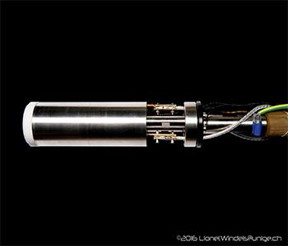 |
| Details of the innovative superconducting coil, conceived and manufactured by researchers from UNIGE and Bruker BioSpin.
© L. Windels - UNIGE |
Abstract:
The unusual electronic properties of some superconducting materials permit lossless and dense electrical currents at very low temperatures, even in high magnetic fields. Conductors made of these materials are thus ideal for winding coils to generate very high magnetic fields, which are essential for a number of applications like magnetic medical imaging, magnetic resonance spectroscopy for the analysis of complex molecules or even accelerator magnets. To generate ever-higher magnetic fields, physicists at the University of Geneva (UNIGE) and an R&D team of Bruker BioSpin in Fällanden (ZH), both in Switzerland, started a collaboration in 2012, which was partially funded by the Swiss National Science Foundation (SNSF). Together, they successfully developed and tested the first superconducting coil able to reach a magnetic field of 25 Tesla. A first in Europe.
Switzerland winds up superconductivity: For the first time in Europe, the Swiss have achieved a fully superconductive coil able to reach a magnetic field of 25 Tesla
Geneva, Switzerland | Posted on June 9th, 2016Today, the magnets used in nuclear magnetic resonance (NMR) and medical magnetic resonance imaging (MRI) represent the primary commercial applications of superconductivity. NMR, used mainly in the chemical and pharmaceutical industry, allows discovering new molecules, studying the structure of proteins or analyzing food content. It is essential for drug development or the quality control of chemical compounds. Modern measurement instruments available on the market today and manufactured particularly by Bruker BioSpin, world leader in this field, are able to produce magnetic fields of up to 23.5 Tesla. This limit is related to the physical properties of conventional superconducting materials used to generate the magnetic field. "However, there is a need for more powerful spectrometers in the biomedical field", says Carmine Senatore, professor in the Department of Quantum Matter Physics in the Faculty of Science at UNIGE. "Indeed, the stronger the magnetic field, the better the resolution of molecular structures. The goal of our collaboration was therefore to reach the new record for the magnetic field intensity of 25 Tesla with newly available superconducting materials, which was a real scientific and technological challenge. It is also an important milestone in the introduction of crucial technologies for the development of commercial ultra-high-field NMR products."
To create the magnetic field of 25 Tesla, the researchers combined a Bruker laboratory magnet producing 21 Tesla, already installed at UNIGE, with an innovative superconducting insert coil increasing the field by an additional 4 Tesla; so in total, a field well beyond the 23.5 Tesla reachable with conventional superconducting coils could be generated. In order to operate, the coil must be cooled with liquid helium to a temperature of ?269°C (4.2 K). The superconductor chosen to achieve such a field is a copper-oxide-based ceramic, YBCO. A one-micrometer thick layer of superconductor covers a thin steel tape which is then wound onto a cylindrical support to obtain the coil. 140 meters of 3 mm wide tape were necessary to produce the superconducting insert coil. In the preliminary design phase, many types of commercially available superconducting tapes were systematically studied and tested in order to understand and control their electrical, magnetic, mechanical and thermal properties. The challenge consisted of finding a conductor with the right balance of properties: it must carry high currents without dissipation, endure the winding process without degradation and withstand the magnetically generated mechanical stresses. This has been accomplished.
"In addition to the achievable higher resolution, which will certainly stimulate the scientific community and the network of institutions working at the forefront of molecular science, the use of YBCO will also simplify the operation of NMR spectrometers by using less complicated cooling systems", explains Riccardo Tediosi, manager of Bruker BioSpin's Superconducting Technologies group.
This first 25 Tesla coil will be a central and integral part of the laboratory of applied superconductivity at UNIGE. Although the coil is not a commercial product, the know-how developed for its design and manufacture represents an invaluable contribution to commercial NMR systems based on this technology. This project demonstrates how the Swiss network of research institutes and corporations active in this field in Switzerland are able to master such technologies. In the near future, this record magnet will be used for basic and fundamental research while scientists and engineers will aim at even more challenging goals: all-superconducting coils generating stable and homogeneous magnetic fields beyond 30 Tesla.
####
For more information, please click here
Contacts:
Carmine Senatore
41-223-796-669
Copyright © University of Geneva (UNIGE)
If you have a comment, please Contact us.Issuers of news releases, not 7th Wave, Inc. or Nanotechnology Now, are solely responsible for the accuracy of the content.
Bookmark:


| Related News Press |
News and information
 Quantum computer improves AI predictions April 17th, 2026
Flexible sensor gains sensitivity under pressure April 17th, 2026
A reusable chip for particulate matter sensing April 17th, 2026
Detecting vibrational quantum beating in the predissociation dynamics of SF6 using time-resolved photoelectron spectroscopy April 17th, 2026
Superconductivity
MXene nanomaterials enter a new dimension Multilayer nanomaterial: MXene flakes created at Drexel University show new promise as 1D scrolls January 30th, 2026
Imaging
Magnetism/Magnons
Metasurfaces smooth light to boost magnetic sensing precision January 30th, 2026
Govt.-Legislation/Regulation/Funding/Policy
Quantum computer improves AI predictions April 17th, 2026
Metasurfaces smooth light to boost magnetic sensing precision January 30th, 2026
New imaging approach transforms study of bacterial biofilms August 8th, 2025
Discoveries
Quantum computer improves AI predictions April 17th, 2026
Flexible sensor gains sensitivity under pressure April 17th, 2026
A reusable chip for particulate matter sensing April 17th, 2026
Detecting vibrational quantum beating in the predissociation dynamics of SF6 using time-resolved photoelectron spectroscopy April 17th, 2026
Announcements
A fundamentally new therapeutic approach to cystic fibrosis: Nanobody repairs cellular defect April 17th, 2026
UC Irvine physicists discover method to reverse ‘quantum scrambling’ : The work addresses the problem of information loss in quantum computing system April 17th, 2026
Interviews/Book Reviews/Essays/Reports/Podcasts/Journals/White papers/Posters
A fundamentally new therapeutic approach to cystic fibrosis: Nanobody repairs cellular defect April 17th, 2026
UC Irvine physicists discover method to reverse ‘quantum scrambling’ : The work addresses the problem of information loss in quantum computing system April 17th, 2026
Tools
Metasurfaces smooth light to boost magnetic sensing precision January 30th, 2026
From sensors to smart systems: the rise of AI-driven photonic noses January 30th, 2026
Japan launches fully domestically produced quantum computer: Expo visitors to experience quantum computing firsthand August 8th, 2025
Research partnerships
Lab to industry: InSe wafer-scale breakthrough for future electronics August 8th, 2025
HKU physicists uncover hidden order in the quantum world through deconfined quantum critical points April 25th, 2025
 |
||
 |
||
| The latest news from around the world, FREE | ||
 |
||
|
|
||
| Premium Products | ||
 |
||
|
Only the news you want to read!
Learn More |
||
 |
||
|
Full-service, expert consulting
Learn More |
||
|
|
||