Home > Press > 'Weak' materials offer strong possibilities for electronics
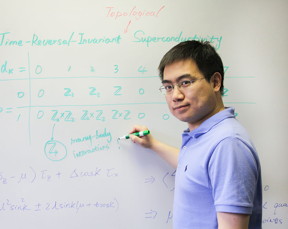 |
| Dr. Fan Zhang |
Abstract:
New fundamental research by UT Dallas physicists may accelerate the drive toward more advanced electronics and more powerful computers.
'Weak' materials offer strong possibilities for electronics
Dallas, TX | Posted on June 1st, 2016The scientists are investigating materials called topological insulators, whose surface electrical properties are essentially the opposite of the properties inside.
"These materials are made of the same thing throughout, from the interior to the exterior," said Dr. Fan Zhang, assistant professor of physics at UT Dallas. "But, the interior does not conduct electrons -- it's an insulator -- while the electrons on the surface are free to move around. The surface is therefore a conductor, like a metal, but it is in fact more robust than a metal."
There are two types of topological insulators: strong and weak. The difference between them is subtle and involves complex physics, but is critically important.
"If you had a cube of material that is a strong topological insulator, all six faces can conduct electrons," Zhang said. "For the weak one, only the four sides are conducting, while the top and bottom surfaces remain insulating."
Strong topological insulators were made experimentally shortly after they were theoretically proposed. Zhang said they are common in nature, and several dozen variations have been identified and experimentally confirmed.
On the other hand, weak topological insulators have been more elusive. Scientists have proposed various ways to construct a weak topological insulator, but because of its distinctive properties, researchers have not been able to say definitively that they have experimentally produced one.
Zhang, a theoretical physicist, has devised a new way to make a weak topological insulator, one that involves a relatively simple mix of two chemical elements: a crystal composed of bismuth combined with either iodine or bromine. He and his colleagues published the research recently in the journal Physical Review Letters and presented their work at the March meeting of the American Physical Society.
In the 1970s, German scientists grew bismuth iodides and bismuth bromides, but they didn't understand their potential as weak topological insulators, Zhang said.
"This class of materials we are proposing is a unique platform for exploring exotic physics with fairly simple chemistry," he said. "With further research and experimentation, our findings could lead to significant advances in technology, especially in electronics and quantum computing."
Electrically conductive materials are the fundamental building blocks of the traditional transistors that power electronic devices including cellphones and computers. Researchers are developing new theories and experiments with innovative physics and materials to create new transistor-like technologies that run devices and make computers more powerful.
With such exotic electrical properties, topological insulators offer a potential option, Zhang said.
"Our lives have been modified over time by our understanding of the conduction of electrons and the exploitation of this physics for use in electronic devices," he said. "We now need to revolutionize transistors. One possible substitution is a so-called topological field effect transistor, which could be made of a thin film of a weak topological insulator."
Computers also are heading for a fundamental redesign, and those efforts might be aided by Zhang's research.
"The fundamental computing scale is now very limited," he said. "For many applications, like weather forecasting and information encoding and decoding, today's computers are way too slow. However, quantum computers have been proposed that would use the principles of quantum physics to compute exponentially faster than today's computers.
"Weak topological insulators could make quantum computing feasible."
As a theorist, Zhang used old-fashioned pencil and paper to construct the basis of his theory about the bismuth compounds. His postdoctoral researcher Dr. Cheng-Cheng Liu, the study's lead author and now an assistant professor at Beijing Institute of Technology, then crunched specific numbers using high-speed supercomputers at the Texas Advanced Computing Center based at UT Austin.
Zhang's UT Dallas colleague, Dr. Bing Lv, assistant professor of physics, has made samples of bismuth iodide.
"The next step will be to characterize the material to explore the unique properties that a weak topological insulator can offer to fundamental physics and to our everyday lives," Zhang said.
###
In addition to Zhang and Liu, other authors of the study are Dr. Jin-Jian Zhou at California Institute of Technology and Yugui Yao at Beijing Institute of Technology.
The work at UT Dallas was primarily supported by University startup funds and the National Science Foundation through the Aspen Center for Physics and Kavli Institute for Theoretical Physics.
####
For more information, please click here
Contacts:
Amanda Siegfried
972-883-4335
Copyright © University of Texas at Dallas
If you have a comment, please Contact us.Issuers of news releases, not 7th Wave, Inc. or Nanotechnology Now, are solely responsible for the accuracy of the content.
Bookmark:


| Related News Press |
News and information
 Quantum computer improves AI predictions April 17th, 2026
Flexible sensor gains sensitivity under pressure April 17th, 2026
A reusable chip for particulate matter sensing April 17th, 2026
Detecting vibrational quantum beating in the predissociation dynamics of SF6 using time-resolved photoelectron spectroscopy April 17th, 2026
Quantum Physics
Detecting vibrational quantum beating in the predissociation dynamics of SF6 using time-resolved photoelectron spectroscopy April 17th, 2026
Beyond silicon: Electronics at the scale of a single molecule January 30th, 2026
MXene nanomaterials enter a new dimension Multilayer nanomaterial: MXene flakes created at Drexel University show new promise as 1D scrolls January 30th, 2026
Physics
UC Irvine physicists discover method to reverse ‘quantum scrambling’ : The work addresses the problem of information loss in quantum computing system April 17th, 2026
Chemistry
Projecting light to dispense liquids: A new route to ultra-precise microdroplets January 30th, 2026
From sensors to smart systems: the rise of AI-driven photonic noses January 30th, 2026
Govt.-Legislation/Regulation/Funding/Policy
Quantum computer improves AI predictions April 17th, 2026
Metasurfaces smooth light to boost magnetic sensing precision January 30th, 2026
New imaging approach transforms study of bacterial biofilms August 8th, 2025
Possible Futures
A fundamentally new therapeutic approach to cystic fibrosis: Nanobody repairs cellular defect April 17th, 2026
UC Irvine physicists discover method to reverse ‘quantum scrambling’ : The work addresses the problem of information loss in quantum computing system April 17th, 2026
Chip Technology
A reusable chip for particulate matter sensing April 17th, 2026
Metasurfaces smooth light to boost magnetic sensing precision January 30th, 2026
Quantum Computing
Quantum computer improves AI predictions April 17th, 2026
UC Irvine physicists discover method to reverse ‘quantum scrambling’ : The work addresses the problem of information loss in quantum computing system April 17th, 2026
Researchers develop molecular qubits that communicate at telecom frequencies October 3rd, 2025
Discoveries
Quantum computer improves AI predictions April 17th, 2026
Flexible sensor gains sensitivity under pressure April 17th, 2026
A reusable chip for particulate matter sensing April 17th, 2026
Detecting vibrational quantum beating in the predissociation dynamics of SF6 using time-resolved photoelectron spectroscopy April 17th, 2026
Materials/Metamaterials/Magnetoresistance
First real-time observation of two-dimensional melting process: Researchers at Mainz University unveil new insights into magnetic vortex structures August 8th, 2025
Researchers unveil a groundbreaking clay-based solution to capture carbon dioxide and combat climate change June 6th, 2025
A 1960s idea inspires NBI researchers to study hitherto inaccessible quantum states June 6th, 2025
Institute for Nanoscience hosts annual proposal planning meeting May 16th, 2025
Announcements
A fundamentally new therapeutic approach to cystic fibrosis: Nanobody repairs cellular defect April 17th, 2026
UC Irvine physicists discover method to reverse ‘quantum scrambling’ : The work addresses the problem of information loss in quantum computing system April 17th, 2026
Interviews/Book Reviews/Essays/Reports/Podcasts/Journals/White papers/Posters
A fundamentally new therapeutic approach to cystic fibrosis: Nanobody repairs cellular defect April 17th, 2026
UC Irvine physicists discover method to reverse ‘quantum scrambling’ : The work addresses the problem of information loss in quantum computing system April 17th, 2026
Grants/Sponsored Research/Awards/Scholarships/Gifts/Contests/Honors/Records
Quantum computer improves AI predictions April 17th, 2026
Detecting vibrational quantum beating in the predissociation dynamics of SF6 using time-resolved photoelectron spectroscopy April 17th, 2026
Metasurfaces smooth light to boost magnetic sensing precision January 30th, 2026
 |
||
 |
||
| The latest news from around the world, FREE | ||
 |
||
|
|
||
| Premium Products | ||
 |
||
|
Only the news you want to read!
Learn More |
||
 |
||
|
Full-service, expert consulting
Learn More |
||
|
|
||