Home > Press > The next generation of carbon monoxide nanosensors
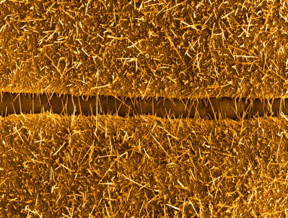 |
| This is an adaptation of a scanning electron microscopy image of copper oxide nanowires bridging the gap between neighbouring copper microstructures CREDIT: OIST |
Abstract:
The detection of carbon monoxide (CO) in the air is a vital issue, as CO is a poisonous gas and an environmental pollutant. CO typically derives from the incomplete combustion of carbon-based fuels, such as cooking gas and gasoline; it has no odour, taste, or colour and hence it is difficult to detect. Scientists have been investigating sensors that can determine CO concentration, and a team from the Okinawa Institute of Science and Technology Graduate University (OIST), in tandem with the University of Toulouse, has found an innovative method to build such sensors.
The next generation of carbon monoxide nanosensors
Okinawa, Japan | Posted on May 26th, 2016As a tool for CO detection, scientists use extremely small wires: copper oxide nanowires. Copper oxide nanowires chemically react with CO, creating an electrical signal that can be used to quantify CO concentration. These nanowires are so thin that it is possible to fit more than 1.000 of them in the average thickness of a human hair.
Two issues have hampered the use of nanowires. "The first problem is the integration of nanowires into devices that are big enough to be handled and that can also be easily mass produced," said Prof Mukhles Sowwan, director of the Nanoparticles by Design Unit at OIST. "The second issue is the ability to control the number and position of nanowires in such devices." Both these difficulties might have been solved by Dr Stephan Steinhauer, postdoctoral scholar at OIST, together with Prof Sowwan, and researchers from the University of Toulouse. They recently published their research in the journal ACS Sensors.
"To create copper oxide nanowires, you need to heat neighbouring copper microstructures. Starting from the microstructures, the nanowires grow and bridge the gap between the microstructures, forming an electrical connection between them," Dr Steinhauer explained. "We integrated copper microstructures on a micro-hotplate, developed by the University of Toulouse. A micro-hotplate is a thin membrane that can heat up to several hundred Celsius degrees, but with very low power consumption." Thanks to the micro-hotplate, researchers have a high degree of control over the quantity and position of the nanowires. Also, the micro-hotplate provides scientists with data on the electrical signal that goes through the nanowires.
The final result is an exceptionally sensitive device, capable of detecting very low concentrations of CO. "Potentially, miniaturized CO sensors that integrate copper oxide nanowires with micro-hotplates are the first step towards the next generation of gas sensors," Prof Sowwan commented. "In contrast to other techniques, our approach is cost effective and suitable for mass production."
This new method could also help scientists in better understanding the sensor lifetime. The performance of a sensor decreases overtime, and this is a major issue in gas sensing. Data obtained with this method could help scientists in understanding the mechanisms behind such phenomenon, providing them with information that starts at the very beginning of the sensor lifetime. Traditionally, researchers first grow the nanowires, then connect the nanowires to a device, and finally start measuring the CO concentration. "Our method allows to grow the nanowires in a controlled atmosphere, where you can immediately perform gas sensing measurements," Dr Steinhauer noted. "Basically, you stop growing and start measuring, all in the same location."
####
For more information, please click here
Contacts:
Kaoru Natori
81-989-662-389
Copyright © Okinawa Institute of Science and Technology Graduate University (OIST)
If you have a comment, please Contact us.Issuers of news releases, not 7th Wave, Inc. or Nanotechnology Now, are solely responsible for the accuracy of the content.
Bookmark:


| Related Links |
| Related News Press |
News and information
 Quantum computer improves AI predictions April 17th, 2026
Flexible sensor gains sensitivity under pressure April 17th, 2026
A reusable chip for particulate matter sensing April 17th, 2026
Detecting vibrational quantum beating in the predissociation dynamics of SF6 using time-resolved photoelectron spectroscopy April 17th, 2026
Sensors
Flexible sensor gains sensitivity under pressure April 17th, 2026
Tiny nanosheets, big leap: A new sensor detects ethanol at ultra-low levels January 30th, 2026
From sensors to smart systems: the rise of AI-driven photonic noses January 30th, 2026
Sensors innovations for smart lithium-based batteries: advancements, opportunities, and potential challenges August 8th, 2025
Discoveries
Quantum computer improves AI predictions April 17th, 2026
Flexible sensor gains sensitivity under pressure April 17th, 2026
A reusable chip for particulate matter sensing April 17th, 2026
Detecting vibrational quantum beating in the predissociation dynamics of SF6 using time-resolved photoelectron spectroscopy April 17th, 2026
Announcements
A fundamentally new therapeutic approach to cystic fibrosis: Nanobody repairs cellular defect April 17th, 2026
UC Irvine physicists discover method to reverse ‘quantum scrambling’ : The work addresses the problem of information loss in quantum computing system April 17th, 2026
Interviews/Book Reviews/Essays/Reports/Podcasts/Journals/White papers/Posters
A fundamentally new therapeutic approach to cystic fibrosis: Nanobody repairs cellular defect April 17th, 2026
UC Irvine physicists discover method to reverse ‘quantum scrambling’ : The work addresses the problem of information loss in quantum computing system April 17th, 2026
Environment
A reusable chip for particulate matter sensing April 17th, 2026
Researchers unveil a groundbreaking clay-based solution to capture carbon dioxide and combat climate change June 6th, 2025
Research partnerships
Lab to industry: InSe wafer-scale breakthrough for future electronics August 8th, 2025
HKU physicists uncover hidden order in the quantum world through deconfined quantum critical points April 25th, 2025
 |
||
 |
||
| The latest news from around the world, FREE | ||
 |
||
|
|
||
| Premium Products | ||
 |
||
|
Only the news you want to read!
Learn More |
||
 |
||
|
Full-service, expert consulting
Learn More |
||
|
|
||