Home > Press > Attosecond physics: A switch for light-wave electronics
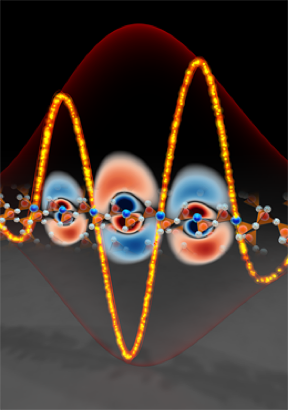 |
| Atoms in silicon dioxide are hit by the light wave, causing the electrons around each atom to oscillate. At the end of the cycle the absorbed energy is returned to the light wave. Recording the temporal evolution of the light field allows the first real-time observation of attosecond-scale electron motions within solids. Image: Christian Hackenberg |
Abstract:
Light waves could in principle be used to drive future transistors. Since the electromagnetic waves of light oscillate approximately one million times in a billionth of a second, i.e. at petahertz (PHz) frequencies, optoelectronic computers could attain switching rates 100,000 times higher than current digital electronic systems. However, to achieve this goal, we will need a better understanding of the sub-atomic electron motion induced by the ultrafast electric field of light. Now a team led by Ferenc Krausz, who holds a Chair in Experimental Physics at LMU and is a Director of the Max Planck Institute for Quantum Optics in Garching, in collaboration with theorists from Tsukuba University in Japan, has used a novel combination of experimental and theoretical techniques, which for the first time provides direct access to the dynamics of this process. The new findings are reported in the journal Nature.
Attosecond physics: A switch for light-wave electronics
Munich, Germany | Posted on May 24th, 2016Insights into attosecond electron dynamics
Electron movements form the basis of electronics, as they facilitate the storage, processing and transfer of information. State-of-the-art electronic circuits have reached their maximum clock rates at some billion switching cycles per second, as any further increase is limited by the heat generated in the process of switching power on and off. The electric field of light changes its direction a trillion times per second and is able to mobilize electrons in solids at this rate. This means that light waves can form the basis for future electronic switching, provided the induced electron motion and its influence on heat accumulation is precisely understood. In two papers published back-to-back in Nature in 2012, Krausz and his team had already shown that it is possible to manipulate the electronic properties of matter at optical frequencies (doi: 10.1038/nature11567, doi:10.1038/nature11720).
As in these earlier experiments, the researchers have now employed extremely intense laser pulses, each lasting for a few femtoseconds (1 fs is a millionth of a billionth of a second) to perturb electrons in glass (silicon dioxide). The light pulse consists of a single oscillation of the field, so the electrons are moved left and right only once. The full temporal characterization of the light field after transmission through the thin glass plate for the first time yields direct insight into the electron dynamics induced by the light pulse in the solid on an attosecond scale.
Optimizing the interaction of light and matter
This measurement technique reveals that electrons react to the incoming light within a few tens of attoseconds (1 as is a billionth of a billionth of a second). The duration of the delay in the response in turn determines the amount of energy transferred between light and matter. Since it is possible to measure the energy exchanged within one light cycle for the first time, the parameters of the light-matter interaction can be precisely determined and optimized for ultrafast signal processing. The greater the degree of reversibility in the exchange and the smaller the amount of energy left behind in the medium after passage of the light pulse, the more suitable the interaction becomes for future light field-driven electronics.
To obtain a detailed understanding of the observed phenomena, and identify the most appropriate set of experimental parameters for that purpose, the experiments were backed up by a novel simulation method based on first principles developed at the Center for Computational Sciences at University of Tsukuba. The theorists there used the K computer, currently the fourth fastest supercomputer in the world, to compute electron motions within solids with unprecedented accuracy.
The researchers succeeded in optimizing the energy consumption by carefully tuning the amplitude of the light field. At certain field strengths energy is transferred from the field to the solid during the first half of the pulse cycle and is almost completely re-emitted during in the second half of the oscillation period. These findings confirm that a potential switching medium for future light-driven electronics would not overheat. The 'cool relationship' between glass and light might thus provide an opportunity to dramatically accelerate electronic signal- and data processing to its ultimate limits.
####
For more information, please click here
Contacts:
Kathrin Bilgeri
49-892-180-6938
Copyright © Ludwig-Maximilians-Universität München (LMU)
If you have a comment, please Contact us.Issuers of news releases, not 7th Wave, Inc. or Nanotechnology Now, are solely responsible for the accuracy of the content.
Bookmark:


| Related News Press |
News and information
 Quantum computer improves AI predictions April 17th, 2026
Flexible sensor gains sensitivity under pressure April 17th, 2026
A reusable chip for particulate matter sensing April 17th, 2026
Detecting vibrational quantum beating in the predissociation dynamics of SF6 using time-resolved photoelectron spectroscopy April 17th, 2026
Possible Futures
A fundamentally new therapeutic approach to cystic fibrosis: Nanobody repairs cellular defect April 17th, 2026
UC Irvine physicists discover method to reverse ‘quantum scrambling’ : The work addresses the problem of information loss in quantum computing system April 17th, 2026
Chip Technology
A reusable chip for particulate matter sensing April 17th, 2026
Metasurfaces smooth light to boost magnetic sensing precision January 30th, 2026
Optical computing/Photonic computing
ICFO researchers overcome long-standing bottleneck in single photon detection with twisted 2D materials August 8th, 2025
Programmable electron-induced color router array May 14th, 2025
Discoveries
Quantum computer improves AI predictions April 17th, 2026
Flexible sensor gains sensitivity under pressure April 17th, 2026
A reusable chip for particulate matter sensing April 17th, 2026
Detecting vibrational quantum beating in the predissociation dynamics of SF6 using time-resolved photoelectron spectroscopy April 17th, 2026
Announcements
A fundamentally new therapeutic approach to cystic fibrosis: Nanobody repairs cellular defect April 17th, 2026
UC Irvine physicists discover method to reverse ‘quantum scrambling’ : The work addresses the problem of information loss in quantum computing system April 17th, 2026
Interviews/Book Reviews/Essays/Reports/Podcasts/Journals/White papers/Posters
A fundamentally new therapeutic approach to cystic fibrosis: Nanobody repairs cellular defect April 17th, 2026
UC Irvine physicists discover method to reverse ‘quantum scrambling’ : The work addresses the problem of information loss in quantum computing system April 17th, 2026
Photonics/Optics/Lasers
Metasurfaces smooth light to boost magnetic sensing precision January 30th, 2026
From sensors to smart systems: the rise of AI-driven photonic noses January 30th, 2026
 |
||
 |
||
| The latest news from around the world, FREE | ||
 |
||
|
|
||
| Premium Products | ||
 |
||
|
Only the news you want to read!
Learn More |
||
 |
||
|
Full-service, expert consulting
Learn More |
||
|
|
||