Home > Press > Two-stage nanoparticle delivery of piperlongumine and TRAIL anti-cancer therapy
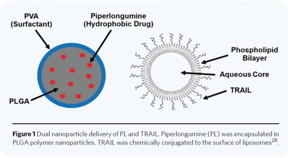 |
| Piperlongumine (PL) was encapsulated in PLGA polymer nanoparticles. TRAIL was chemically conjugated to the surface of liposomes. CREDIT: TECHNOLOGY |
Abstract:
A team of researchers from Cornell University in Ithaca, New York demonstrated a drug delivery mechanism that utilizes two independent vehicles, allowing for delivery of chemically and physically dis-tinct agents. The mechanism was utilized to deliver a new anti-cancer combination therapy consisting of piperlongumine (PL) and TRAIL to treat PC3 prostate cancer and HCT116 colon cancer cells. PL, a small-molecule hydrophobic drug, was encapsulated in poly (lactic-co-glycolic acid) (PLGA) nanoparticles. TRAIL was chemically conjugated to the surface of nanoscale liposomes. PL was first administered to sensitize cancer cells to the effects of TRAIL. PC3 and HCT116 cells had lower survival rates in vitro after receiving the dual nanoparticle therapy compared to each agent individually. In vivo testing involved a subcutaneous mouse xenograft model using NOD-SCID gamma mice and HCT116 cells. Two treatment cycles were administered over 48 hours. Higher apoptotic rates were observed for HCT116 tumor cells that received the dual nanoparticle therapy compared to individual stages of the nanoparticle therapy alone. The report appears in the latest issue of the journal TECHNOLOGY.
Two-stage nanoparticle delivery of piperlongumine and TRAIL anti-cancer therapy
Singapore | Posted on May 23rd, 2016"We have found that liposomal TRAIL shows great promise for the destruction of tumor cells in the bloodstream, lymphatic system, and also in solid tumors," says Daljit S. and Elaine Sarkaria Professor Michael R. King, Ph.D., of Cornell University and senior author of the study.
In the paper, the Cornell researchers describe a nanoparticle-based drug delivery mechanism developed for a combination cancer therapy. Nanoparticle delivery platforms have been previously pursued for a variety of cancer therapies. A number of studies have focused on complex particle structures and designs aimed at improving delivery. The Cornell group's system utilizes a different approach through the use of a dual nanoparticle delivery mechanism. Therapeutic components were administered through separate particles as opposed to delivering the agents in a single particle. Given the hydrophobic nature of the TRAIL sensitizer, the drug was encapsulated in polymer-based nanoparticles.
In the study, researchers observed of a higher number of apoptotic cells in mouse trials, consistent with their observed laboratory results that demonstrated an increased therapeutic efficacy when utilizing the two-stage nanoparticle therapy compared to each individual nanoparticle stage alone. The dual nanoparticle delivery system provided a level of flexibility when administering the two stages of the therapy, allowing for an opportunity for sensitization of the tumor cells prior to administering the second component of the therapy.
The team from Cornell is working now to develop a new therapeutic approach to target cancer cells in the bloodstream for the prevention of prostate cancer metastasis, that utilizes circulating leukocytes as a carrier for the apoptosis ligand TRAIL. Once introduced into the bloodstream, E-selectin/TRAIL liposomes attach to the surface of peripheral blood leukocytes, to render these "unnatural killer cells" cytotoxic to circulating cancer cells without affecting blood cell or endothelial cell viability. They previously showed that viable cancer cells can be rapidly cleared from the bloodstream, using liposome-bound TRAIL concentrations that are two orders of magnitude lower than the dosages used in prior human clinical trials of soluble TRAIL protein. More recently, they have found that E-selectin/TRAIL liposomes can completely block metastasis and also shrink primary prostate cancer tumors in mice.
###
Additional co-authors of the TECHNOLOGY paper are Charles Sharkey, Jiahe Li, Ph.D., Sweta Roy, and Qianhui Wu, all from the Meinig School of Biomedical Engineering at Cornell University.
Corresponding author for this study in TECHNOLOGY is Professor Michael King, Ph.D., .
####
For more information, please click here
Contacts:
Philly Lim
65-646-65775
Copyright © World Scientific
If you have a comment, please Contact us.Issuers of news releases, not 7th Wave, Inc. or Nanotechnology Now, are solely responsible for the accuracy of the content.
Bookmark:


| Related News Press |
News and information
 Quantum computer improves AI predictions April 17th, 2026
Flexible sensor gains sensitivity under pressure April 17th, 2026
A reusable chip for particulate matter sensing April 17th, 2026
Detecting vibrational quantum beating in the predissociation dynamics of SF6 using time-resolved photoelectron spectroscopy April 17th, 2026
Cancer
New molecular technology targets tumors and simultaneously silences two ‘undruggable’ cancer genes August 8th, 2025
Ben-Gurion University of the Negev researchers several steps closer to harnessing patient's own T-cells to fight off cancer June 6th, 2025
Self-propelled protein-based nanomotors for enhanced cancer therapy by inducing ferroptosis June 6th, 2025
Nanomedicine
A fundamentally new therapeutic approach to cystic fibrosis: Nanobody repairs cellular defect April 17th, 2026
New molecular technology targets tumors and simultaneously silences two ‘undruggable’ cancer genes August 8th, 2025
New imaging approach transforms study of bacterial biofilms August 8th, 2025
Electrifying results shed light on graphene foam as a potential material for lab grown cartilage June 6th, 2025
Discoveries
Quantum computer improves AI predictions April 17th, 2026
Flexible sensor gains sensitivity under pressure April 17th, 2026
A reusable chip for particulate matter sensing April 17th, 2026
Detecting vibrational quantum beating in the predissociation dynamics of SF6 using time-resolved photoelectron spectroscopy April 17th, 2026
Announcements
A fundamentally new therapeutic approach to cystic fibrosis: Nanobody repairs cellular defect April 17th, 2026
UC Irvine physicists discover method to reverse ‘quantum scrambling’ : The work addresses the problem of information loss in quantum computing system April 17th, 2026
Interviews/Book Reviews/Essays/Reports/Podcasts/Journals/White papers/Posters
A fundamentally new therapeutic approach to cystic fibrosis: Nanobody repairs cellular defect April 17th, 2026
UC Irvine physicists discover method to reverse ‘quantum scrambling’ : The work addresses the problem of information loss in quantum computing system April 17th, 2026
Nanobiotechnology
A fundamentally new therapeutic approach to cystic fibrosis: Nanobody repairs cellular defect April 17th, 2026
New molecular technology targets tumors and simultaneously silences two ‘undruggable’ cancer genes August 8th, 2025
New imaging approach transforms study of bacterial biofilms August 8th, 2025
Electrifying results shed light on graphene foam as a potential material for lab grown cartilage June 6th, 2025
 |
||
 |
||
| The latest news from around the world, FREE | ||
 |
||
|
|
||
| Premium Products | ||
 |
||
|
Only the news you want to read!
Learn More |
||
 |
||
|
Full-service, expert consulting
Learn More |
||
|
|
||