Home > Press > Nanotubes are beacons in cancer-imaging technique: Rice University researchers use spectral triangulation to pinpoint location of tumors
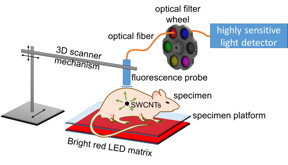 |
| A new Rice University method for medical imaging uses strong light from an LED array and an avalanche photodiode detector to pinpoint the location of tumors that have been tagged by antibody-targeted carbon nanotubes. The method can detect fluorescence from single-walled carbon nanotubes (SWCNTs) through up to 20 millimeters of tissue. Credit: Weisman Lab/Rice University |
Abstract:
Bathing a patient in LED light may someday offer a new way to locate tumors, according to Rice University researchers.
Nanotubes are beacons in cancer-imaging technique: Rice University researchers use spectral triangulation to pinpoint location of tumors
Houston, TX | Posted on May 21st, 2016The spectral triangulation system developed by Rice chemist Bruce Weisman and his colleagues is intended to pinpoint targeted cancer tumors tagged with antibody-linked carbon nanotubes. It is described in a paper in the Royal Society of Chemistry journal Nanoscale.
Because the absorption of short-wave infrared light in tissues varies with its wavelength, spectral analysis of light coming through the skin can reveal the depth of tissue through which that light has passed. This allows the three-dimensional coordinates of the nanotube beacon to be deduced from a small set of noninvasive optical measurements.
The Rice technique relies on the fact that single-walled carbon nanotubes naturally fluoresce at short-wave infrared wavelengths when excited by visible light. A highly sensitive detector called an InGaAs (indium gallium arsenide) avalanche photodiode made it possible to read faint signals from nanotubes up to 20 millimeters deep in the simulated tissue used for lab tests.
"We're using an unusually sensitive detector that hasn't been applied to this sort of work before," said Weisman, a recognized pioneer for his discovery and interpretation of near-infrared fluorescence from single-walled nanotubes.
"This avalanche photodiode can count photons in the short-wave infrared, which is a challenging spectral range for light sensors. The main goal is to see how well we can detect and localize emission from very small concentrations of nanotubes inside biological tissues. This has potential applications in medical diagnosis."
Using light-emitting diodes to excite the nanotubes is effective -- and inexpensive, Weisman said. "It's relatively unconventional to use LEDs," he said. "Instead, lasers are commonly used for excitation, but laser beams can’t be focused inside tissues because of scattering. We bathe the surface of the specimen in unfocused LED light, which diffuses through the tissues and excites nanotubes inside."
A small optical probe mounted on the frame of a 3-D printer follows a computer-programmed pattern as the probe gently touches the skin to make readings at grid points spaced a few millimeters apart.
Before reaching the detector, light from the nanotubes is partly absorbed by water as it travels through tissues. Weisman and his team use that to their advantage. "A two-dimensional search tells us the emitter’s X and Y coordinates but not Z -- the depth," he said. "That's a very difficult thing to deduce from a surface scan."
Spectral triangulation overcomes the limitation. "We make use of the fact that different wavelengths of nanotube emission are absorbed differently going through tissue," Weisman said. "Water (in the surrounding tissue) absorbs the longer wavelengths coming from nanotubes much more strongly than it does the shorter wavelengths.
"If we're detecting nanotubes close to the surface, the long and the short wavelength emissions are relatively similar in intensity. We say the spectrum is unperturbed.
"But if the emission source is deeper, water in that tissue absorbs the longer wavelengths preferentially to the shorter wavelengths," he said. "So the balance between the intensities of the short and long wavelengths is a yardstick to measure how deep the source is. That's how we get the Z coordinate."
The detector is now being tested in the lab of Dr. Robert Bast, an expert in ovarian cancer and vice president for translational research at the University of Texas MD Anderson Cancer Center.
"It gives us a fighting chance to see nanotubes deeper inside tissues because so little of the light that nanotubes emit finds its way to the surface," Weisman said. "We've been able to detect deeper into the tissues than I think anyone else has reported."
Rice graduate student Ching-Wei Lin is lead author of the paper. Rice research scientist Sergei Bachilo, postdoctoral fellow Michael Vu and Kathleen Beckingham, a professor of biochemistry and cell biology, are co-authors.
The National Science Foundation, the Welch Foundation, the National Institutes of Health and the John S. Dunn Foundation Collaborative Research Award Program supported the research.
####
About Rice University
Located on a 300-acre forested campus in Houston, Rice University is consistently ranked among the nation’s top 20 universities by U.S. News & World Report. Rice has highly respected schools of Architecture, Business, Continuing Studies, Engineering, Humanities, Music, Natural Sciences and Social Sciences and is home to the Baker Institute for Public Policy. With 3,910 undergraduates and 2,809 graduate students, Rice’s undergraduate student-to-faculty ratio is 6-to-1. Its residential college system builds close-knit communities and lifelong friendships, just one reason why Rice is ranked No. 1 for best quality of life and for lots of race/class interaction by the Princeton Review. Rice is also rated as a best value among private universities by Kiplinger’s Personal Finance. To read “What they’re saying about Rice,” go to tinyurl.com/RiceUniversityoverview.
Follow Rice News and Media Relations via Twitter @RiceUNews
For more information, please click here
Contacts:
David Ruth
713-348-6327
Mike Williams
713-348-6728
Copyright © Rice University
If you have a comment, please Contact us.Issuers of news releases, not 7th Wave, Inc. or Nanotechnology Now, are solely responsible for the accuracy of the content.
Bookmark:


| Related Links |
 Wiess School of Natural Sciences:
| Related News Press |
News and information
Quantum computer improves AI predictions April 17th, 2026
Flexible sensor gains sensitivity under pressure April 17th, 2026
A reusable chip for particulate matter sensing April 17th, 2026
Detecting vibrational quantum beating in the predissociation dynamics of SF6 using time-resolved photoelectron spectroscopy April 17th, 2026
Imaging
Simple algorithm paired with standard imaging tool could predict failure in lithium metal batteries August 8th, 2025
First real-time observation of two-dimensional melting process: Researchers at Mainz University unveil new insights into magnetic vortex structures August 8th, 2025
Cancer
New molecular technology targets tumors and simultaneously silences two ‘undruggable’ cancer genes August 8th, 2025
Display technology/LEDs/SS Lighting/OLEDs
Spinel-type sulfide semiconductors to operate the next-generation LEDs and solar cells For solar-cell absorbers and green-LED source October 3rd, 2025
Govt.-Legislation/Regulation/Funding/Policy
Quantum computer improves AI predictions April 17th, 2026
Metasurfaces smooth light to boost magnetic sensing precision January 30th, 2026
New imaging approach transforms study of bacterial biofilms August 8th, 2025
Possible Futures
A fundamentally new therapeutic approach to cystic fibrosis: Nanobody repairs cellular defect April 17th, 2026
UC Irvine physicists discover method to reverse ‘quantum scrambling’ : The work addresses the problem of information loss in quantum computing system April 17th, 2026
Nanotubes/Buckyballs/Fullerenes/Nanorods/Nanostrings/Nanosheets
Tiny nanosheets, big leap: A new sensor detects ethanol at ultra-low levels January 30th, 2026
Enhancing power factor of p- and n-type single-walled carbon nanotubes April 25th, 2025
Chainmail-like material could be the future of armor: First 2D mechanically interlocked polymer exhibits exceptional flexibility and strength January 17th, 2025
Innovative biomimetic superhydrophobic coating combines repair and buffering properties for superior anti-erosion December 13th, 2024
Discoveries
Quantum computer improves AI predictions April 17th, 2026
Flexible sensor gains sensitivity under pressure April 17th, 2026
A reusable chip for particulate matter sensing April 17th, 2026
Detecting vibrational quantum beating in the predissociation dynamics of SF6 using time-resolved photoelectron spectroscopy April 17th, 2026
Announcements
A fundamentally new therapeutic approach to cystic fibrosis: Nanobody repairs cellular defect April 17th, 2026
UC Irvine physicists discover method to reverse ‘quantum scrambling’ : The work addresses the problem of information loss in quantum computing system April 17th, 2026
Interviews/Book Reviews/Essays/Reports/Podcasts/Journals/White papers/Posters
A fundamentally new therapeutic approach to cystic fibrosis: Nanobody repairs cellular defect April 17th, 2026
UC Irvine physicists discover method to reverse ‘quantum scrambling’ : The work addresses the problem of information loss in quantum computing system April 17th, 2026
Tools
Metasurfaces smooth light to boost magnetic sensing precision January 30th, 2026
From sensors to smart systems: the rise of AI-driven photonic noses January 30th, 2026
Japan launches fully domestically produced quantum computer: Expo visitors to experience quantum computing firsthand August 8th, 2025
Grants/Sponsored Research/Awards/Scholarships/Gifts/Contests/Honors/Records
Quantum computer improves AI predictions April 17th, 2026
Detecting vibrational quantum beating in the predissociation dynamics of SF6 using time-resolved photoelectron spectroscopy April 17th, 2026
Metasurfaces smooth light to boost magnetic sensing precision January 30th, 2026
 |
||
 |
||
| The latest news from around the world, FREE | ||
 |
||
|
|
||
| Premium Products | ||
 |
||
|
Only the news you want to read!
Learn More |
||
 |
||
|
Full-service, expert consulting
Learn More |
||
|
|
||