Home > Press > Scientists create novel 'liquid wire' material inspired by spiders' capture silk: Secret of always-taut spider threads inspires new material
 |
Abstract:
Why doesn't a spider's web sag in the wind or catapult flies back out like a trampoline? The answer, according to new research by an international team of scientists, lies in the physics behind a 'hybrid' material produced by spiders for their webs.
Scientists create novel 'liquid wire' material inspired by spiders' capture silk: Secret of always-taut spider threads inspires new material
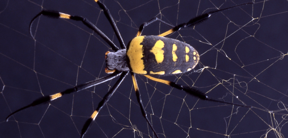
Oxford, UK | Posted on May 17th, 2016Pulling on a sticky thread in a garden spider's orb web and letting it snap back reveals that the thread never sags but always stays taut -- even when stretched to many times its original length. This is because any loose thread is immediately spooled inside the tiny droplets of watery glue that coat and surround the core gossamer fibres of the web's capture spiral.
This phenomenon is described in the journal PNAS by scientists from the University of Oxford, UK and the Université Pierre et Marie Curie, Paris, France.
The researchers studied the details of this 'liquid wire' technique in spiders' webs and used it to create composite fibres in the laboratory which, just like the spider's capture silk, extend like a solid and compress like a liquid. These novel insights may lead to new bio-inspired technology.
Professor Fritz Vollrath of the Oxford Silk Group in the Department of Zoology at Oxford University said: 'The thousands of tiny droplets of glue that cover the capture spiral of the spider's orb web do much more than make the silk sticky and catch the fly. Surprisingly, each drop packs enough punch in its watery skins to reel in loose bits of thread. And this winching behaviour is used to excellent effect to keep the threads tight at all times, as we can all observe and test in the webs in our gardens.'
The novel properties observed and analysed by the scientists rely on a subtle balance between fibre elasticity and droplet surface tension. Importantly, the team was also able to recreate this technique in the laboratory using oil droplets on a plastic filament. And this artificial system behaved just like the spider's natural winch silk, with spools of filament reeling and unreeling inside the oil droplets as the thread extended and contracted.
Dr Hervé Elettro, the first author and a doctoral researcher at Institut Jean Le Rond D'Alembert, Université Pierre et Marie Curie, Paris, said: 'Spider silk has been known to be an extraordinary material for around 40 years, but it continues to amaze us. While the web is simply a high-tech trap from the spider's point of view, its properties have a huge amount to offer the worlds of materials, engineering and medicine.
'Our bio-inspired hybrid threads could be manufactured from virtually any components. These new insights could lead to a wide range of applications, such as microfabrication of
####
For more information, please click here
Contacts:
Tom Calver
44-186-527-0046
Copyright © University of Oxford
If you have a comment, please Contact us.Issuers of news releases, not 7th Wave, Inc. or Nanotechnology Now, are solely responsible for the accuracy of the content.
Bookmark:


| Related News Press |
News and information
 Quantum computer improves AI predictions April 17th, 2026
Flexible sensor gains sensitivity under pressure April 17th, 2026
A reusable chip for particulate matter sensing April 17th, 2026
Detecting vibrational quantum beating in the predissociation dynamics of SF6 using time-resolved photoelectron spectroscopy April 17th, 2026
Flexible Electronics
Flexible sensor gains sensitivity under pressure April 17th, 2026
Flexible electronics integrated with paper-thin structure for use in space January 17th, 2025
Beyond wires: Bubble technology powers next-generation electronics:New laser-based bubble printing technique creates ultra-flexible liquid metal circuits November 8th, 2024
Videos/Movies
ICFO researchers overcome long-standing bottleneck in single photon detection with twisted 2D materials August 8th, 2025
Possible Futures
A fundamentally new therapeutic approach to cystic fibrosis: Nanobody repairs cellular defect April 17th, 2026
UC Irvine physicists discover method to reverse ‘quantum scrambling’ : The work addresses the problem of information loss in quantum computing system April 17th, 2026
Discoveries
Quantum computer improves AI predictions April 17th, 2026
Flexible sensor gains sensitivity under pressure April 17th, 2026
A reusable chip for particulate matter sensing April 17th, 2026
Detecting vibrational quantum beating in the predissociation dynamics of SF6 using time-resolved photoelectron spectroscopy April 17th, 2026
Materials/Metamaterials/Magnetoresistance
First real-time observation of two-dimensional melting process: Researchers at Mainz University unveil new insights into magnetic vortex structures August 8th, 2025
Researchers unveil a groundbreaking clay-based solution to capture carbon dioxide and combat climate change June 6th, 2025
A 1960s idea inspires NBI researchers to study hitherto inaccessible quantum states June 6th, 2025
Institute for Nanoscience hosts annual proposal planning meeting May 16th, 2025
Announcements
A fundamentally new therapeutic approach to cystic fibrosis: Nanobody repairs cellular defect April 17th, 2026
UC Irvine physicists discover method to reverse ‘quantum scrambling’ : The work addresses the problem of information loss in quantum computing system April 17th, 2026
Interviews/Book Reviews/Essays/Reports/Podcasts/Journals/White papers/Posters
A fundamentally new therapeutic approach to cystic fibrosis: Nanobody repairs cellular defect April 17th, 2026
UC Irvine physicists discover method to reverse ‘quantum scrambling’ : The work addresses the problem of information loss in quantum computing system April 17th, 2026
Nanobiotechnology
A fundamentally new therapeutic approach to cystic fibrosis: Nanobody repairs cellular defect April 17th, 2026
New molecular technology targets tumors and simultaneously silences two ‘undruggable’ cancer genes August 8th, 2025
New imaging approach transforms study of bacterial biofilms August 8th, 2025
Electrifying results shed light on graphene foam as a potential material for lab grown cartilage June 6th, 2025
 |
||
 |
||
| The latest news from around the world, FREE | ||
 |
||
|
|
||
| Premium Products | ||
 |
||
|
Only the news you want to read!
Learn More |
||
 |
||
|
Full-service, expert consulting
Learn More |
||
|
|
||