Home > Press > New world record for fullerene-free polymer solar cells
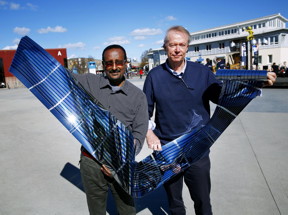 |
| Polymer solar cells manufactured using low-cost roll-to-roll printing technology, demonstrated here by professors Olle Inganäs (right) and Shimelis Admassie. CREDIT: Stefan Jerrevång/Linkoping university |
Abstract:
Polymer solar cells can be even cheaper and more reliable thanks to a breakthrough by scientists at Linköping University and the Chinese Academy of Sciences (CAS). This work is about avoiding costly and unstable fullerenes.
New world record for fullerene-free polymer solar cells
Linköping, Sweden | Posted on April 20th, 2016Polymer solar cells have in recent years emerged as a low cost alternative to silicon solar cells. In order to obtain high efficiency, fullerenes are usually required in polymer solar cells to separate charge carriers. However, fullerenes are unstable under illumination, and form large crystals at high temperatures.
Now, a team of chemists led by Professor Jianhui Hou at the CAS set a new world record for fullerene-free polymer solar cells by developing a unique combination of a polymer called PBDB-T and a small molecule called ITIC. With this combination, the sun's energy is converted with an efficiency of 11%, a value that strikes most solar cells with fullerenes, and all without fullerenes.
Feng Gao, together with his colleagues Olle Inganäs and Deping Qian at Linköping University, have characterized the loss spectroscopy of photovoltage (Voc), a key figure for solar cells, and proposed approaches to further improving the device performance.
The two research groups are now presenting their results in the high-profile journal Advanced Materials.
-We have demonstrated that it is possible to achieve a high efficiency without using fullerene, and that such solar cells are also highly stable to heat. Because solar cells are working under constant solar radiation, good thermal stability is very important, said Feng Gao, a physicist at the Department of Physics, Chemistry and Biology, Linköping University.
-The combination of high efficiency and good thermal stability suggest that polymer solar cells, which can be easily manufactured using low-cost roll-to-roll printing technology, now come a step closer to commercialization, said Feng Gao.
####
For more information, please click here
Contacts:
Feng Gao
46-132-86882
Copyright © Linköping University
If you have a comment, please Contact us.Issuers of news releases, not 7th Wave, Inc. or Nanotechnology Now, are solely responsible for the accuracy of the content.
Bookmark:


| Related Links |
| Related News Press |
News and information
 Quantum computer improves AI predictions April 17th, 2026
Flexible sensor gains sensitivity under pressure April 17th, 2026
A reusable chip for particulate matter sensing April 17th, 2026
Detecting vibrational quantum beating in the predissociation dynamics of SF6 using time-resolved photoelectron spectroscopy April 17th, 2026
Possible Futures
A fundamentally new therapeutic approach to cystic fibrosis: Nanobody repairs cellular defect April 17th, 2026
UC Irvine physicists discover method to reverse ‘quantum scrambling’ : The work addresses the problem of information loss in quantum computing system April 17th, 2026
Nanotubes/Buckyballs/Fullerenes/Nanorods/Nanostrings/Nanosheets
Tiny nanosheets, big leap: A new sensor detects ethanol at ultra-low levels January 30th, 2026
Enhancing power factor of p- and n-type single-walled carbon nanotubes April 25th, 2025
Chainmail-like material could be the future of armor: First 2D mechanically interlocked polymer exhibits exceptional flexibility and strength January 17th, 2025
Innovative biomimetic superhydrophobic coating combines repair and buffering properties for superior anti-erosion December 13th, 2024
Discoveries
Quantum computer improves AI predictions April 17th, 2026
Flexible sensor gains sensitivity under pressure April 17th, 2026
A reusable chip for particulate matter sensing April 17th, 2026
Detecting vibrational quantum beating in the predissociation dynamics of SF6 using time-resolved photoelectron spectroscopy April 17th, 2026
Materials/Metamaterials/Magnetoresistance
First real-time observation of two-dimensional melting process: Researchers at Mainz University unveil new insights into magnetic vortex structures August 8th, 2025
Researchers unveil a groundbreaking clay-based solution to capture carbon dioxide and combat climate change June 6th, 2025
A 1960s idea inspires NBI researchers to study hitherto inaccessible quantum states June 6th, 2025
Institute for Nanoscience hosts annual proposal planning meeting May 16th, 2025
Announcements
A fundamentally new therapeutic approach to cystic fibrosis: Nanobody repairs cellular defect April 17th, 2026
UC Irvine physicists discover method to reverse ‘quantum scrambling’ : The work addresses the problem of information loss in quantum computing system April 17th, 2026
Interviews/Book Reviews/Essays/Reports/Podcasts/Journals/White papers/Posters
A fundamentally new therapeutic approach to cystic fibrosis: Nanobody repairs cellular defect April 17th, 2026
UC Irvine physicists discover method to reverse ‘quantum scrambling’ : The work addresses the problem of information loss in quantum computing system April 17th, 2026
Energy
Sensors innovations for smart lithium-based batteries: advancements, opportunities, and potential challenges August 8th, 2025
Simple algorithm paired with standard imaging tool could predict failure in lithium metal batteries August 8th, 2025
Research partnerships
Lab to industry: InSe wafer-scale breakthrough for future electronics August 8th, 2025
HKU physicists uncover hidden order in the quantum world through deconfined quantum critical points April 25th, 2025
Solar/Photovoltaic
Spinel-type sulfide semiconductors to operate the next-generation LEDs and solar cells For solar-cell absorbers and green-LED source October 3rd, 2025
KAIST researchers introduce new and improved, next-generation perovskite solar cell November 8th, 2024
Groundbreaking precision in single-molecule optoelectronics August 16th, 2024
Development of zinc oxide nanopagoda array photoelectrode: photoelectrochemical water-splitting hydrogen production January 12th, 2024
 |
||
 |
||
| The latest news from around the world, FREE | ||
 |
||
|
|
||
| Premium Products | ||
 |
||
|
Only the news you want to read!
Learn More |
||
 |
||
|
Full-service, expert consulting
Learn More |
||
|
|
||