Home > Press > Ames Laboratory physicists discover new material that may speed computing
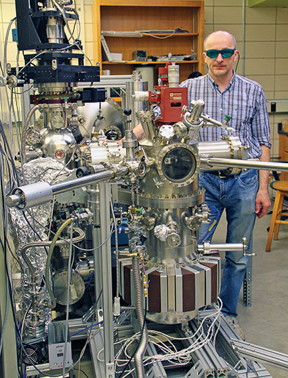 |
| Kaminski and his ARPES equipment. Ames Laboratory |
Abstract:
Physicists at the U.S. Department of Energy's Ames Laboratory have discovered a topological metal, PtSn4 (platinum and tin), with a unique electronic structure that may someday lead to energy efficient computers with increased processor speeds and data storage.
Ames Laboratory physicists discover new material that may speed computing
Ames, IA | Posted on April 12th, 2016The electrons in topological quantum materials can travel close to speed of light thanks to unique property called Dirac dispersion. Up until now, only isolated points, called Dirac points, with relatively small numbers of conduction electrons, were known to exist in such materials. In PtSn4, the scientists not only discovered a high density of conduction electrons, but also large number of closely positioned Dirac points forming extended lines or Dirac node arcs.
"This type of electron transport is very special," said Adam Kaminski, Ames Laboratory scientist and professor at Iowa State University's Department of Physics and Astronomy. "Our research has been able to associate the extreme magnetoresistance with novel features in their electronic structure, which may lead to future improvements in computer speed, efficiency and data storage."
The discovery was made using a laser-based angle-resolved photoemission spectroscopy (ARPES) instrument, which was developed at Ames Laboratory by Kaminski, and the measurement provides high-resolution details of the electronic properties of materials.
"Laser ARPES has given us unprecedented tunability and resolution for visualizing these remarkable properties in laboratory environments," said Paul Canfield, Ames Laboratory scientist and Distinguished Professor of Physics and Astronomy at Iowa State University. "Combining it with Ames Laboratory's computational modeling abilities and our 80-year reputation in designing and growing new materials has led to our success in this discovery."
###
The research was supported by the U.S. Department of Energy Office of Science.
####
About Ames Laboratory
Ames Laboratory is a U.S. Department of Energy Office of Science national laboratory operated by Iowa State University. Ames Laboratory creates innovative materials, technologies and energy solutions. We use our expertise, unique capabilities and interdisciplinary collaborations to solve global problems.
DOE's Office of Science is the single largest supporter of basic research in the physical sciences in the United States, and is working to address some of the most pressing challenges of our time. For more information, please visit science.energy.gov.
Disclaimer
For more information, please click here
Contacts:
Laura Millsaps
(515) 294-3474
Adam Kaminski
Division of Materials Science and Engineering
(515) 294-0849
Paul Canfield
Division of Materials Science and Engineering
(515) 294-6270
Copyright © Ames Laboratory
If you have a comment, please Contact us.Issuers of news releases, not 7th Wave, Inc. or Nanotechnology Now, are solely responsible for the accuracy of the content.
Bookmark:


| Related Links |
| Related News Press |
News and information
 Quantum computer improves AI predictions April 17th, 2026
Flexible sensor gains sensitivity under pressure April 17th, 2026
A reusable chip for particulate matter sensing April 17th, 2026
Detecting vibrational quantum beating in the predissociation dynamics of SF6 using time-resolved photoelectron spectroscopy April 17th, 2026
Laboratories
Researchers develop molecular qubits that communicate at telecom frequencies October 3rd, 2025
A battery’s hopping ions remember where they’ve been: Seen in atomic detail, the seemingly smooth flow of ions through a battery’s electrolyte is surprisingly complicated February 16th, 2024
Govt.-Legislation/Regulation/Funding/Policy
Quantum computer improves AI predictions April 17th, 2026
Metasurfaces smooth light to boost magnetic sensing precision January 30th, 2026
New imaging approach transforms study of bacterial biofilms August 8th, 2025
Possible Futures
A fundamentally new therapeutic approach to cystic fibrosis: Nanobody repairs cellular defect April 17th, 2026
UC Irvine physicists discover method to reverse ‘quantum scrambling’ : The work addresses the problem of information loss in quantum computing system April 17th, 2026
Chip Technology
A reusable chip for particulate matter sensing April 17th, 2026
Metasurfaces smooth light to boost magnetic sensing precision January 30th, 2026
Memory Technology
Researchers tackle the memory bottleneck stalling quantum computing October 3rd, 2025
First real-time observation of two-dimensional melting process: Researchers at Mainz University unveil new insights into magnetic vortex structures August 8th, 2025
Utilizing palladium for addressing contact issues of buried oxide thin film transistors April 5th, 2024
Discoveries
Quantum computer improves AI predictions April 17th, 2026
Flexible sensor gains sensitivity under pressure April 17th, 2026
A reusable chip for particulate matter sensing April 17th, 2026
Detecting vibrational quantum beating in the predissociation dynamics of SF6 using time-resolved photoelectron spectroscopy April 17th, 2026
Materials/Metamaterials/Magnetoresistance
First real-time observation of two-dimensional melting process: Researchers at Mainz University unveil new insights into magnetic vortex structures August 8th, 2025
Researchers unveil a groundbreaking clay-based solution to capture carbon dioxide and combat climate change June 6th, 2025
A 1960s idea inspires NBI researchers to study hitherto inaccessible quantum states June 6th, 2025
Institute for Nanoscience hosts annual proposal planning meeting May 16th, 2025
Announcements
A fundamentally new therapeutic approach to cystic fibrosis: Nanobody repairs cellular defect April 17th, 2026
UC Irvine physicists discover method to reverse ‘quantum scrambling’ : The work addresses the problem of information loss in quantum computing system April 17th, 2026
Interviews/Book Reviews/Essays/Reports/Podcasts/Journals/White papers/Posters
A fundamentally new therapeutic approach to cystic fibrosis: Nanobody repairs cellular defect April 17th, 2026
UC Irvine physicists discover method to reverse ‘quantum scrambling’ : The work addresses the problem of information loss in quantum computing system April 17th, 2026
 |
||
 |
||
| The latest news from around the world, FREE | ||
 |
||
|
|
||
| Premium Products | ||
 |
||
|
Only the news you want to read!
Learn More |
||
 |
||
|
Full-service, expert consulting
Learn More |
||
|
|
||