Home > Press > Hybrid pixel array detectors enter the low-noise regime
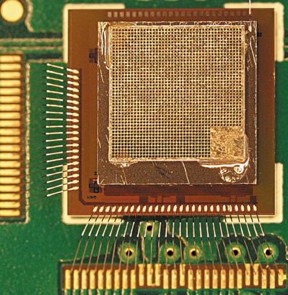 |
| This is a photograph of the JUNGFRAU-0.4 chip and sensor on top of which a 150 µm-thick laser-drilled tungsten mask (Laser Zentrum Hannover eV, Hannover, Germany) with 28 µm-diameter holes is placed. CREDIT: Jungmann-Smith et al |
Abstract:
The detector group at the Swiss Light Source at PSI has been one of the pioneers in the development of custom-made hybrid pixel array detectors (HPADs) for synchrotron applications. In a paper published recently [Jungmann-Smith et al. (2016). J. Synchrotron Rad. 23, 385-394; doi:10.1107/S1600577515023541], this group shows that it is now possible to develop HPADs with sufficient low noise to allow single-photon detection below 1 keV as well as to perform spectroscopic imaging. A commentary has also been written about the work [Graafsma (2016). J. Synchrotron Rad. 23, 383-384; doi:10.1107/S1600577516002721].
Hybrid pixel array detectors enter the low-noise regime
Chester | Posted on March 31st, 2016For decades, detectors have been a limiting factor in experiments at synchrotron radiation facilities. Even though imaging detectors evolved over time, the evolution of the source always outran the evolution of the detector. This situation started to change with the introduction of the so-called hybrid pixel array detectors, which contain a pixelated readout chip custom-designed for a well-defined experiment or technique. One of the revolutionising advantages offered by this technology is that every single pixel contains all necessary electronics, including for instance counters, for X-ray detection. This massive parallelisation increased the overall efficiency of the detector by several orders of magnitude as compared with the charge-coupled-device-based system. There are now various examples of HPADs, specifically developed for X-ray experiments at storage-ring synchrotron sources, as well as various spin-off companies commercialising them. Most of these systems are so-called photon-counting detectors, where each incoming photon is processed by the readout electronics in the pixel and individually counted. The advantage of photon counting is that electronic noise, present in any system, can be efficiently discriminated against, yielding `noise-free' detectors. An application for such low-noise systems is in energy-dispersive measurements. The researchers show in their paper that, with the use of a proper mask to shield the edge regions between pixels, very good fluorescence spectra can be obtained. This capability was subsequently used for multi-colour imaging at the SOLEIL synchrotron.
The innovative aspect of the work contained in this paper does not lie in the spectroscopic results obtained as they could very well have been obtained with other detectors. But what is truly impressive is that these results were obtained with an HPAD using a standard planar diode array as sensor. This means that the system uses relatively standard and thus easy-to-manufacture components, making it possible to envision building larger and/or further-optimised systems in the near future. And with that, low-noise HPADs have entered a field formally reserved for silicon drift detectors and complementary metal-oxide semiconductor imagers.
####
For more information, please click here
Contacts:
Jonathan Agbenyega
44-012-443-42878
Copyright © International Union of Crystallography
If you have a comment, please Contact us.Issuers of news releases, not 7th Wave, Inc. or Nanotechnology Now, are solely responsible for the accuracy of the content.
Bookmark:


| Related News Press |
News and information
 Quantum computer improves AI predictions April 17th, 2026
Flexible sensor gains sensitivity under pressure April 17th, 2026
A reusable chip for particulate matter sensing April 17th, 2026
Detecting vibrational quantum beating in the predissociation dynamics of SF6 using time-resolved photoelectron spectroscopy April 17th, 2026
Imaging
Simple algorithm paired with standard imaging tool could predict failure in lithium metal batteries August 8th, 2025
Sensors
Flexible sensor gains sensitivity under pressure April 17th, 2026
Tiny nanosheets, big leap: A new sensor detects ethanol at ultra-low levels January 30th, 2026
From sensors to smart systems: the rise of AI-driven photonic noses January 30th, 2026
Sensors innovations for smart lithium-based batteries: advancements, opportunities, and potential challenges August 8th, 2025
Discoveries
Quantum computer improves AI predictions April 17th, 2026
Flexible sensor gains sensitivity under pressure April 17th, 2026
A reusable chip for particulate matter sensing April 17th, 2026
Detecting vibrational quantum beating in the predissociation dynamics of SF6 using time-resolved photoelectron spectroscopy April 17th, 2026
Announcements
A fundamentally new therapeutic approach to cystic fibrosis: Nanobody repairs cellular defect April 17th, 2026
UC Irvine physicists discover method to reverse ‘quantum scrambling’ : The work addresses the problem of information loss in quantum computing system April 17th, 2026
Interviews/Book Reviews/Essays/Reports/Podcasts/Journals/White papers/Posters
A fundamentally new therapeutic approach to cystic fibrosis: Nanobody repairs cellular defect April 17th, 2026
UC Irvine physicists discover method to reverse ‘quantum scrambling’ : The work addresses the problem of information loss in quantum computing system April 17th, 2026
Tools
Metasurfaces smooth light to boost magnetic sensing precision January 30th, 2026
From sensors to smart systems: the rise of AI-driven photonic noses January 30th, 2026
Japan launches fully domestically produced quantum computer: Expo visitors to experience quantum computing firsthand August 8th, 2025
 |
||
 |
||
| The latest news from around the world, FREE | ||
 |
||
|
|
||
| Premium Products | ||
 |
||
|
Only the news you want to read!
Learn More |
||
 |
||
|
Full-service, expert consulting
Learn More |
||
|
|
||