Home > Press > INRS takes giant step forward in generating optical qubits
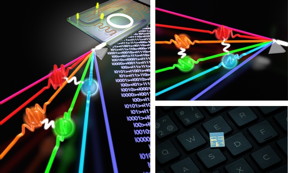 |
| In a recently published article in Science, Prof. Roberto Morandotti and his team demonstrate the generation of complex entangled quantum states on an optical chip, bringing us one step closer to practical applications in quantum information processing. Left: On-chip frequency combs for scalable, complex quantum state generation. Top right: Quantum frequency comb of entangled photons. Bottom right: Photonic chip – compatible with common semiconductor fabrication technologies. Credits : Ultrafast Optical Processing Group, 2016. |
Abstract:
The optical chip developed at INRS by Prof. Roberto Morandotti's team overcomes a number of obstacles in the development of quantum computers, which are expected to revolutionize information processing. The international research team has demonstrated that on-chip quantum frequency combs can be used to simultaneously generate multiphoton entangled quantum bit (qubit) states.
INRS takes giant step forward in generating optical qubits
Montreal, Canada | Posted on March 13th, 2016Quantum computing differs fundamentally from classical computing, in that it is based on the generation and processing of qubits. Unlike classical bits, which can have a state of either 1 or 0, qubits allow a superposition of the 1 and 0 states (both simultaneously). Strikingly, multiple qubits can be linked in so-called 'entangled' states, where the manipulation of a single qubit changes the entire system, even if individual qubits are physically distant. This property is the basis for quantum information processing, aiming towards building superfast quantum computers and transferring information in a completely secure way.
Professor Morandotti has focused his research efforts on the realization of quantum components compatible with established technologies. The chip developed by his team was designed to meet numerous criteria for its direct use: it is compact, inexpensive to make, compatible with electronic circuits, and uses standard telecommunication frequencies. It is also scalable, an essential characteristic if it is to serve as a basis for practical systems. But the biggest technological challenge is the generation of multiple, stable, and controllable entangled qubit states.
The generation of qubits can rely on several different approaches, including electron spins, atomic energy levels, and photon quantum states. Photons have the advantage of preserving entanglement over long distances and time periods. But generating entangled photon states in a compact and scalable way is difficult. "What is most important, several such states have to be generated simultaneously if we are to arrive at practical applications," added INRS research associate Dr. Michael Kues.
Roberto Morandotti's team tackled this challenge by using on-chip optical frequency combs for the first time to generate multiple entangled qubit states of light. As Michael Kues explains, optical frequency combs are light sources comprised of many equally-spaced frequency modes. "Frequency combs are extraordinarily precise sources and have already revolutionized metrology and sensing, as well as earning their discoverers the 2005 Nobel Prize in Physics."
Thanks to these integrated quantum frequency combs, the chip developed by INRS is able to generate entangled multi-photon qubit states over several hundred frequency modes. It is the first time anyone has demonstrated the simultaneous generation of qubit multi-photon and two-photon entangled states: Until now, integrated systems developed by other research teams had only succeeded in generating individual two-photon entangled states on a chip.
The results published in Science will provide a foundation for new research, both in integrated quantum photonics and quantum frequency combs. This could revolutionize optical quantum technologies, while at the same time maintaining compatibility with existing semiconductor chip technology.
####
About INRS
Institut national de recherche scientifique (INRS) is a graduate-level research and training university and ranks first in Canada for research intensity (average grant funding per faculty member). INRS brings together some 150 professors and close to 700 students and postdoctoral fellows at its four centres in Montreal, Quebec City, Laval, and Varennes. Its basic research is essential to the advancement of science in Quebec and internationally even as it plays a key role in the development of concrete solutions to the problems faced by our society.
For more information, please click here
Contacts:
Stephanie Thibault
514-499-6612
Copyright © INRS
If you have a comment, please Contact us.Issuers of news releases, not 7th Wave, Inc. or Nanotechnology Now, are solely responsible for the accuracy of the content.
Bookmark:


| Related Links |
| Related News Press |
News and information
 Quantum computer improves AI predictions April 17th, 2026
Flexible sensor gains sensitivity under pressure April 17th, 2026
A reusable chip for particulate matter sensing April 17th, 2026
Detecting vibrational quantum beating in the predissociation dynamics of SF6 using time-resolved photoelectron spectroscopy April 17th, 2026
Videos/Movies
ICFO researchers overcome long-standing bottleneck in single photon detection with twisted 2D materials August 8th, 2025
New X-ray imaging technique to study the transient phases of quantum materials December 29th, 2022
Solvent study solves solar cell durability puzzle: Rice-led project could make perovskite cells ready for prime time September 23rd, 2022
Scientists prepare for the world’s smallest race: Nanocar Race II March 18th, 2022
Chip Technology
A reusable chip for particulate matter sensing April 17th, 2026
Metasurfaces smooth light to boost magnetic sensing precision January 30th, 2026
Quantum Computing
Quantum computer improves AI predictions April 17th, 2026
UC Irvine physicists discover method to reverse ‘quantum scrambling’ : The work addresses the problem of information loss in quantum computing system April 17th, 2026
Researchers develop molecular qubits that communicate at telecom frequencies October 3rd, 2025
Optical computing/Photonic computing
ICFO researchers overcome long-standing bottleneck in single photon detection with twisted 2D materials August 8th, 2025
Programmable electron-induced color router array May 14th, 2025
Discoveries
Quantum computer improves AI predictions April 17th, 2026
Flexible sensor gains sensitivity under pressure April 17th, 2026
A reusable chip for particulate matter sensing April 17th, 2026
Detecting vibrational quantum beating in the predissociation dynamics of SF6 using time-resolved photoelectron spectroscopy April 17th, 2026
Announcements
A fundamentally new therapeutic approach to cystic fibrosis: Nanobody repairs cellular defect April 17th, 2026
UC Irvine physicists discover method to reverse ‘quantum scrambling’ : The work addresses the problem of information loss in quantum computing system April 17th, 2026
Interviews/Book Reviews/Essays/Reports/Podcasts/Journals/White papers/Posters
A fundamentally new therapeutic approach to cystic fibrosis: Nanobody repairs cellular defect April 17th, 2026
UC Irvine physicists discover method to reverse ‘quantum scrambling’ : The work addresses the problem of information loss in quantum computing system April 17th, 2026
Photonics/Optics/Lasers
Metasurfaces smooth light to boost magnetic sensing precision January 30th, 2026
From sensors to smart systems: the rise of AI-driven photonic noses January 30th, 2026
 |
||
 |
||
| The latest news from around the world, FREE | ||
 |
||
|
|
||
| Premium Products | ||
 |
||
|
Only the news you want to read!
Learn More |
||
 |
||
|
Full-service, expert consulting
Learn More |
||
|
|
||