Home > Press > What makes penguin feathers ice-proof
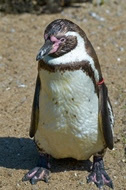 |
| The architecture of Humboldt penguins' feathers make them ice-proof. Credit: tatianaput/iStock/Thinkstock |
Abstract:
Humboldt penguins live in places that dip below freezing in the winter, and despite getting wet, their feathers stay sleek and free of ice. Scientists have now figured out what could make that possible. They report in ACS' Journal of Physical Chemistry C that the key is in the microstructure of penguins' feathers. Based on their findings, the scientists replicated the architecture in a nanofiber membrane that could be developed into an ice-proof material.
What makes penguin feathers ice-proof
Washington, DC | Posted on February 24th, 2016The range of Humboldt penguins extends from coastal Peru to the tip of southern Chile. Some of these areas can get frigid, and the water the birds swim in is part of a cold ocean current that sweeps up the coast from the Antarctic. Their feathers keep them both warm and ice-free. Scientists had suspected that penguin feathers' ability to easily repel water explained why ice doesn't accumulate on them: Water would slide off before freezing. But research has found that under high humidity or ultra-low temperatures, ice can stick to even superhydrophobic surfaces. So Jingming Wang and colleagues sought another explanation.
The researchers closely examined Humboldt penguin feathers using a scanning electron microscope. They found that the feathers were comprised of a network of barbs, wrinkled barbules and tiny interlocking hooks. In addition to being hydrophobic, this hierarchical architecture with grooved structures is anti-adhesive. Testing showed ice wouldn't stick to it. Mimicking the feathers' microstructure, the researchers developed an icephobic polyimide fiber membrane. They say it could potentially be used in applications such as electrical insulation.
The authors acknowledge funding from the National Research Fund for Fundamental Key Projects, the National Natural Science Foundation, the Chinese Academy of Sciences, the 111 Project and the Beijing Higher Education Young Elite Teacher Project.
####
About American Chemical Society
The American Chemical Society is a nonprofit organization chartered by the U.S. Congress. With more than 158,000 members, ACS is the world's largest scientific society and a global leader in providing access to chemistry-related research through its multiple databases, peer-reviewed journals and scientific conferences. Its main offices are in Washington, D.C., and Columbus, Ohio.
For more information, please click here
Contacts:
Michael Bernstein
202-872-6042
Katie Cottingham, Ph.D.
301-775-8455
Jingming Wang, D.Sc.
Key Laboratory of Bio-Inspired Smart Interfacial Science and Technology
Ministry of Education
School of Chemistry and Environment
Beihang University
Beijing, China
Copyright © American Chemical Society
If you have a comment, please Contact us.Issuers of news releases, not 7th Wave, Inc. or Nanotechnology Now, are solely responsible for the accuracy of the content.
Bookmark:


| Related Links |
| Related News Press |
News and information
 Quantum computer improves AI predictions April 17th, 2026
Flexible sensor gains sensitivity under pressure April 17th, 2026
A reusable chip for particulate matter sensing April 17th, 2026
Detecting vibrational quantum beating in the predissociation dynamics of SF6 using time-resolved photoelectron spectroscopy April 17th, 2026
Govt.-Legislation/Regulation/Funding/Policy
Quantum computer improves AI predictions April 17th, 2026
Metasurfaces smooth light to boost magnetic sensing precision January 30th, 2026
New imaging approach transforms study of bacterial biofilms August 8th, 2025
Possible Futures
A fundamentally new therapeutic approach to cystic fibrosis: Nanobody repairs cellular defect April 17th, 2026
UC Irvine physicists discover method to reverse ‘quantum scrambling’ : The work addresses the problem of information loss in quantum computing system April 17th, 2026
Discoveries
Quantum computer improves AI predictions April 17th, 2026
Flexible sensor gains sensitivity under pressure April 17th, 2026
A reusable chip for particulate matter sensing April 17th, 2026
Detecting vibrational quantum beating in the predissociation dynamics of SF6 using time-resolved photoelectron spectroscopy April 17th, 2026
Materials/Metamaterials/Magnetoresistance
First real-time observation of two-dimensional melting process: Researchers at Mainz University unveil new insights into magnetic vortex structures August 8th, 2025
Researchers unveil a groundbreaking clay-based solution to capture carbon dioxide and combat climate change June 6th, 2025
A 1960s idea inspires NBI researchers to study hitherto inaccessible quantum states June 6th, 2025
Institute for Nanoscience hosts annual proposal planning meeting May 16th, 2025
Announcements
A fundamentally new therapeutic approach to cystic fibrosis: Nanobody repairs cellular defect April 17th, 2026
UC Irvine physicists discover method to reverse ‘quantum scrambling’ : The work addresses the problem of information loss in quantum computing system April 17th, 2026
Interviews/Book Reviews/Essays/Reports/Podcasts/Journals/White papers/Posters
A fundamentally new therapeutic approach to cystic fibrosis: Nanobody repairs cellular defect April 17th, 2026
UC Irvine physicists discover method to reverse ‘quantum scrambling’ : The work addresses the problem of information loss in quantum computing system April 17th, 2026
Sports
Electrifying results shed light on graphene foam as a potential material for lab grown cartilage June 6th, 2025
Surrey reveals its implantable biosensor that operates without batteries May 22nd, 2020
Collagen nanofibrils in mammalian tissues get stronger with exercise December 14th, 2018
Nanobiotechnology
A fundamentally new therapeutic approach to cystic fibrosis: Nanobody repairs cellular defect April 17th, 2026
New molecular technology targets tumors and simultaneously silences two ‘undruggable’ cancer genes August 8th, 2025
New imaging approach transforms study of bacterial biofilms August 8th, 2025
Electrifying results shed light on graphene foam as a potential material for lab grown cartilage June 6th, 2025
 |
||
 |
||
| The latest news from around the world, FREE | ||
 |
||
|
|
||
| Premium Products | ||
 |
||
|
Only the news you want to read!
Learn More |
||
 |
||
|
Full-service, expert consulting
Learn More |
||
|
|
||