Home > Press > Hybrid material presents potential for 4-D-printed adaptive devices
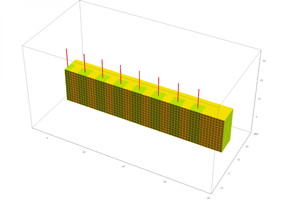 |
| In order to create a material that is both strong and malleable and displays different behavior when exposed to more than one stimulus, researchers embedded light-responsive fibers, which are coated with spirobenzopyran (SP) chromophores, into a temperature-sensitive gel. This new material displays distinctly different behavior in the presence of light and heat. CREDIT: University of Pittsburgh |
Abstract:
ombining photo-responsive fibers with thermo-responsive gels, researchers at the University of Pittsburgh's Swanson School of Engineering and Clemson University have modeled a new hybrid material that could reconfigure itself multiple times into different shapes when exposed to light and heat, allowing for the creation of devices that not only adapt to their environment, but also display distinctly different behavior in the presence of different stimuli.
Hybrid material presents potential for 4-D-printed adaptive devices
Pittsburgh, PA | Posted on December 15th, 2015Computational modeling developed by Anna C. Balazs, Distinguished Professor of Chemical and Petroleum Engineering at Pitt, and Olga Kuksenok, Associate Professor of Materials Science and Engineering at Clemson, predicted these composites would be both highly reconfigurable and mechanically strong, signaling a potential for biomimetic four-dimensional printing. Their research, "Stimuli-responsive behavior of composites integrating thermo-responsive gels with photoresponsive fibers," was recently published in the journal Materials Horizons, published by the Royal Society of Chemistry (DOI: 10.1039/C5MH00212E).
"In 4D printing, time is the fourth dimension that characterizes the structure of the material; namely, these materials can change shape even after they have been printed. The ability of a material to morph into a new shape alleviates the need to build a new part for every new application, and hence, can lead to significant cost savings," Dr. Balazs explained. "The challenge that researchers have faced is creating a material that is both strong and malleable and displays different behavior when exposed to more than one stimulus."
Drs Balazs and Kuksenok resolved this issue by embedding light-responsive fibers, which are coated with spirobenzopyran (SP) chromophores, into a temperature-sensitive gel. This new material displays distinctly different behavior in the presence of light and heat.
"If we anchor a sample of the composite to a surface, it will bend in one direction when exposed to light, and in the other direction when exposed to heat," Dr. Kuksenok said. "When the sample is detached, it shrinks like an accordion when heated and curls like a caterpillar when illuminated. This programmable behavior allows a single object to display different shapes and hence functions, depending on how it is exposed to light or heat."
The researchers note that by localizing the SP functionality specifically on the fibers, the composites can encompass "hidden" patterns that are only uncovered in the presence of light, allowing the material to be tailored in ways that would not be possible by simply heating the sample. This biomimetic, stimuli-responsive motion could allow for joints that bend and unbend with light and become an essential component for new adaptive devices, such as flexible robots.
"Robots are wonderful tools, but when you need something to examine a delicate structure, such as inside the human body, you want a "squishy" robot rather than the typical devices we think of with interlocking gears and sharp edges," Dr. Balazs said. "This composite material could pave the way for soft, reconfigurable devices that display programmed functions when exposed to different environmental cues."
As Dr. Balazs points out, "the real significance of the work is that we designed a single composite that yields access to a range of dynamic responses and structures. On a conceptual level, our results provide guidelines for combining different types of stimuli-responsive components to create adaptive materials that can be controllably and repeatedly actuated to display new dynamic behavior and large-scale motion."
Future research with this discovery will focus on tailoring the arrangements of the partially-embedded fibers to create hand-like structures that could serve as a type of gripper.
####
For more information, please click here
Contacts:
Paul Kovach
412-624-0265
Copyright © University of Pittsburgh
If you have a comment, please Contact us.Issuers of news releases, not 7th Wave, Inc. or Nanotechnology Now, are solely responsible for the accuracy of the content.
Bookmark:


| Related Links |
| Related News Press |
News and information
 Quantum computer improves AI predictions April 17th, 2026
Flexible sensor gains sensitivity under pressure April 17th, 2026
A reusable chip for particulate matter sensing April 17th, 2026
Detecting vibrational quantum beating in the predissociation dynamics of SF6 using time-resolved photoelectron spectroscopy April 17th, 2026
Robotics
Nanofibrous metal oxide semiconductor for sensory face November 8th, 2024
Femtosecond laser technique births "dancing microrobots": USTC's breakthrough in multi-material microfabrication August 11th, 2023
Possible Futures
A fundamentally new therapeutic approach to cystic fibrosis: Nanobody repairs cellular defect April 17th, 2026
UC Irvine physicists discover method to reverse ‘quantum scrambling’ : The work addresses the problem of information loss in quantum computing system April 17th, 2026
Discoveries
Quantum computer improves AI predictions April 17th, 2026
Flexible sensor gains sensitivity under pressure April 17th, 2026
A reusable chip for particulate matter sensing April 17th, 2026
Detecting vibrational quantum beating in the predissociation dynamics of SF6 using time-resolved photoelectron spectroscopy April 17th, 2026
Materials/Metamaterials/Magnetoresistance
First real-time observation of two-dimensional melting process: Researchers at Mainz University unveil new insights into magnetic vortex structures August 8th, 2025
Researchers unveil a groundbreaking clay-based solution to capture carbon dioxide and combat climate change June 6th, 2025
A 1960s idea inspires NBI researchers to study hitherto inaccessible quantum states June 6th, 2025
Institute for Nanoscience hosts annual proposal planning meeting May 16th, 2025
Announcements
A fundamentally new therapeutic approach to cystic fibrosis: Nanobody repairs cellular defect April 17th, 2026
UC Irvine physicists discover method to reverse ‘quantum scrambling’ : The work addresses the problem of information loss in quantum computing system April 17th, 2026
Interviews/Book Reviews/Essays/Reports/Podcasts/Journals/White papers/Posters
A fundamentally new therapeutic approach to cystic fibrosis: Nanobody repairs cellular defect April 17th, 2026
UC Irvine physicists discover method to reverse ‘quantum scrambling’ : The work addresses the problem of information loss in quantum computing system April 17th, 2026
Research partnerships
Lab to industry: InSe wafer-scale breakthrough for future electronics August 8th, 2025
HKU physicists uncover hidden order in the quantum world through deconfined quantum critical points April 25th, 2025
 |
||
 |
||
| The latest news from around the world, FREE | ||
 |
||
|
|
||
| Premium Products | ||
 |
||
|
Only the news you want to read!
Learn More |
||
 |
||
|
Full-service, expert consulting
Learn More |
||
|
|
||