Home > Press > New ceramic firefighting foam becomes stronger when temperature increases
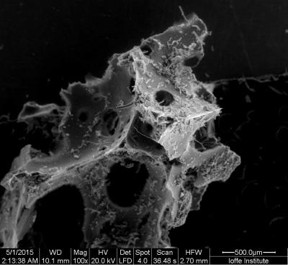 |
| This is an electronic microscope image of hybrid silica foam. CREDIT: ITMO University |
Abstract:
A team of chemists from ITMO University, in collaboration with research company SOPOT, has developed a novel type of firefighting foam based on inorganic silica nanoparticles. The new foam beats existing analogues in fire extinguishing capacity, thermal and mechanical stability and biocompatibility. The results of the study were published in ACS Advanced Materials & Interfaces.
New ceramic firefighting foam becomes stronger when temperature increases
Saint Petersburg, Russia | Posted on December 14th, 2015Fighting large-scale fires usually involves firefighting foams based on synthetic substances, such as prefluorinated surfactants, that, despite their effectiveness, are extremely toxic for living organisms. Complete biodegradation of such foams can last for more than 200 years, with residues quickly penetrating deep into soil and surface water. This leads to the the accumulation of toxic elements in living organisms, such as plants, animals and men. Many countries have declined the use of such fire extinguishing agents or opted for reducing the production of such substances despite the absence of any decent alternatives.
A group of scientists from the International Laboratory of Advanced Materials and Technologies (SCAMT) at ITMO University in Saint Petersburg and research company SOPOT devised a foam, which was awarded full biodegradability and whose fire extinguishing capacity is higher than that of any existing analogue currently in use by fire fighters. After the fire is extinguished, the substance actively absorbs water, softens and falls apart into bioinert silica particles. And even when the foam accidentally enters living organisms, it does not not pose any danger to them.
"Our foam is based on silica nanoparticles, which create a polymer network when exposed to air," says Alexander Vinogradov, deputy head of the SCAMT laboratory. "Such a network embraces and adheres to the burning object and momentarily cools it down. At the same time, the foam itself hardens. The inorganic origin of this polymer network allows it to resist temperatures above 1000 degrees Celsius, which ensures gigantic stability from the aggressive environment in the midst of a raging fire."
"Most existing foams are made of organic materials and quickly deteriorate when temperature approaches 300 degrees Celsius. In our case, the foam creates a hard frame that not only puts out the fire, but also protects the object from re-ignition. With ordinary foams, re-ignition occurs within seconds after flame is applied to the object again."
The scientists conducted a series of large-scale experiments of the hardening foam, including the imitation of an actual forest fire. The foam was used to create a flame retardant belt that was supposed stop the spread of the fire. The tests demonstrated that the foam easily localizes the forest fire seat and can stay active during the whole fire season.
"The flame retardant belt made of our foam will prevent the spread of any forest fire, regardless of its strength and level of complexity," says Gennady Kuprin, head of SOPOT. "We can localize the fire and be sure that the adjacent territories will be safe. This is crucial to organize evacuation works during forest fires, where 9 of 10 people die in our and other countries."
####
For more information, please click here
Contacts:
Dmitry Malkov
895-337-75508
Copyright © ITMO University
If you have a comment, please Contact us.Issuers of news releases, not 7th Wave, Inc. or Nanotechnology Now, are solely responsible for the accuracy of the content.
Bookmark:


| Related News Press |
News and information
 Quantum computer improves AI predictions April 17th, 2026
Flexible sensor gains sensitivity under pressure April 17th, 2026
A reusable chip for particulate matter sensing April 17th, 2026
Detecting vibrational quantum beating in the predissociation dynamics of SF6 using time-resolved photoelectron spectroscopy April 17th, 2026
Chemistry
Projecting light to dispense liquids: A new route to ultra-precise microdroplets January 30th, 2026
From sensors to smart systems: the rise of AI-driven photonic noses January 30th, 2026
"Nanoreactor" cage uses visible light for catalytic and ultra-selective cross-cycloadditions October 3rd, 2025
Cambridge chemists discover simple way to build bigger molecules – one carbon at a time June 6th, 2025
Discoveries
Quantum computer improves AI predictions April 17th, 2026
Flexible sensor gains sensitivity under pressure April 17th, 2026
A reusable chip for particulate matter sensing April 17th, 2026
Detecting vibrational quantum beating in the predissociation dynamics of SF6 using time-resolved photoelectron spectroscopy April 17th, 2026
Materials/Metamaterials/Magnetoresistance
First real-time observation of two-dimensional melting process: Researchers at Mainz University unveil new insights into magnetic vortex structures August 8th, 2025
Researchers unveil a groundbreaking clay-based solution to capture carbon dioxide and combat climate change June 6th, 2025
A 1960s idea inspires NBI researchers to study hitherto inaccessible quantum states June 6th, 2025
Institute for Nanoscience hosts annual proposal planning meeting May 16th, 2025
Announcements
A fundamentally new therapeutic approach to cystic fibrosis: Nanobody repairs cellular defect April 17th, 2026
UC Irvine physicists discover method to reverse ‘quantum scrambling’ : The work addresses the problem of information loss in quantum computing system April 17th, 2026
Interviews/Book Reviews/Essays/Reports/Podcasts/Journals/White papers/Posters
A fundamentally new therapeutic approach to cystic fibrosis: Nanobody repairs cellular defect April 17th, 2026
UC Irvine physicists discover method to reverse ‘quantum scrambling’ : The work addresses the problem of information loss in quantum computing system April 17th, 2026
 |
||
 |
||
| The latest news from around the world, FREE | ||
 |
||
|
|
||
| Premium Products | ||
 |
||
|
Only the news you want to read!
Learn More |
||
 |
||
|
Full-service, expert consulting
Learn More |
||
|
|
||