Home > Press > The subtle dance of atoms influences enzyme activity: Certain infinitesimal fluctuations of distant atoms can control enzyme function even though they are not directly involved in enzyme catalysis
 |
Abstract:
Infinitesimal fluctuations occurring on the milli- and even nano-second time scales within the three-dimensional structure of enzymes may be one of the keys to explaining protein function. Professor Nicolas Doucet's team at INRS has demonstrated that even when certain amino acids are far from the active site of an enzyme, a change in their flexibility and atomic fluctuations can significantly impact enzyme activity. This phenomenon, which has been underestimated up to now, could explain certain protein engineering failures and help improve the way synthetic functional enzymes are designed.
The subtle dance of atoms influences enzyme activity: Certain infinitesimal fluctuations of distant atoms can control enzyme function even though they are not directly involved in enzyme catalysis
Québec, Canada | Posted on December 10th, 2015Enzymes are nanomachines that are exceptionally efficient at catalyzing a chemical reaction. They play a role in all cellular mechanisms. Like all proteins, they are made up of amino acid chains that are folded and assembled in a very precise 3D structure. Some enzymes, like ribonuclease A, are so efficient that they catalyze the transformation of chemical molecules thousands of times per second.
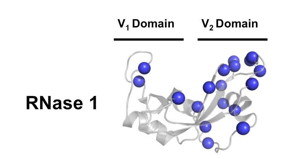
In this study, Donald Gagné, a researcher in Professor Doucet's lab holding a PhD in biology from INRS, analyzed the impact of removing a methyl group located near a loop distant from the reaction site of ribonuclease A--a very slight change that presumably would have no effect. The mutation does not perturb the 3D structure of the enzyme. However, it did result in a four-fold reduction in the affinity of ribonuclease A for nucleotides (molecules to which it must bind to carry out its function). How is this possible?
Using crystallography techniques and nuclear magnetic resonance to examine the enzyme at atomic resolution, Donald Gagné compared normal ribonuclease A with the mutated enzyme. He observed that when ribonuclease A is modified, the nucleotides do not position themselves correctly and have a harder time binding to the active site. It appears that this repositioning is due to an increase in enzyme fluctuations caused by the elimination of this distant methyl group, which we can picture as creating vibrations that spread through the enzyme structure all the way to the site of catalysis.
This demonstration of the importance of enzyme dynamics could change our understanding of protein and enzyme mechanisms. While it remains a challenge to measure fluctuations at this atomic scale, researchers have studied the three-dimensional structure of proteins to understand how they function. Despite the staggering complexity of this phenomenon, we now know that proteins are increasingly regulated by the subtle dance of their atoms.
####
About INRS
INRS is a graduate-level research and training university and ranks first in Canada for research intensity (average grant funding per faculty member). INRS brings together some 150 professors and close to 700 students and postdoctoral fellows in its four centres located in Montreal, Quebec City, Laval, and Varennes. Its applied and fundamental research is essential to the advancement of science in Quebec and internationally, playing a key role in the development of tangible solutions to the problems faced by our society.
For more information, please click here
Contacts:
Stéphanie Thibault
514-499-6612
Copyright © INRS
If you have a comment, please Contact us.Issuers of news releases, not 7th Wave, Inc. or Nanotechnology Now, are solely responsible for the accuracy of the content.
Bookmark:


| Related Links |
| Related News Press |
News and information
 Quantum computer improves AI predictions April 17th, 2026
Flexible sensor gains sensitivity under pressure April 17th, 2026
A reusable chip for particulate matter sensing April 17th, 2026
Detecting vibrational quantum beating in the predissociation dynamics of SF6 using time-resolved photoelectron spectroscopy April 17th, 2026
Chemistry
Projecting light to dispense liquids: A new route to ultra-precise microdroplets January 30th, 2026
From sensors to smart systems: the rise of AI-driven photonic noses January 30th, 2026
"Nanoreactor" cage uses visible light for catalytic and ultra-selective cross-cycloadditions October 3rd, 2025
Cambridge chemists discover simple way to build bigger molecules – one carbon at a time June 6th, 2025
Govt.-Legislation/Regulation/Funding/Policy
Quantum computer improves AI predictions April 17th, 2026
Metasurfaces smooth light to boost magnetic sensing precision January 30th, 2026
New imaging approach transforms study of bacterial biofilms August 8th, 2025
Nanomedicine
A fundamentally new therapeutic approach to cystic fibrosis: Nanobody repairs cellular defect April 17th, 2026
New molecular technology targets tumors and simultaneously silences two ‘undruggable’ cancer genes August 8th, 2025
New imaging approach transforms study of bacterial biofilms August 8th, 2025
Electrifying results shed light on graphene foam as a potential material for lab grown cartilage June 6th, 2025
Discoveries
Quantum computer improves AI predictions April 17th, 2026
Flexible sensor gains sensitivity under pressure April 17th, 2026
A reusable chip for particulate matter sensing April 17th, 2026
Detecting vibrational quantum beating in the predissociation dynamics of SF6 using time-resolved photoelectron spectroscopy April 17th, 2026
Announcements
A fundamentally new therapeutic approach to cystic fibrosis: Nanobody repairs cellular defect April 17th, 2026
UC Irvine physicists discover method to reverse ‘quantum scrambling’ : The work addresses the problem of information loss in quantum computing system April 17th, 2026
Interviews/Book Reviews/Essays/Reports/Podcasts/Journals/White papers/Posters
A fundamentally new therapeutic approach to cystic fibrosis: Nanobody repairs cellular defect April 17th, 2026
UC Irvine physicists discover method to reverse ‘quantum scrambling’ : The work addresses the problem of information loss in quantum computing system April 17th, 2026
Grants/Sponsored Research/Awards/Scholarships/Gifts/Contests/Honors/Records
Quantum computer improves AI predictions April 17th, 2026
Detecting vibrational quantum beating in the predissociation dynamics of SF6 using time-resolved photoelectron spectroscopy April 17th, 2026
Metasurfaces smooth light to boost magnetic sensing precision January 30th, 2026
Nanobiotechnology
A fundamentally new therapeutic approach to cystic fibrosis: Nanobody repairs cellular defect April 17th, 2026
New molecular technology targets tumors and simultaneously silences two ‘undruggable’ cancer genes August 8th, 2025
New imaging approach transforms study of bacterial biofilms August 8th, 2025
Electrifying results shed light on graphene foam as a potential material for lab grown cartilage June 6th, 2025
Research partnerships
Lab to industry: InSe wafer-scale breakthrough for future electronics August 8th, 2025
HKU physicists uncover hidden order in the quantum world through deconfined quantum critical points April 25th, 2025
 |
||
 |
||
| The latest news from around the world, FREE | ||
 |
||
|
|
||
| Premium Products | ||
 |
||
|
Only the news you want to read!
Learn More |
||
 |
||
|
Full-service, expert consulting
Learn More |
||
|
|
||