Home > Press > Scientists design a QKD-based quantum private query with no failure
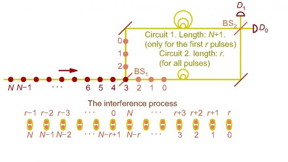 |
| The interference wiring diagram of the newly proposed QPQ protocol, where the database generates a single-photon signal with N optical pulses and shifts the phase of each pulse randomly by 0 or π, then the user extracts the phase differential of two pulses of them by the circuits on the right side and a random number r.
©science china press |
Abstract:
Cryptography is the approach to protect data secrecy in public environment. Certain cryptographic communications require not only the security of the transmitted message against eavesdropping from an outside adversary, but also the communicators' individual privacy against each other. Symmetrically private information retrieval (SPIR), which deals with the problem of private user queries to a database, is an example of such communication protocols. In a SPIR protocol Alice can obtain one item (i.e. one secret) from Bob's secret database in such a manner that Bob does not know which item Alice has obtained and, simultaneously, Alice cannot get additional items except the one she wanted in the database.
Scientists design a QKD-based quantum private query with no failure
Beijing, China | Posted on November 25th, 2015With the advantage of unconditional security, as we know, quantum cryptography has attracted a great deal of attention now. Quantum private query (QPQ) is the quantum scheme for SPIR problem. Since the first QPQ protocol was proposed by Vittorio Giovannetti et al in 2008, quite a few scholars have participated in the study of this interesting and important field. The original QPQ protocols are based on oracle operations. Though those protocols have significant advantages in theory, they are difficult to implement since the dimension of the oracle operation would be exceedingly high when a large database is concerned.
In 2011, to overcome the above drawback, scholars proposed a new type of QPQ, i.e. quantum-key-distribution (QKD)-based QPQ. Based on the mature technology of QKD, this new kind of QPQ has some important advantages such as being easy to realize and loss-tolerant. Therefore, as a practical model, QKD-based QPQ is overwhelmingly attractive and soon becomes a research hotspot.
However, QKD-based QPQ seems somewhat unreliable in the sense that all the existing protocols would fail with a non-zero probability. Besides, the database would generally reveal some additional secrets to the honest user. Even worse, to reduce the failure probability, one must increase the expectation of the number of the revealed secrets, while to protect the security of the
database better, the protocol would be more likely to fail. It seems incompatible to improve the above two disadvantages of the present QKD-based QPQ. Fortunately, based on a differential phase-shift (DPS) QKD protocol, researchers have tactfully and perfectly removed these two obstacles.
The DPS-QKD protocol mentioned above was proposed by Toshihiko Sasaki et al. in the famous journal Nature in 2014. In this QKD protocol participants need not to monitor signal disturbance anymore. It can tolerate up to 50% bit error rate by setting a parameter large enough, while the generally used BB84 protocol can only tolerate 11% at most. Besides, the DPS-QKD protocol is naturally immune to the photon-number-splitting attack, where the adversary utilizes the imperfection of the photon source in practice to attack. As is seen, the technology of DPS has greatly promoted the development of QKD and captured lots of attention. Recently, researchers find that DPS is also beneficial for QKD-based QPQ.
Based on the DPS-QKD, a new QPQ protocol was proposed by Bin Liu, Fei Gao, Wei Huang and Qiaoyan Wen, scientists at the State Key Laboratory of Networking and Switching Technology, Beijing University of Posts and Telecommunications, in the Chinese city of Beijing (See Figure 1). "It maintains the advantages of the QKD-based QPQ, i.e., easy to implement and loss tolerant" according to the four scholars.
In an article connected with College of Computer Science, Chongqing University, in the Chinese city of Chongqing, they revealed in the study, which was published in Science China-Physics, Mechanics & Astronomy, that it is the randomness in the dilution of the oblivious key, one of the main processes in such protocols, that caused the possible failure of previous QKD-based QPQ. And utilizing the features of DPS, their protocol successfully avoids the process of dilution.
Without the process of dilution, this new protocol becomes more reliable and reasonable, compared with the previous QKD-based QPQ protocols. Just as the scholars stated in their article: "Different from the situations in the previous QKD-based QPQ protocols, in our protocol, the number of the items an honest user will obtain is always one and the failure probability is always zero."
They also calculated an upper bound for the leaked information of the database in theory, and claimed that when the number of the database items "become larger, the advantage of our protocol's bound would be highlighted comparing with the other QKD-based QPQ protocols".
What's more, just like the DPS-QKD, the QKD-based QPQ protocol proposed by the four scholars is also naturally immune to the photon-number-splitting attacks. While other QKD-based QPQ protocols would leak more secrets of the database than expected to both the outside adversaries and the dishonest users provided the photon source were not perfect.
At the end of this article, these four scholars summarized "the proposed protocol is the first QKD-based QPQ protocol without the process of the oblivious key dilution, and, therefore, it is the first QKD-based one with no failure probability and no information reveal for the database when the user is honest", and they believed that "the proposed protocol initiates a new branch of QKD-based QPQ".
###
This research was funded by the National Natural Science Foundation of China (Grant Nos. 61272057 and 61170270).
####
For more information, please click here
Contacts:
Gao Fei
Copyright © Science China Press
If you have a comment, please Contact us.Issuers of news releases, not 7th Wave, Inc. or Nanotechnology Now, are solely responsible for the accuracy of the content.
Bookmark:


| Related Links |
| Related News Press |
News and information
 Quantum computer improves AI predictions April 17th, 2026
Flexible sensor gains sensitivity under pressure April 17th, 2026
A reusable chip for particulate matter sensing April 17th, 2026
Detecting vibrational quantum beating in the predissociation dynamics of SF6 using time-resolved photoelectron spectroscopy April 17th, 2026
Law enforcement/Anti-Counterfeiting/Security/Loss prevention
Chainmail-like material could be the future of armor: First 2D mechanically interlocked polymer exhibits exceptional flexibility and strength January 17th, 2025
With VECSELs towards the quantum internet Fraunhofer: IAF achieves record output power with VECSEL for quantum frequency converters April 5th, 2024
Researchers’ approach may protect quantum computers from attacks March 8th, 2024
Govt.-Legislation/Regulation/Funding/Policy
Quantum computer improves AI predictions April 17th, 2026
Metasurfaces smooth light to boost magnetic sensing precision January 30th, 2026
New imaging approach transforms study of bacterial biofilms August 8th, 2025
Discoveries
Quantum computer improves AI predictions April 17th, 2026
Flexible sensor gains sensitivity under pressure April 17th, 2026
A reusable chip for particulate matter sensing April 17th, 2026
Detecting vibrational quantum beating in the predissociation dynamics of SF6 using time-resolved photoelectron spectroscopy April 17th, 2026
Announcements
A fundamentally new therapeutic approach to cystic fibrosis: Nanobody repairs cellular defect April 17th, 2026
UC Irvine physicists discover method to reverse ‘quantum scrambling’ : The work addresses the problem of information loss in quantum computing system April 17th, 2026
Interviews/Book Reviews/Essays/Reports/Podcasts/Journals/White papers/Posters
A fundamentally new therapeutic approach to cystic fibrosis: Nanobody repairs cellular defect April 17th, 2026
UC Irvine physicists discover method to reverse ‘quantum scrambling’ : The work addresses the problem of information loss in quantum computing system April 17th, 2026
Quantum nanoscience
Beyond silicon: Electronics at the scale of a single molecule January 30th, 2026
MXene nanomaterials enter a new dimension Multilayer nanomaterial: MXene flakes created at Drexel University show new promise as 1D scrolls January 30th, 2026
ICFO researchers overcome long-standing bottleneck in single photon detection with twisted 2D materials August 8th, 2025
 |
||
 |
||
| The latest news from around the world, FREE | ||
 |
||
|
|
||
| Premium Products | ||
 |
||
|
Only the news you want to read!
Learn More |
||
 |
||
|
Full-service, expert consulting
Learn More |
||
|
|
||